We are all caught up in pigeonholing and the desire for clear classifications. This is evident, among other things, in the discussion and the recurring question: Is the collapse movement part of the climate movement? In our reflections after Collapse Camp 1 and in the course of slowly beginning to concretely think about and plan what we intend to do with CollapseLARP in 2026, there was also some time and the need to think about this more intensively.
The collapse movement is not the climate movement, and that's a good thing
For me, it is clear that the collapse movement is not part of the climate justice movement, nor can or should it be. To describe the relationship between these two aspects or directions, the term ‘strategic partnership’ comes to mind, because overlaps, thematic (and personal) interconnections, but above all meaningful cooperation and mutual benefit are obvious.
What about the climate justice movement?
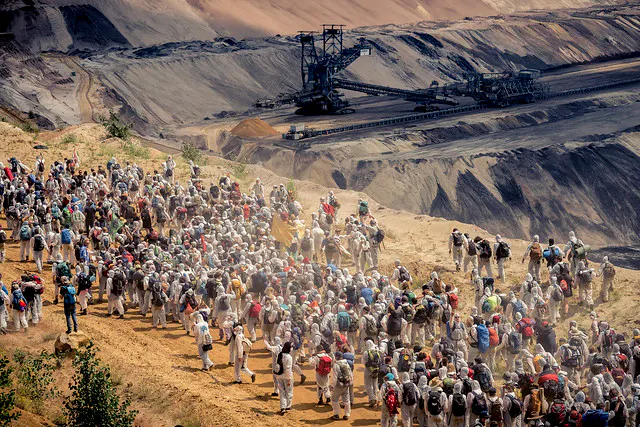
The only part of the climate justice movement that, in my opinion, really makes sense and is necessary under the current circumstances is the disobedient, activist part, which must do everything in its power, using a variety of means ranging from civil disobedience to sabotage, to continue fighting fossil fuels as well as blind militarisation and arms mania, preparations for war and the facilitation of genocide. For me, the key word here is ‘blind’, because I cannot and will not ignore geopolitical realities, and therefore defence options are certainly relevant to me in a discussion about a radical left-wing position on the issue, which I believe still needs to be held. However, I do not wish to hold that discussion here and now. It is obvious that the expansion of fossil fuel infrastructure of any kind, mining projects, the transformation of car factories into tank factories, the construction of new Rheinmetall branches, etc., can and must be opposed by the climate justice movement and directly attacked, prevented, disrupted, delayed and made more expensive by disruptive actions. The fight against capitalism, even if it is to be green washed, is just as much a top priority as the fight against rampant fascism. It takes actions, blockades, (autonomous) small groups and a great deal of creativity to produce maximum output in line with our requirements. The tasks and forms of action for a relevant, strong climate justice movement are therefore clear. In order to be able to act in this sense, training, knowledge transfer and, from time to time, overarching strategy discussions are needed to plan and coordinate joint action. In the broadest sense, a climate justice movement makes demands, even if it has to stop formulating them in an appealing manner directed at party politics, governments and parliaments. The demands are clear, but we take implementation into our own hands by exerting pressure to enforce implementation, on a small scale and, in the best case, on a large scale.
Orientation of a collapse movement

However, all of this differs significantly from what I and others who initiated the collapse movement and organised the first Collapse Camp understand by the term “collapse movement”. For us, this movement is very practically oriented. It is about taking action so that powerlessness and dependence on others (in the form of the state, state institutions, agencies and resources) can be minimised and so that we can actively do something long before the above-mentioned state actors are even responsible. We want to become capable of acting ourselves and give others this opportunity as well: to gradually reach a point where we can help ourselves and others (within a certain framework) so that together we can achieve something, even and especially beyond the obvious catastrophic events that will occur on a limited scale in terms of time and location (e.g. forest fires, floods). We are not making demands; we want to learn for ourselves in order to act. Nor are there any demands that a collapse movement as a whole can make. Because collapse, as we understand it, is multifaceted and varies from person to person. Collapse can be the fear of being attacked by Nazis on the way home from a demonstration, or the fear of no longer being able to obtain necessary medication or being stuck in a hot attic flat. Collapse is the fear of not being able to afford food until the end of the month because money is running out, or of not being able to reach family and friends when the internet and mobile phone networks are down. Demands that combine all this and much more are very difficult to formulate if one wants to be more specific than ‘capitalism must go’, which, incidentally, should not be a demand but common sense 😉 Unlike the climate justice movement, a collapse movement is therefore a movement without overarching, clear demands. And even though we are also concerned with education, knowledge transfer and training, the focus of all this is obviously different. To be able to treat wounds, I don't need to practise how blockades work, and in order to get medication in an emergency, legal training on ID refusal is of no help to me.
Sometimes together
Of course, there are common points of contact, opportunities for cooperation, skills and knowledge that interlock and from which we both benefit in a symbiotic interaction. The more successful the climate justice movement becomes again, the better for the collapse scenarios that are ‘available for selection,’ because even in the context of solidarity-based preparedness, it makes a difference whether we are talking about climate catastrophe at level 76 or 17 and fascism at level 45 or 9.
Furthermore, we must not underestimate the existing knowledge on the part of the climate justice movement: mobilising large numbers of people in a short period of time, access to and knowledge of infrastructure from A for afternoon tea to B for buses to Z for tents. All of this is important and relevant in disaster scenarios of all kinds. Thus, we are definitely partners and not competitors.
Please, no uniformity
However, we must be very careful not to lump everything together, because that would be fatal for both sides, and in my opinion, it would even be the death knell for the collapse movement (in Germany), which is just beginning to emerge.
The climate justice movement is in crisis for reasons that are well known. At the moment, I am very happy to see how it is coming back to life and how, in the wake of Palestine solidarity, we are finally regaining our edge. This is an important process and should be given space and time. It is important to welcome new people from other struggles, to forge connections, to strengthen previously neglected aspects (above all anti-colonial ones) and to find activist ways to make our presence felt through actions. At the same time, the climate justice movement is finally becoming bolder again, which is evident in its actions. The motto here is: keep up the good work! Incidentally, the issue of repression should not be neglected. Climate activists are massively exposed to it. It would be disastrous to immediately bring an emerging collapse movement fully into the focus of the repressive authorities. I think that will happen soon enough.
The collapse movement is not yet a ‘movement’ in the true sense of the word, but rather a growing, yet completely undefined and indefinable, fluctuating space of people with different ideas, starting points, interests and goals. Perhaps something is emerging here that could one day become a movement. This is always a fragile and delicate process, because so much is open and possible, so many different things collide, have to find their place, etc. This also requires space and time so that (as happened with the climate justice movement) different spaces, fields of activity, focal points, etc. can form. In addition, the collapse movement is not an activist movement in the true sense of the word.
If one attempts (for whatever reason) to assign labels too early and define one thing as part of another, natural (and important) processes are disrupted and suppressed. The emerging collapse movement is also still too small and too ‘weak’ (in the sense of being undefined, ambiguous and lacking any stable structures) to be able to assert itself as something independent within the climate justice movement.
There is no reason or necessity (apart from the hoped-for ego boost and the search for new relevance by some failed climate movement leaders) to think of the climate and collapse movements as one movement, let alone to force them to be one. It is perfectly fine and entirely sensible to allow both to exist and have their own raison d'être, because then both can benefit.
Each of us is free to become active and get involved on both sides. There are more than enough needs and reasons for both climate activism and solidarity-based prepping.
Data
15/01/2026
Argomento
English
0 commenti
Vuoi essere la prima persona a commentare?
Abbonati a disrupt! e avvia una conversazione.

