May 2022
Cross-border spatial planning in most countries aims to align strategic spatial planning objectives across borders. After more than three decades of intensified cooperation in the European Union, such harmonisation still presents a major challenge between most countries. Different cultures, impacting spatial planning practices or simply different objectives for the same cross-border areas are just two reasons why cross-border spatial planning is a difficult endeavour.
To stimulate discussion and exchange on spatial planning, the cross-border area around Luxembourg, the Greater Region, developed a tool including integrated maps.
The ‘Spatial Planning Concept of the Greater Region (Si apre in una nuova finestra)' (French and German abbreviations are SDTGR or REKGR) is a cross-border spatial planning concept that has been developed and approved by decision-makers of all parts of the Greater Region. It lists 45 concrete operative measures under four strategic axes, to structure cross-border cooperation. Recently it has been complemented by five integrated maps to support the further discussion and territorialisation of SDTGR / REKGR measures. There is one map for each of the four axes and one map on key players of territorial cooperation.
Transformative processes
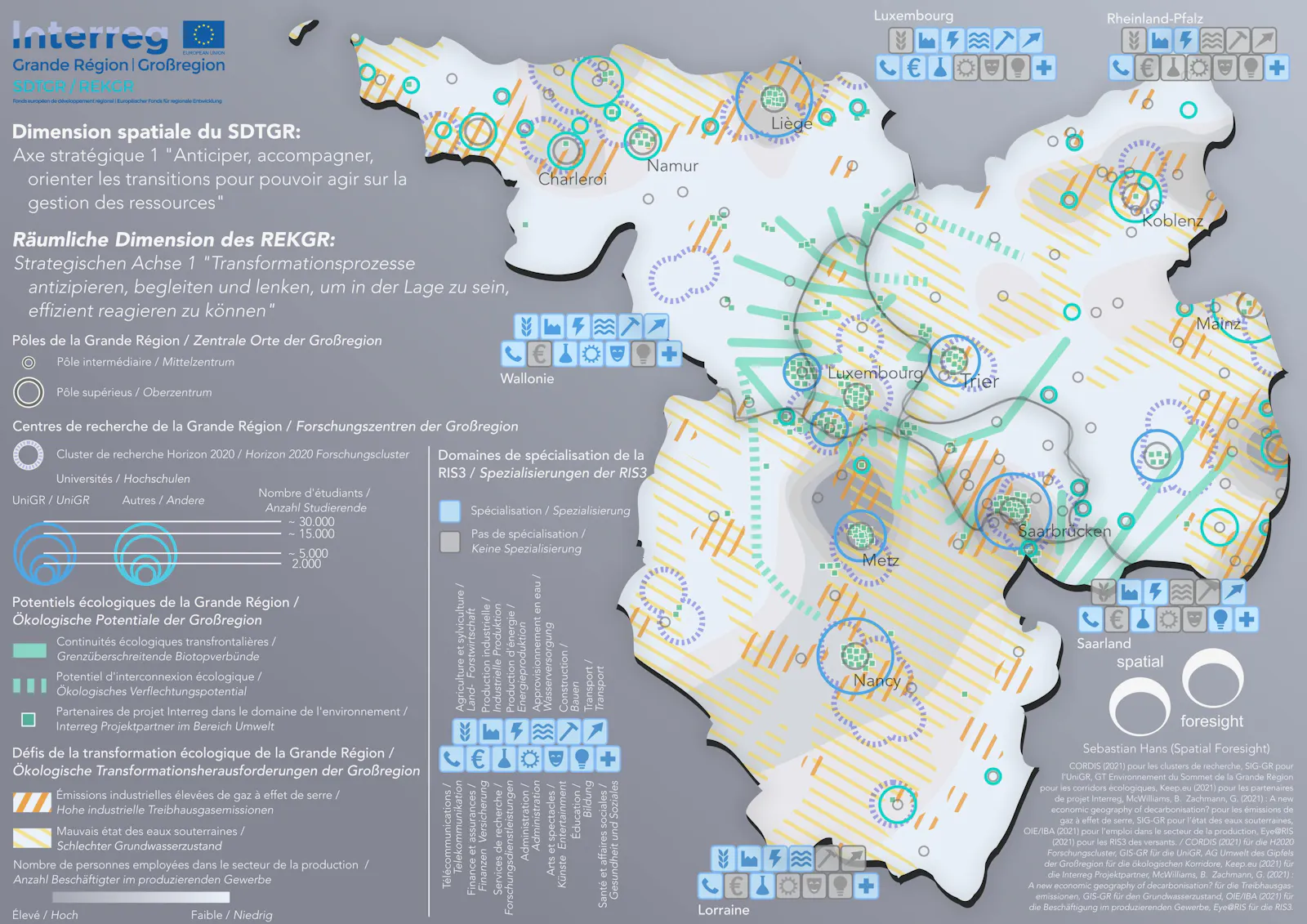
Strategic axis 1 ‘Anticipative, monitor and steer transformative processes, to allow for effective public responses’ describes the enhanced efforts needed to interlink research and development activities across the border. Protection of natural resources plays a role as well as to steer the transformative processes towards more renewable economic models in the Greater Region society. Many players of the Greater Region are already active in researching and testing transformative processes. These are the University of the Greater Region, a cross-border university but also private and public research institutes, which can be located by the areas with increased Horizon 2020 research project participation. The individual regions’ innovation strategies (RIS3) show potential for closer cooperation due to similar and complementing topics. In terms of ecological potential, the Greater Region has much to offer through the various biotope networks that cross borders. There’s still some potential for further connection and some Interreg projects are realised with an environmental focus, illustrating ongoing activities in transformative environmental processes. In contrast, large parts of the Greater Region feature important transformative challenges, which is illustrated by areas of high greenhouse gas emissions, areas with bad groundwater quality as well as areas with significant employment in industrial, more pollutive industries.
Goods & services
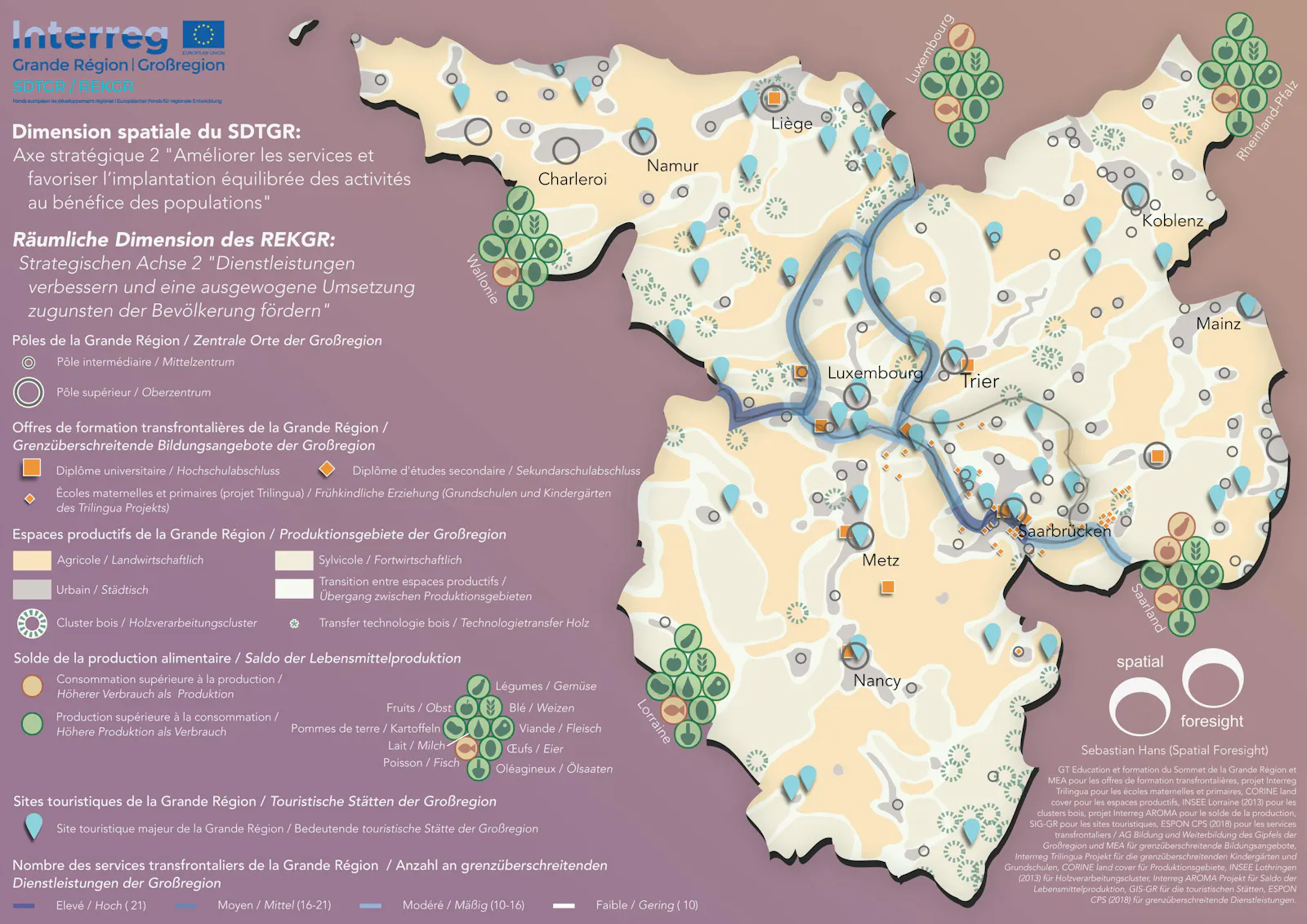
Strategic axis 2 ‘Improve services and support their balanced territorial rollout’ describes the future efforts needed for a balanced territorial development. Ensuring equal access to goods and services is a key political importance across national borders in the Greater Region. These include food production as well as services of general interest. Cross-border learning is important and supported by the many cross-border kindergartens, schools and university courses offered in the Greater Region. Food and good production near consumers will become more important in future, requiring efforts to close food production circuits, connecting production and consumption. Many areas already today produce sufficient food to cover domestic consumption. Forest economy has resulted in specialised knowledge in wood production clusters. High quality tourism services that can be found in all Greater Region are an interesting mean to boost internal tourism exchanges across borders. Despite the long tradition of organising cross-border services in the Greater Region, there are still areas with potential for further improvement.
Decarbonisation
Strategic axis 3 ‘Initiate the development of decarbonised and resilient rural and urban spaces’ describes efforts to render the Greater Region more climate neutral and resilient towards climate change. For these, several elements in the field of spatial planning are relevant. Shifting economic activities towards more digital services requires a well-established server structure, which is predominantly existing in Luxembourg. Following the concept of a ‘de-concentrated concentration’, many first-, second and third tier centres throughout the Greater Region will need to increase housing development to increase proximity between place of work and home. In Western Wallonia, South Luxembourg, between Nancy and the Luxembourg border as well as vast areas in Saarland, many brownfield areas are available for development due to industrial heritage. The same applies for former military districts all over Rhineland-Palatinate. Cross-border sustainable forms of transport are of key importance for a decarbonisation in the Greater Region. Many sustainable cross-border connections exist between Luxembourg and its neighbours but also between Germany and France and Germany and Belgium. The energy mix in the Greater Region leaves some potential for greening: with Wallonia and Lorraine having large amounts of their energy produced by nuclear plants, the Saarland region with coal and Rhineland-Palatinate with gas, shows still a large dependence on fossil sources.

Citizens
Strategic axis 4 ‘Common development of projects and structures of the Greater Region with increased involvement of citizens’ describes future efforts to forward the institutional cooperation in the Greater Region. In this, a stronger focus needs to be given to municipalities in the cross-border cooperation. Strengthening cultural integration via public curricular, share of young people in the Greater Region shows areas where measures might be particularly effective. On the contrary, population decline affects vast areas of the territory, calling for new approaches to service provision. Coworking spaces can help to reduce the need for transport between places. Public transport systems at different tiers across borders need to be strengthened to account for the increasing number of passengers travelling across and within the Greater Region. High quality connections between urban areas and natural zones as recreation areas can bolster the use of public transport.

Territorial cooperation
In all the above axes, information on players of cross-border cooperation was difficult to convey. A fifth map, showing the players of territorial cooperation was developed to account for the numerous relations and structures that today form the intense links across borders in the Greater Region.

With the help of the maps, the project provided a strong starting position for future discussions, helping to condense cross-border cooperation from strategic level to applied projects. The integrated maps facilitate the discussion between stakeholders as they provide and present data following the specific needs for data of experts of cross-border cooperation.
by Sebastian Hans
https://steadyhq.com/en/spatialforesight/about (Si apre in una nuova finestra)
Data
24/05/2022
Argomento
Territories
0 commenti
Vuoi essere la prima persona a commentare?
Abbonati a spatialforesight e avvia una conversazione.