(note: this is the first in an in-depth multipart series, with many more pieces to follow; c. 2212 words)
War has always been fought over land, sea, air, cities, ports, roads, bridges, weapons, supply lines, and bodies. And war has always been fought over “hearts and minds” - but the war for hearts and minds is fundamentally a psychological war - one of perception, fostering changes in allegiance and identity, deception, diverting action by an adversary down irrelevant rabbit holes, imposing opportunity costs, soaking up thinking time, attempting to impose learned helplessness, diverting planning and action and resources to wasted ends, all in the service of victory (a goal state, a tomorrow which has not yet come).
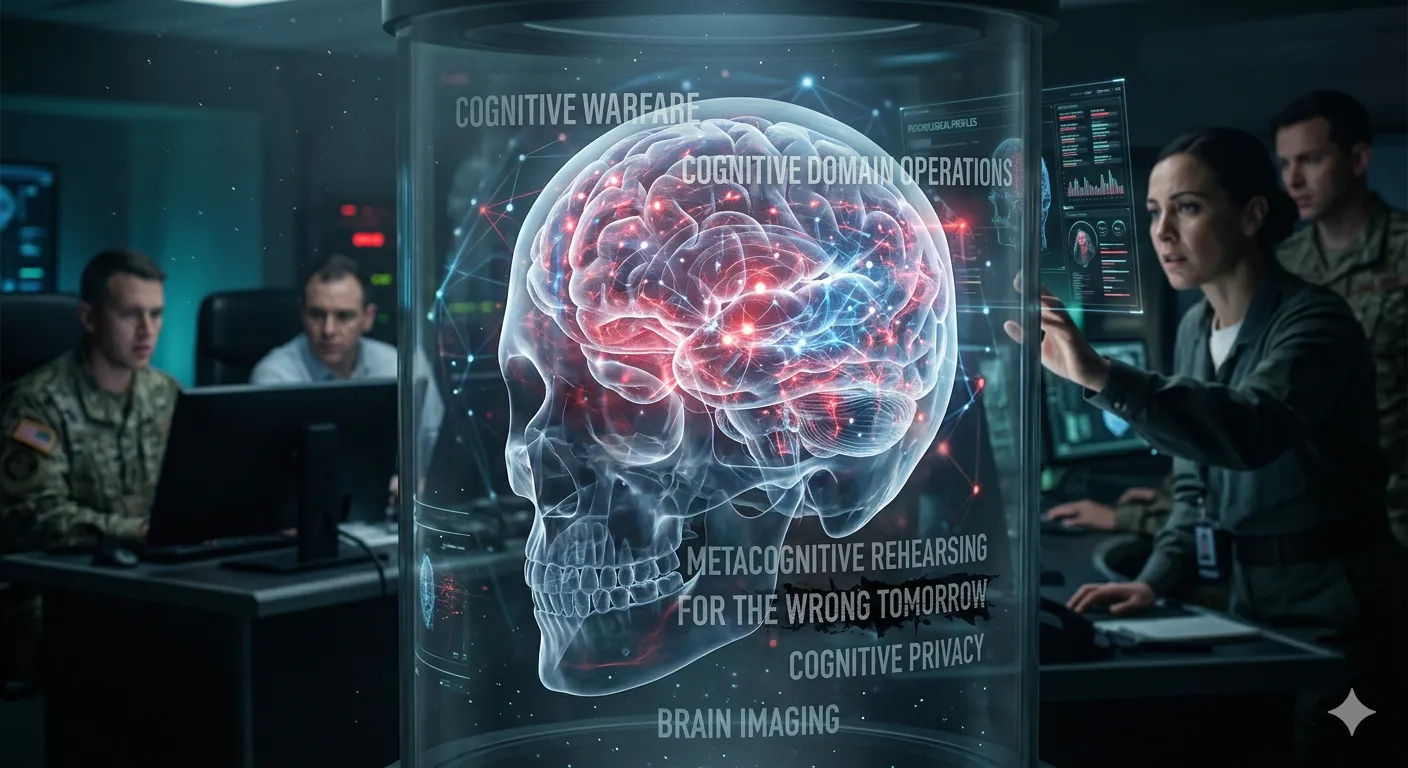
Cognitive warfare is the much newer and more elastic, and probably more useful, phrase for this bundle of ideas, and while a somewhat poorly defined concept, cognitive warfare refers to something real:- the deliberate attempt by one or other parties to a conflict to shape what the other party perceives, believes, feels, remembers, trusts, decides, and does, in the service of winning a war.
Cognitive warfare is, therefore, war fought as a contest of knowledge and metaknowledge - what you know, what you think you know, what your adversary thinks you know, what you think they know. These are the cognitive systems that war is fought under: you need to know what the enemy or adversary is doing, and you need to know how to deceive, confound, fool them in order to prevail - war is fundamentally a cognitive event long before it becomes a physical and kinetic event.
An alternative phrase is ‘cognitive domain operations’, which is a little more neutral, and has a greater range of applicability, as it refers to battles for hearts and minds in all sorts of other contexts.
Cognitive warfare is generally not ‘kinetic’ in nature, although of course it may employ kinetic means as feints to fool an adversary in some way. Equally, cognitive warfare is not simply the ‘weaponisation’ of public opinion, whatever that means - while it might embrace attempts at weaponising public opinion, but, as a century of research on behaviour and attitudes has shown, this is a very difficult thing to do in a sustained and predictable way.
Fundamentally, cognitive warfare is war conducted through the political, social, and related systems channeling and directing human behaviour during conflict, with a focus on targeting how fundamental cognitive processes such as attention, emotion, memory, identity, prediction, trust, and judgement are deployed collectively in the service of continuing a conflict effectively.
Cognitive warfare is both a direct challenge to the ideas and ideals of the Cognitive Republic, and an under-recognised challenge to our collective defence of the liberal democratic order. I will show in subsequent pieces both why we both should be and should not be alarmed by cognitive warfare.
(My interest is cognitive warfare arises in part from our recently funded €10.4 M European Research Council Synergy research grant: Project Justice, which you can read all about via this link (Abre numa nova janela))
To step back a little, then, cognitive warfare focuses on the fundamental collective cognitive processes of an adverary - cognitive warfare seeks to slow-down and weaken decision-making, destroy confidence, fracture trust, inflame grievance, delegitimise institutions, confuse perception, misinform, and prepare the ground for other forms of action.
Cognitive warfare is therefore close to the deep Clausewitzian idea: war as the continuation of politics by other means - war as a clash of wills and motivation and endurance.
The targets are thoughts and feelings, the sense of shared reality among a group, a polity, a nation. The means are non-kinetic, making use of informational, epistemic, cognitive tactics with the desired result the direct or indirect control over the behaviour of an adversary, diverting their thoughts and actions in ways that would otherwise not have occurred, with the aim of eventually overwhelming them and defeating them.
cognitive warfare is a new front in war - not just cyber
The traditional operational domains of war are land, sea, and air. Cyber and space have joined them as the new and obviously modern domains. Cognitive warfare is sometimes incorrectly and inappropriately, even lazily, treated as an extension of cyber, because so much of information now moves through digital systems: social platforms, bot networks, hacked material, targeted messaging, synthetic media, AI-generated content, and behavioural analytics.
What was one of the greatest acts of cognitive warfare in history - Operation Mincemeat, where the Axis forces were led to believe by Allied actions that a major land, sea, and air operation was going to take place at sites other than the intended site - happened long before cyber warfare was possible.
Cognitive warfare can use cyber means, but its target is cognitive and social: these might be attempts at a rumour whispered in a village, slogans repeated on the radio, speeches designed to humiliate the enemy, or forged documents placed in the right file, or a flood of contradictory claims released at the right moment: each can be part of a cognitive operation.
The channels for cognitive warfare are manifold, but the human problem remains: it is people that must notice, interpret, remember, trust, decide, and act.
Cyber may be part of this, but often cyber attacks are conducted for other purposes - attacking electrical grids, healthcare systems, information systems, banking and finance systems.
Cognitive warfare is perhaps best understood as the ongoing attempt to interfere with an adversary’s capacity to make sense of the world, and to interfere and degrade their ability to act upon the world.
the message as invitation
A useful phrase from recent writing on cognitive warfare/cognitive domain operations is: “the message is the invitation”, which captures something important about how these epistemic influence operations, to be effective, must work. A message must do much more than deliver content: it must invite multiple people into something new; it must entice, linger in thought, bedazzle in some way; it should offer an emotion, an identity, a role, a future, status, rewards - something other than a bald statement regarding something - a studied ambiguity that allows the recipient to infer something. Or, as the writing advice puts it: ‘show, don’t tell’.
The same invitations can equally become a door into fear, resentment, fatalism, suspicion, pride, or action. A message can make an enemy seem near, a betrayal seem obvious, defeat inevitable, institutions corrupt, or even violence necessary. It can ask a person to see themselves as abandoned, heroic, humiliated, threatened, chosen, or avenged.
The deeper question is: what mental posture does the message invite? What kind of person does it ask the listener to become? What future does it make imaginable? Cognitive warfare succeeds when the target begins to think, feel, remember, and act from inside the frame offered to them.
what does ‘cognitive’ mean?
The word “cognitive” should not be a decorative synonym for propaganda; after all, a serious account of cognitive warfare requires a serious account of what we mean by cognition. A reasonable definition is that cognition is the active, distributed process of transforming information into adaptive action; cognition is therefore the abstract psychological processes by which we know, represent, understand, and act upon the external world.
Three broad ways of considering cognition matter here:
The standard human information-processing model treats cognition in stages: sensory input is encoded, held in working memory, interacts with processes of encoding and retrieval from long-term memory, and used to guide behaviour. This older model remains useful because it clarifies how information is received, stored, retrieved, and acted upon.
The predictive processing model treats the brain as an anticipatory system, where the brain continually generates expectations about the world and updates them when reality produces error signals. Perception is therefore active inference, not simple reception.
The collective cognition model examines cognition as it is distributed across people, tools, institutions, and cultures. Groups remember, reason, and decide through shared practices, records, technologies, conversations, and social roles.
Cognition comprises many component processes, and these are the target of cognitive warfare. The target may be attention: what becomes salient and what disappears into the background. It may be perception: what seems to be happening. It may be emotion: fear, anger, humiliation, pride, disgust, fatigue, suspicion. It may be memory: which past is retrieved, rehearsed, and weaponised. It may be identity: who “we” are, who “they” are, and what “people like us” must now do. It may be trust: which sources are believed and which are dismissed before they speak. It may be prediction: what future seems likely, unavoidable, or already lost. It may be decision-making: which options feel available and which feel unthinkable.
social identity
Cognitive warfare, in one form, is the hostile engineering of social identity. Much political manipulation works by sharpening the boundary between in-group and out-group. Demagogues have known this for centuries. They do not need a formal theory of social psychology to discover people can be mobilised by stories of threat, betrayal, humiliation, and revenge. They test slogans, enemies, rumours, grievances, and symbols. What works is repeated. What fails is discarded. Over time, a practical technology of mobilisation emerges.
stress as terrain
Cognitive warfare feeds on existing stresses. It may work best where people are already tired, anxious, angry, humiliated, distrustful, economically pressed, or socially fragmented. One way to describe this is the parasitic exploitation of allostatic load: a chronically-stressed population has fewer cognitive reserves for careful judgement. It may become more receptive to simple explanations, vivid enemies, emotional shortcuts, and conspiratorial thinking.
A cognitive attack does not need to cater to every grievance, but can amplify selectively an important already present grievance. It can take old resentments, class injuries, ethnic memories, religious fears, national humiliations, institutional failures, economic precarity, or moral disgust and give them a sharper target. The most effective cognitive operations often work with local material. They are parasitic on the emotional ecology of the society they enter.
This is why cognitive warfare best arrives through what people already fear, already remember, already suspect, or already long to hear confirmed.
precision cognitive warfare
The best example of precision cognitive warfare remains Operation Mincemeat (Abre numa nova janela), which I will examine in detail in a subsequent post.
In 1943, British intelligence wanted the Germans to believe the Allied invasion of southern Europe would fall on Greece or Sardinia rather than Sicily. They placed false documents on a corpse dressed as a British officer, and manouvered circumstances to ensure the material reached German intelligence. The deception was audacious, theatrical, and meticulously controlled.
The importance of Mincemeat as cognitive domain operations lies in its remarkable and coherent epistemic discipline. Mincemeat had a particular and carefully defined target: German strategic judgement. It had a desired false belief which it wanted to implant in German strategic thinking: that an attack on Sicily was a feint and the real target lay elsewhere. It had a particular behavioural goal: that enemy forces and attention would be displaced away from the true invasion site. It had a time horizon: the deception only needed to last long enough to assist the Sicily operation. It had a way of being assessed: German reactions could be monitored through intelligence channels.
Most importantly, Mincemeat had an internal truth boundary. The British knew the lie was a lie, and Allied planning remained anchored in reality. The false documents were designed to enter the German model of the world, not the Allied model of the world. The deception was aimed outward; ground truth was preserved internally.
Mincemeat worked because the Allies lied to the enemy without lying to themselves.
Operation Mincemeat constructed a plausible world. The British did not simply assert that the Allies would invade Greece or Sardinia rather than Sicily. They created an evidentiary ecology in which German intelligence could infer that conclusion for itself: a dead courier; personal letters; military documents; bureaucratic texture; human messiness; the appearance of accidental disclosure; a body found in Spain; channels through which the material would predictably pass.
That is the genius of the operation: Mincemeat allowed the German system to complete a set of patterns in their pre-exisiting thnking - it was confirmation bias writ large - providing a glimpse into a world in miniature, and allowing them, never ever telling them, to draw the wrong conclusions.
People and institutions as cognitive communities are often more powerfully persuaded by conclusions they believe they have reached themselves. The operation exploited expectation, confirmation, source credibility, narrative coherence, and institutional habit. German intelligence already knew Sicily was the obvious target. They also knew that the Allies knew Sicily was obvious.
A deception suggesting that Sicily was a feint therefore had a certain higher-order plausibility, because it fitted an expectation about deception itself.
Mincemeat also worked because the evidence appeared costly, contingent, and accidental. A random broadcast saying “we will invade Greece” would have had little value. A corpse carrying private correspondence that seemed to have been lost by accident was cognitively richer. The Axis forces could tell themselves: ‘this was not sent to persuade us; we found it’ and that distinction was, collectively, cognitively decisive.
The deep lie succeeded because it was embedded in mundane realism: a named officer, his personal effects, tiresome ordinary paperwork, all too plausible personal issues (money, relationships, the usual), bureaucratic detail; all the little details, the bits of pocket litter, dated theatre stubs, demands for an overdraft to be settled promptly, all giving the falsehood the texture of a significant and important life as a military officer.
The lesson: good deception does not overpower the target’s thinking, but instead supplies the right materials at the right time, and lets the target mislead themselves.
This is the first in a multipart series on one of the most important issues confronting democratic societies today; if you would like to support this work and be deeply informed about what is the oldest and newest front in warfare, just click below:
Most future pieces on cognitive warfare will be partially or completely paywalled.
Data
03/06/2026
0 comentários
Gostaria de ser o primeiro a escrever um comentário?
Torne-se membro de Cognitive Republic e comece a conversa.