January 2024
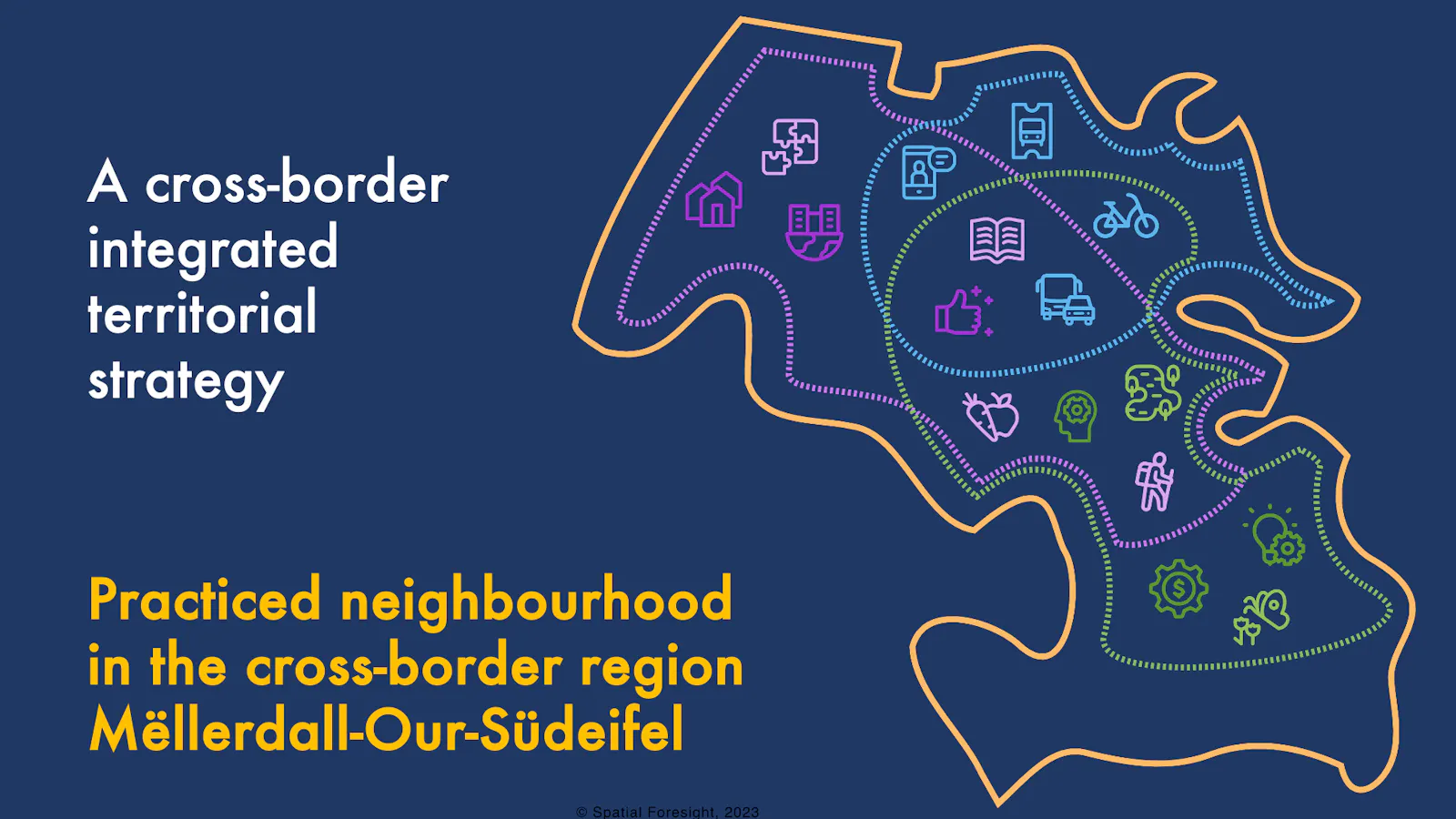
Integrated territorial strategies are an important tool to master today´s complex development challenges. As discussed in an earlier blog post on territorial strategies (S'ouvre dans une nouvelle fenêtre), finding the appropriate territorial focus for a strategy is essential. Often this leads to a functional area approach, as where the definition of the functional area (S'ouvre dans une nouvelle fenêtre) is closely linked to the objectives of the strategy, as discussed in an other blog post (S'ouvre dans une nouvelle fenêtre). In border regions, such functional areas may very well stretch beyond national borders and call for cross-border territorial strategies.
Mëllerdall-Our-Südeifel strategy
Currently, a number of such cross-border territorial strategies are elaborated along Luxembourg’s borders with Belgium, France and Germany. One of them concerns the Luxembourgish-German border region Mëllerdall-Our-Südeifel where the national border is defined by the rivers Our and Sauer. In November 2023, stakeholders in this region agreed on a strategy to intensify cross-border cooperation and work towards a sustainable and vibrant future.
In the context of the Interreg Programme for the Greater Region, the functional cross-border region Mëllerdall-Our-Südeifel has been identified as an area where long-standing collaborations can be taken to a new level. It builds on a long history of cross-border cooperation between Luxembourg and the German state of Rhineland-Palatinate in this region. It involves among others the establishment of the German-Luxembourg Nature Park back in 1964. This joint venture laid the groundwork for an increasingly integrated approach to managing the region’s natural treasures.
With the new strategy, this collaboration shall be further stimulated. The strategy has been elaborated in a co-creative and participative process, designed and facilitated by Spatial Foresight, drawing on the insights and priorities of key players in the region. The process involved representatives from nature parks, LEADER local action groups, nature, forestry, and agricultural administrations, as well as from municipal and regional levels, from the fields of tourism and culture, along with ministerial representatives from the areas of spatial development, environment, nature conservation, water management and tourism.
Together they elaborated a strategy which holds the potential for a paradigm shift in regional cooperation in the area. The strategy's development hinged on transformative thinking, adaptability, and a learning-oriented approach. With a focus on enhancing the area's natural beauty, improving liveability, and erasing borders in practical terms, the strategy aligns with various national, regional, and international development plans. This alignment signals a deep-seated commitment to regional cohesion and collective growth, beyond mere geographical boundaries.
For a sustainable, attractive, liveable and borderless future along Our and Sauer
At the heart of the strategy is the idea of an actively practiced neighbourhood, which collectively shapes the present and future living space and nature under this motto. This vision encapsulates the essence of active, cooperative, and positive cross-border relationships. In this ideal neighbourhood, residents and stakeholders engage regularly, support each other, and jointly pursue projects that enhance communal well-being, security, and unity. This vision also emphasises the integration of the region into a cohesive whole, where borders become inconsequential. Central to this vision are concepts like cooperation, a borderless existence, and a shared commitment to the region's future.
The guiding principle of the strategy is to connect and sustainably utilise the diverse opportunities of the region around Our and Sauer to strengthen people’s livelihoods and help them grow together and foster a sense of unity that transcends time, extending beyond 2028 (i.e. the current Interreg funding period).
The strategy categorises its objectives into five thematic areas: Nature & Environment, Ecological Footprint, Transport & Mobility, Regional Identity, and Quality of Life. Each area features specific broad and detailed objectives, geared towards environmental stewardship, sustainable development, comprehensive mobility solutions, cultural vibrancy, and enhanced living standards:
Nature & Environment: The protection and development of nature & environment are crucial to ensure the long-term viability of the region around Our and Sauer. Climate change and the associated increase in extreme events (e.g. floods or droughts) and greenhouse gases increasingly threaten the health of the environment and the residents of the region. Therefore, the strategy underlines that players in the region must respect and preserve nature and the environment to guarantee further sustainable development of the region and quality of life. This includes, for example promoting and supporting the expansion and maintenance of a diverse and sustainable cultural landscape, as well as the networking of fauna and flora and of protected areas in accordance with existing regulations.
Ecological Footprint: Measuring and reducing the ecological footprint is essential for promoting sustainable development. The strategy sets out to reducing the environmental impact of human activities by raising awareness and creating individual and regional incentives. This includes supporting and promoting future-oriented uses of local resources and local knowledge to strengthen regional circular economy initiatives. It also involves creating conditions for innovation in the region and promoting sustainable, ecological, and circular economic forms in the region.
Transport & Mobility: The strategy acknowledges the critical role of sustainable transport in enhancing regional connectivity and reducing ecological impacts. The goals of the strategy include cross-border mobility that is multimodal, service- and user-oriented, climate-friendly, and social. The urgent and important development of sustainable transportation systems, in the context of climate change, aims to reduce negative environmental impacts (such as air pollution, noise pollution, and greenhouse gas emissions) and promote public transportation systems, sharing programmes, and pedestrian-friendly infrastructures. These efforts allow for improved accessibility and mobility while simultaneously reducing traffic congestion, air pollution, and carbon emissions.
Regional Identity: Cross-border cooperation is of particular importance to counteract feelings of exclusivity or even conflicts between different regions. Therefore, the strategy focuses on strengthening awareness of the attractiveness and identification with the region around Our and Sauer, for example, through the establishment, continuation, and deepening of cross-border cooperation and the involvement and sensitisation of regional players and the population. This will also strengthen the potential and attractiveness for tourism, which is an important pillar of the region’s economy. It also involves the development of joint regional and cross-border educational and information offers for a sustainable development for all generations.
Quality of Life: While regional identity focuses on the belonging and connection of people in and with the region around Our and Sauer, quality of life describes the general well-being and satisfaction they experience in everyday life. It encompasses various aspects of life, such as physical health, mental and emotional well-being, social relationships, environmental factors, and access to resources and opportunities. Accordingly, the strategy has set itself the goal of improving the attractiveness of the living space through easily accessible offers of basic services and leisure in a healthy and diverse nature & environment. This includes, among other things, supporting and promoting the development and expansion of future-oriented and needs-based infrastructure.
Another aspect entailed by the strategy is the envisaged cross-border governance structure, designed to ensure collaborative decision-making and broad stakeholder participation. It underlines the commitment to a unified approach in realising the strategy's objectives. The exact format of this will be discussed and shaped in spring 2024.
Overall, the Mëllerdall-Our-Südeifel strategy is more than a regional development plan. It's a beacon of cross-border cooperation. By transcending national boundaries, it offers a model for sustainable regional development, fostering a sense of community and shared destiny. As this strategy unfolds, it holds the promise of setting a benchmark for international cooperation, proving that when borders unite, visions align, and a brighter future for all is assured.
For more information, please consult the full version of the strategy (in German) (S'ouvre dans une nouvelle fenêtre).
by Kai Böhme, Jean Claude Zeimet, Kirsti Hagemann
https://steadyhq.com/en/spatialforesight/posts/9b98b10c-37c7-47ff-bfd0-8499e7264c12 (S'ouvre dans une nouvelle fenêtre)
Date
08/01/2024
Sujet
Territories
0 commentaire
Vous voulez être le·la premier·ère à écrire un commentaire ?
Devenez membre de spatialforesight et lancez la conversation.