December 2025
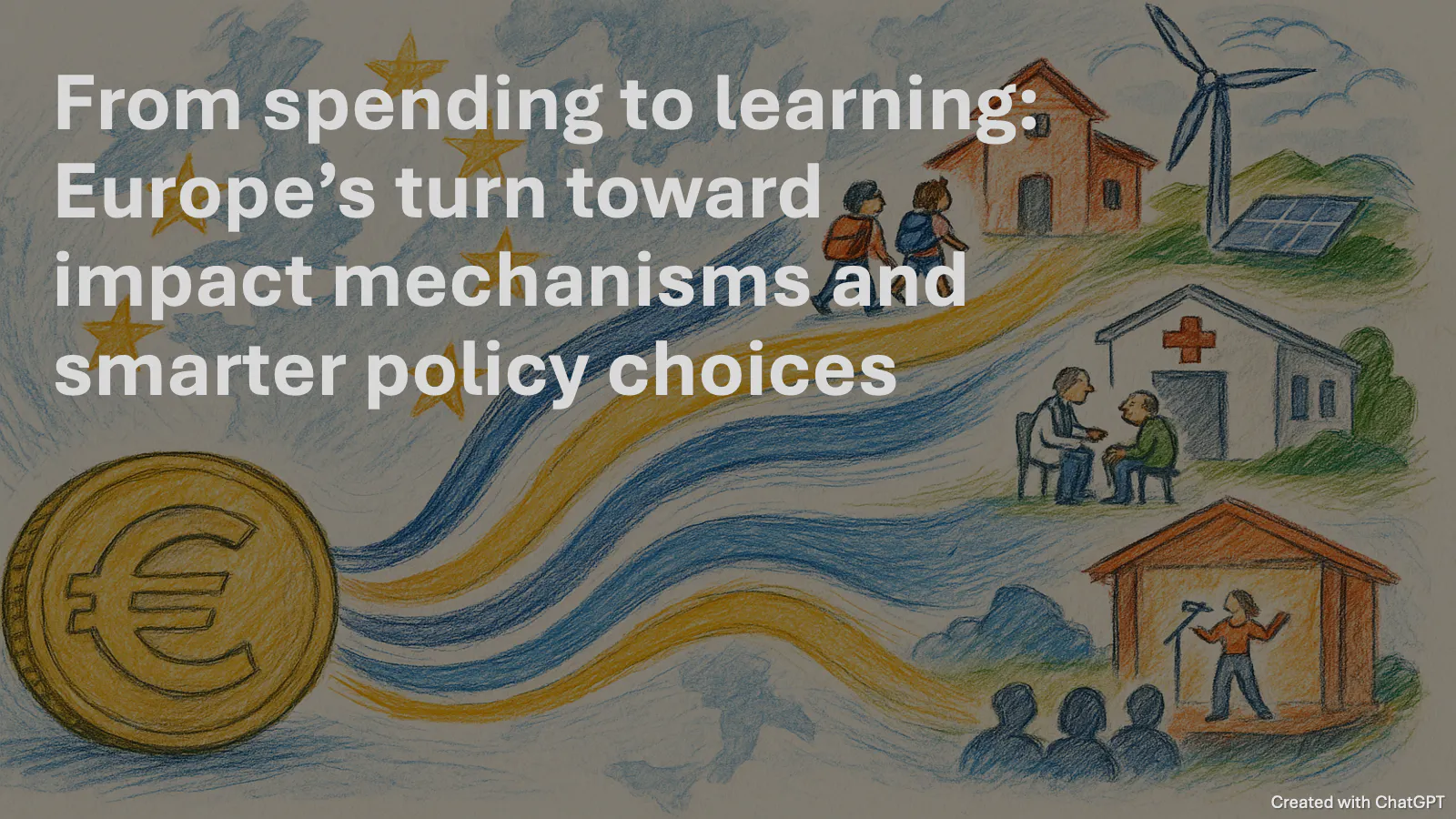
As Europe enters the next phase of budgetary debate, a quiet revolution is underway. The focus of the conversation is shifting from how much to spend to how to spend better. Amid growing fiscal constraints, political polarisation and public demand for accountability, policymakers are realising that the credibility of the European project depends not only on the size of its budget, but also on its demonstrable impact.
In an era of complex challenges such as climate change, demographic shifts, social inequality and geopolitical fragmentation, simply increasing budgets will not suffice. What matters is the capacity to learn, compare and adapt, to identify which investments deliver real outcomes and which do not.
The current proposal for Europe’s next Multiannual Financial Framework (MFF) hints at this change. By strengthening monitoring frameworks, transparency requirements and conditionality, the European Commission is laying the groundwork for a more evidence-based approach to policy delivery. If this is taken seriously, it could mark a profound cultural shift from input-output accounting to impact-informed decision-making.
Inspired by this debate, we have developed a series of scenarios exploring alternative approaches to the future MFF. These scenarios are based on the concept of a more impactful and risk-taking MFF that dares to invest in scale, coordination, and experimentation.
One scenario explores how the EU could put this aspiration into practice, with a renewed focus on impact mechanisms, smarter policy comparison methodologies, and funding models that reward results rather than compliance.
MFF Scenario 4: An MFF Built Around Impact Mechanisms
In this scenario, the EU budget serves as both a source of financing and a laboratory for learning. The MFF evolves into a framework for testing, comparing and scaling up policies based on their real-world outcomes.
Three complementary dynamics underpin this shift:
Embedding outcome-based funding across major instruments. Rather than reimbursing eligible costs, programmes would release payments upon verified outcomes, such as reduced emissions, improved skills matching, or lower excess mortality. This would encourage implementers to prioritise results.
Integrating comparative impact methodologies into policy design and evaluation. Decision-makers would systematically compare intervention options using robust models of expected and observed impacts, thus promoting evidence-based decision-making across sectors and regions.
Institutionalising transparency and adaptive learning as part of governance. Open data on beneficiaries, progress and outcomes would enable benchmarking, peer learning and public accountability.
At its best, this scenario would transform the EU budget into a continuous feedback loop between design, delivery and learning, where policies evolve in response to evidence rather than inertia.
From spending lines to a stronger impact focus
If realised, the shift towards impact mechanisms and comparative methodologies could greatly strengthen the EU’s strategic capacity and legitimacy.
Better use of public resources. Outcome-oriented financing ensures that money flows to projects that are effective, rather than merely administratively compliant. This would reduce waste and increase efficiency across the EU’s multi-level system.
Stronger accountability and trust. Transparent monitoring and clearly communicated impacts could rebuild public confidence in EU spending, particularly in Member States where Eurosceptic narratives thrive on perceptions of inefficiency and opacity.
Smarter policy design. By embedding ex-ante impact assessment and ex-post comparison, the EU could systematically identify the most effective policy designs in different contexts. Over time, this could generate a European evidence base for effective regional development, climate adaptation and social inclusion policies.
Improved coherence across instruments. Impact metrics could provide a common language for diverse funds, from cohesion to research to resilience, enabling better coordination and reducing duplication.
Political space for experimentation. Once funding is tied to outcomes rather than compliance, the policy system becomes more tolerant of innovation and risk. Failing early becomes acceptable if it leads to better long-term learning.
If nurtured, this scenario could thus shift Europe’s governance logic from spending to learning.
A sceptical read: when metrics mislead
However, turning impact ambition into practice is far from straightforward. There are at least five pitfalls to avoid:
Metric myopia. Not everything that matters can be easily measured. Overreliance on quantitative indicators may crowd out qualitative dimensions such as social cohesion, empowerment or cultural value, which are core elements of European territorial policy.
Misaligned incentives. If poorly designed, outcome-based payments can incentivise short-term, easily verifiable results rather than deep structural change. Implementers may focus on 'low-hanging fruit' to secure payments rather than addressing systemic problems.
Administrative overload. Designing and verifying outcome metrics requires data, expertise and coordination. Without simplification, smaller regions and organisations risk being excluded due to capacity constraints.
Unequal access to evaluation capacity. Member states and regions vary widely in their ability to collect and interpret impact data. Without capacity-building support, the shift towards outcome-based governance could exacerbate existing disparities.
Political misuse of data. Metrics and comparisons can be powerful, but they can also be politicised. Selective interpretation or strategic benchmarking could distort learning processes and erode trust rather than strengthen it.
In short, impact orientation is a powerful tool, but only if it remains embedded in learning, contextual sensitivity and genuine multi-level partnerships.
Making it work: ingredients for an impact-driven MFF
In order to deliver on this scenario, institutional innovation would be required at several levels. Five interlocking elements stand out:
Clear and credible impact frameworks. The EU needs to define what success looks like in each major policy area. These frameworks should include quantitative targets, such as reducing CO₂ emissions and increasing the skills match rate, as well as qualitative indicators, such as citizen wellbeing and social resilience. These frameworks should be co-designed with Member States, regions and social partners to ensure legitimacy and ownership.
Experimental policy design and evaluation. Building on the ‘missions’ approach of Horizon Europe and the milestone logic of the Recovery and Resilience Facility, the EU could establish experimental design practices such as randomised trials, comparative case studies and counterfactual modelling. Programmes would systematically test alternative interventions before scaling them up.
Adaptive funding mechanisms. Outcome-based approaches require flexibility. Payments should be linked to milestones and verified results, but they should also allow for mid-course corrections when evidence suggests a better approach. This could include impact funds that reinvest savings from high-performing projects into scaling up or replication.
Open data and comparative transparency. Public dashboards showing project progress, beneficiaries and outcome trajectories could encourage peer learning and build public trust. Regions could benchmark their progress against comparable peers, stimulating healthy competition and policy diffusion.
Building capacity for impact governance. The EU should invest in regional and national 'impact units' to strengthen analytical and evaluation skills. Just as fiscal rules are supported by independent bodies, impact governance could be institutionalised through European and national observatories, which would ensure methodological consistency and integrity.
Together, these elements could transform the MFF from a funding mechanism into a learning system that not only delivers results, but continuously improves the way it does so.
Territorial reflections: comparing impacts across Europe
From a territorial perspective, this shift has significant implications.
Regions differ in their economic structures, data ecosystems, administrative capacities and policy cultures. While some regions can already deploy advanced monitoring tools and real-time evaluation dashboards, others struggle to collect even basic data on programme results.
For impact-based governance to strengthen cohesion rather than undermine it, territorial diversity must be built into its design.
Differentiated impact frameworks. Outcome indicators should be tailored to functional territories. A one-size-fits-all metric risks penalising regions for structural constraints beyond their control. For instance, employment outcomes in ageing rural areas or mountainous regions should be evaluated using context-sensitive benchmarks.
Place-based impact pipelines. Regions should be involved in designing as well as reporting outcomes. Territorial compacts could define locally relevant impact trajectories linked to national and European objectives. This would create a two-way bridge between local learning and EU-level strategy.
Strengthening the local evidence. Cohesion policy's extensive experience with territorial indicators and evaluation systems provides a solid basis for this. By linking local monitoring data with EU-wide impact frameworks, the next MFF could establish the first pan-European impact observatory.
Cross-border comparability. Impact-oriented governance opens up new possibilities for learning across borders. Regions facing similar challenges, such as industrial transition, depopulation and flood risks, could compare outcomes and exchange solutions. Interreg could evolve into a learning accelerator, funding comparative pilots rather than isolated cooperation projects.
Safeguarding inclusiveness. Outcome-based funding must not exclude weaker actors. Dedicated technical assistance and pre-financing mechanisms should help less developed regions participate in the impact agenda. Otherwise, the EU risks replacing one kind of inequality (in funding) with another (in learning).
In short, territorial cohesion and impact governance must reinforce each other. The experience of cohesion policy with place-based monitoring could become a cornerstone of Europe’s broader impact architecture.
Examples of what it could look like
To illustrate, consider how outcome- and impact-based mechanisms might reshape familiar policy domains:
Climate adaptation missions. Regions would receive funding based on verified improvements in flood resilience, as measured by risk reduction indices and citizen safety metrics, rather than the number of kilometres of dyke construction.
Skills and employment programmes. Payments depend on sustained employment outcomes after six months rather than on the number of participants trained. Regional partnerships are rewarded for long-term employability gains.
Urban regeneration. Outcome frameworks link physical renewal with well-being indicators, such as reductions in energy poverty or improvements in perceived safety, combining quantitative and qualitative data.
Digital infrastructure. Impact metrics assess connectivity improvements in underserved areas and their impact on business creation, rather than merely measuring coverage percentages.
Health and wellbeing pilots. Multi-sector initiatives that link health, social care and community infrastructure could use milestone-based funding, releasing payments when demonstrable improvements in well-being or access are achieved.
The guiding principle in each case is the same: fund what works and learn from what doesn’t.
The bottom line
Europe’s future competitiveness and cohesion depend not only on its financial capacity, but also on its ability to learn. The MFF is uniquely positioned to drive this transformation. By incorporating impact mechanisms and comparative methodologies, the EU can shift its focus from expenditure to steering, from outputs to outcomes, and ultimately from accountability for funds spent to accountability for changes achieved.
This scenario is not about technocratic control, but democratic intelligence. Transparent, evidence-based decision-making can enhance trust in European institutions, while outcome-based approaches can empower regions and implementers to innovate and adapt.
However, success will require political courage. Impact governance challenges entrenched habits and vested interests. It requires a readiness to confront uncomfortable facts and acknowledge failure as an opportunity for learning.
If the EU embraces this mindset, the next MFF could become Europe’s most powerful learning mechanism, not just a financial framework. By aligning funding with outcomes, evidence with choice and diversity with shared purpose, Europe could make better policy decisions, not by chance but by design.
by Kai Böhme & Kaisa Lähteenmäki-Smith
 (S'ouvre dans une nouvelle fenêtre)
Date
04/12/2025
Sujet
Cohesion (policy)
0 commentaire
Vous voulez être le·la premier·ère à écrire un commentaire ?
Devenez membre de spatialforesight et lancez la conversation.