December 2022
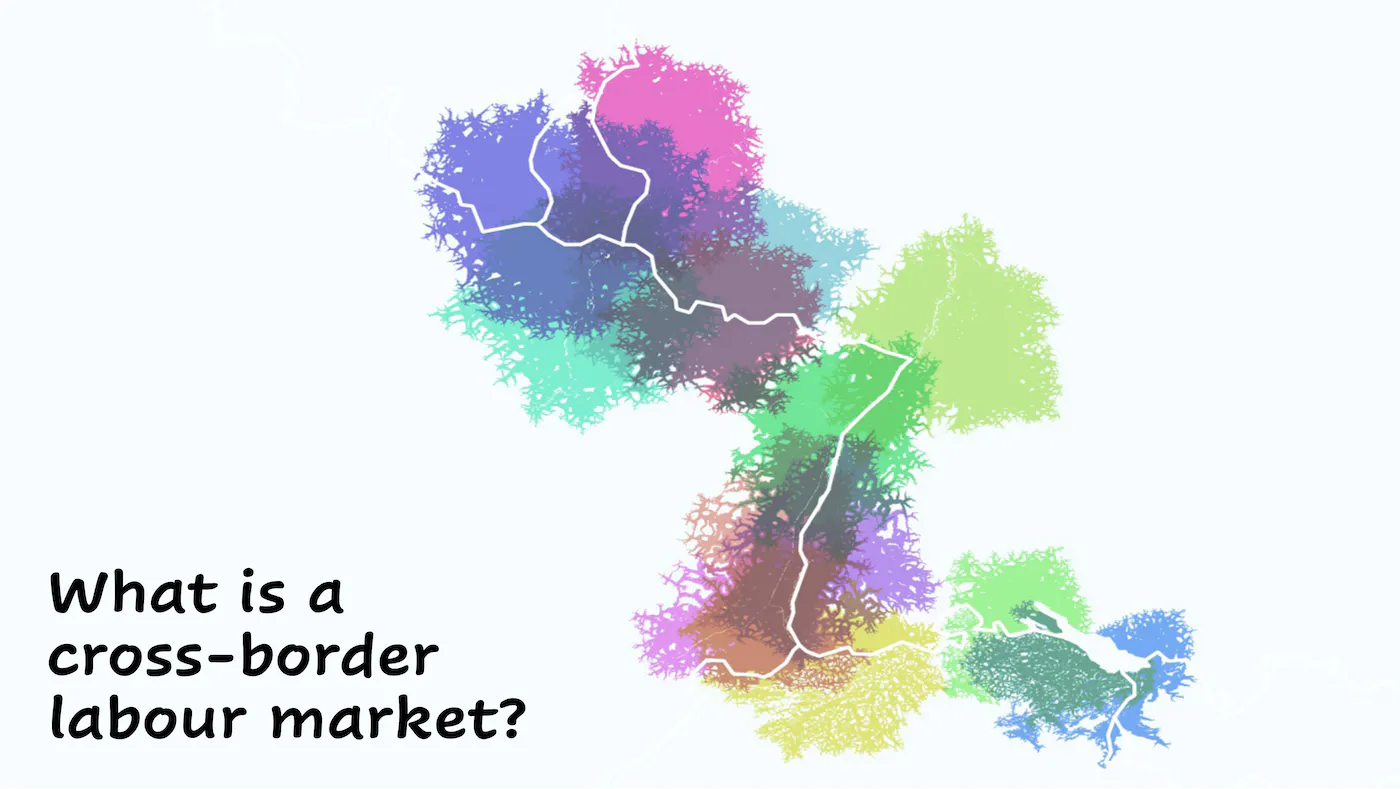
In an ideal Europe, commuting flows would be no different in cross-border regions than in any other area. We know that this is far from being the case. Language and culture barriers are only part of the reason why labour mobility primarily occurs within European countries. Borders are interfaces between national economic systems with different labour costs and wage levels. Different mismatches between skill offer and demand occur in each country. Despite numerous bilateral agreements, European cross-border workers need to overcome many administrative hurdles to pay their taxes, access public health insurance and contribute to pension schemes. In addition, intra-national mobility needs are often given priority when decisions are made on transport infrastructure investments and on public transport services.
It is therefore easy to understand why the European Commission pays specific attention to cross-border labour markets. Their development would be a proof that Single Market integration is effectively progressing. They would demonstrate some level of coordination between administrative and legal systems. Maybe most importantly, they would pay testimony to the fact that many mental barriers to living and working in different countries have been overcome. This is part of the reason why the border focal point of the European Commission’s “Futurium platform” will organise a conference entitled “Vibrant Cross-Border Labour Markets (S'ouvre dans une nouvelle fenêtre)” in January 2023.
Discussions on cross border labour markets should be informed by evidence. Different challenges need to be overcome to produce such evidence. A first challenge, which is less trivial than one may think, is to answer the question “what is a cross-border labour market?” Is it an observable reality? Or rather a political project, whose spatial extent and potential for integration is in the eyes of the beholder? In the former case, it should be possible to delineate in the same way as any other labour market. In the latter case, the objective is rather to explore the feasibility and implications of different policy agendas.
Different patterns of cross-border commuting
Only a few European cross-border regions experience massive cross-border commuting flows. These are primarily observed around Luxembourg and Switzerland, with cities such as Geneva and Basel acting as attractors of commuters. In these cases, cross-border labour markets could theoretically be delineated using the “harmonised definition of urban areas (S'ouvre dans une nouvelle fenêtre)” developed jointly by the OECD and by the European Commission in 2019. According to this approach, all local units with at least 15 % of their employed residents working in a city (or a set of cities linked by commuting flows) are part of its labour market (or “commuting zone”). However, this methodology has not been applied across national borders. In other words, all OECD/European Commission functional urban areas currently stop at national borders (S'ouvre dans une nouvelle fenêtre). This is mainly because the variable availability of data on cross-border commuting makes it impossible to delineate cross-border labour markets in a consistent way across Europe. However, some national statistical institutes have delineated functional areas whose centre is partly or entirely located abroad. For example, in France, INSEE has delineated the functional areas (S'ouvre dans une nouvelle fenêtre)of Basel – Saint-Louis, Geneva – Annemasse, Charleroi, Lausanne, Luxembourg, Monaco and Saarbrücken.
However, cross-border commuting also occurs in other areas. Even when such mobility concern less than 15 % of the employed population, it can have significant effects. Cross-border commuting can be relatively limited even in well-established rcoss-border regions. For example, in the Öresund region only 16 500 persons commuted across the border in 2020 (S'ouvre dans une nouvelle fenêtre) , out of a total population of more than 4 million. In the Öresund region, cross-border commuting flows have also been decreasing since 2015. There are also numerous examples of rural border regions with diffuse cross-border commuting flows. Potential effects of cross-border commuting can therefore be analysed in many parts of Europe where in and out-flows of commuters are a marginal component of primarily national labour markets.
When analysing effective or potential cross-border commuting in these areas, one must first agree on a definition of cross-border commuting. Should one only consider daily commuting, or also weekly commuting? The EU regulation on the coordination of social security systems (S'ouvre dans une nouvelle fenêtre) opts for the second solution. When applying this approach, the analysis of cross-border labour market integration patterns or potentials in not necessarily limited to border regions. With the development of remote working, one can be employed in a country, but be physically present at the workplace only occasionally. In some cases, labour mobility is “transnational” rather than “cross-border”. This is typically the case for highly qualified persons that commute between metropolitan regions using airline or high-speed railway connections.
How can they be approached analytically?
The notion of cross-border labour markets is therefore initially inspired by a limited number of areas with massive cross-border commuting flows. However, in current European policy discussions, it more generally designates effective or potential commuter flows across European internal and external borders limited to border regions (i.e. excluding transnational commuting patterns).
When applying this broader definition, models designed for functional urban areas become less relevant for the analysis of cross-border labour markets. Three alternative approaches of cross-border labour markets may be proposed:
An empirical and prospective approach, based on econometric and gravity models. Such models can formalise the complex relationship three dimensions: (1) distance between home and workplace, (2) border effects, i.e. obstacles linked to crossing a national border (3) push and pull factors linked to economic and social characteristics of places of living and (potential) places of work. The objective is to simulate effects that different policy measures or socio-economic trends may have on cross-border commuting flows. Model parameters are determined by observed behaviour.
A normative approach, based on desirable mobility. Policymakers and representatives of the civil society may formulate norms regarding desirable mobility of workers, e.g. on the basis of maximum travel times, energy consumption and greenhouse gas emissions. On this basis, one can delineate an area within which cross-border commuting would be promoted. Analyses can simulate effects of such a strategy, e.g. on labour market mismatches, wage levels and economic development.
A policy and governance-oriented approach, focusing on established territories of cross-border cooperation. Cross-border commuting is then approached as a component of a policy seeking to capitalise on differences and potential synergies between border regions. Analyses then build on the potential contribution of enhanced cross-border commuting to adopted strategic objectives for the cooperation area. These objectives can for example concern access to services of general interest such as health and education, innovation and economic growth.
The term “cross-border labour markets” therefore designates many different things in European policy discussions. It can be a concrete and observable object of study, a framework for the simulation of worker mobility behaviour in border regions, a mobility hypothesis explored by border region policymakers and stakeholders or a component of a cross-border cooperation strategy. In each case, different analytical approaches should be mobilised to produce relevant evidence.
by Erik Gløersen
https://steadyhq.com/en/spatialforesight/posts/68b8f735-202a-4bb7-ae94-5500bfb6bf87 (S'ouvre dans une nouvelle fenêtre)
Date
19/12/2022
Sujet
Territories
0 commentaire
Vous voulez être le·la premier·ère à écrire un commentaire ?
Devenez membre de spatialforesight et lancez la conversation.