November 2023
In the current landscape of the EU, a dynamic re-evaluation is underway, encompassing geographical considerations, institutional reforms, enhanced competencies, and strategic funding allocations. This reassessment is prompted by a critical juncture marked by geopolitical shifts, transnational crises, and internal intricacies. At the forefront of this recalibration is the imperative for EU enlargement, which has taken on renewed significance in the face of an increasingly challenging international context.
Towards a reform agenda
The inclusion of new member states is not merely a policy choice but is viewed as a geostrategic imperative. Notably these are Albania, Bosnia and Herzegovina, Kosovo, Montenegro, North Macedonia, and Serbia on the Western Balkans, as well as Ukraine, Moldova and possibly Georgia. European leaders have recommitted to the enlargement agenda recognising its crucial role in maintaining the stability of the continent and ensuring the security of both the EU and its candidate countries. This also necessitates. rapid progress in the enlargement process, regardless of its scale.
The commitment to enlargement prospects comes with a shared understanding across the EU that reforms are essential before further expansion. The EU's institutions, policies, and budget must undergo thorough reforms to mitigate potential risks to the union's functionality. Despite widespread recognition of the need for reform, particularly in the context of a potential treaty revision, there exists a certain timidity in taking concrete steps toward this ambitious goal. Some may argue that the EU has weathered numerous crises in recent years, demonstrating resilience. However, reform is not merely a luxury but an imperative to prepare the EU for future challenges, especially given the complex international landscape.
The urgency of initiating reform is underlined by the looming 2030 target for the next enlargement, necessitating a proactive and sustained effort to navigate what will undoubtedly be a protracted and intricate process.
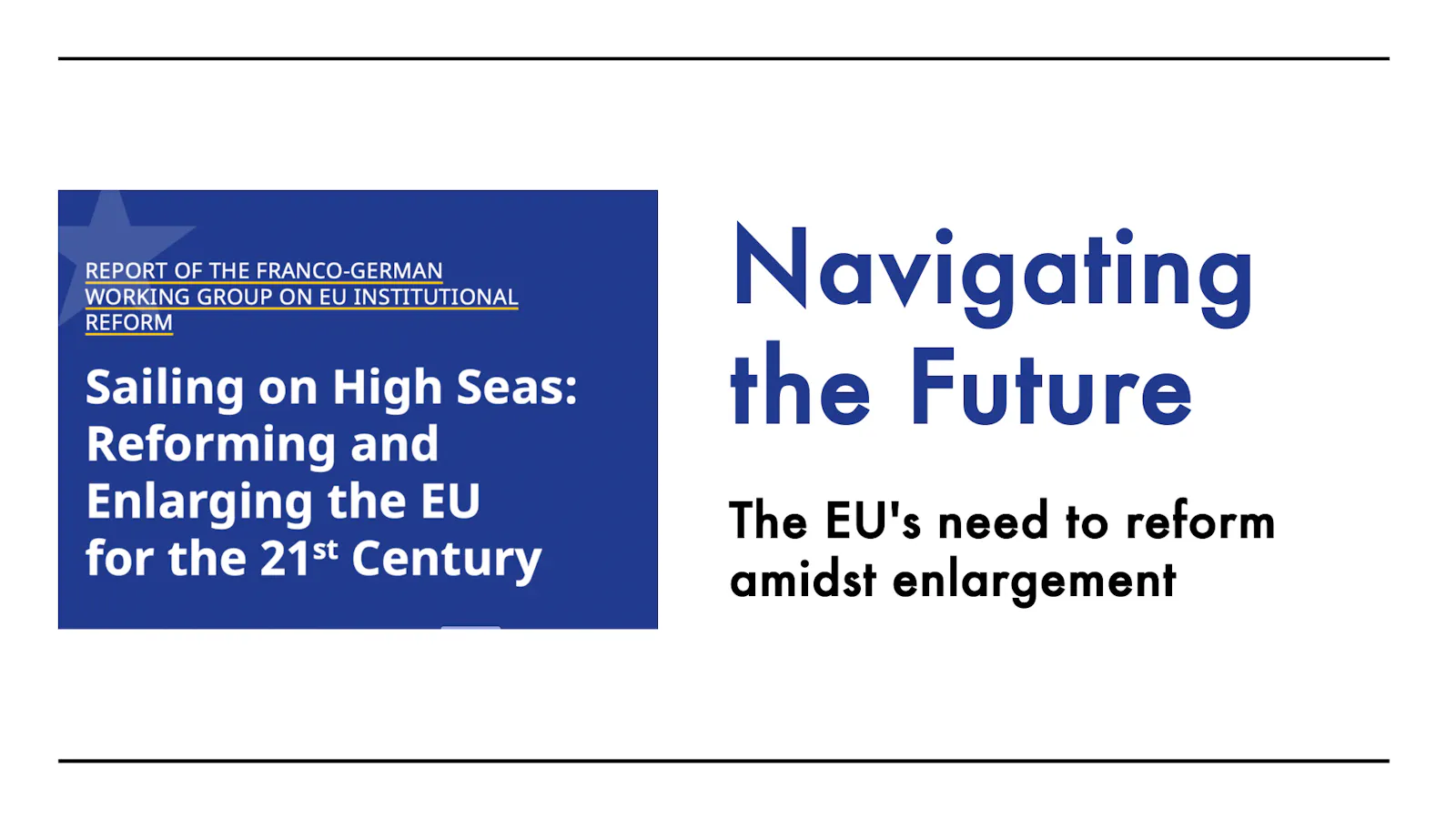
Acknowledging the gravity of the situation, a 'working group on EU institutional reforms' was convened by the French and German governments. It comprised twelve high-level experts, including Olivier Costa, Daniela Schwarzer, Pervenche Berès, Gilles Gressani, Gaëlle Marti, Franz Mayer, Thu Nguyen, Nicolai von Ondarza, Sophia Russack, Funda Tekin, Shahin Vallée, and Christine Verger. The group dedicated several months to deliberate on the multifaceted challenges facing the EU. In September 2023, they presented their collective insights in a thought-provoking report that serves as a compass for navigating the complexities of EU reform: Sailing on High Seas: Reforming and Enlarging the EU for the 21st Century.
The fundamental assumption of the report aligns with the group's mandate: EU enlargement must be accompanied by concrete legislative, institutional and decision-making reforms that enhance efficiency, capacity to act, democratic legitimacy, and the rule of law. The imperative for concrete steps before or during new members' accession is emphasised, setting the stage for a long and complex process.
The report's recommendations are aimed at achieving a triangle of three core aims: (1) strengthening the rule of law and democratic legitimacy, (2) increasing the capacity to act, and (3) getting the institutions enlargement ready It suggests that the reform task at hand does not lend itself for ad hoc solutions. However, the EU should learn from the multiple crises it has mastered in past decades, to move towards effective measures.
Protecting the rule of law
The report underlines the non-negotiable nature of the rule of law as a constitutional principle and a prerequisite for the EU's proper functioning. In this context, several recommendations are made to fortify the EU's ability to protect and strengthen the rule of law. These include strengthening budgetary conditionality to sanction breaches of the rule of law and, more generally, systematic breaches of the European values enshrined in the Treaty. The recommendations include refining Article 7 TEU procedure – concerning the suspension of certain rights from a member state.
Addressing institutional challenges
In their report, the twelve experts address five areas of institutional reform. They have been selected due to their significance and feasibility, while acknowledging that there are many other relevant fields for debate and reforms. Each of which is crucial to achieve the above mentioned three goals for reform.
European Parliament and Council Reform: The report advocates for maintaining the current number of the European Parliament, modifying the 'trio' system for rotating presidencies, and exploring options for the Commission's College structure.
Decision-making processes: A comprehensive reform of the decision-making processes within the Council is recommended. This entails a shift from unanimity to qualified majority voting, accompanied by full co-decision with the European Parliament to ensure adequate democratic legitimacy. Mechanisms such as a 'sovereignty safety net,' a rebalance of voting shares, and an opt-out mechanism aim to enhance acceptability.
Democratic legitimacy: The report emphasises the significance of democratic legitimacy in EU decision-making and proposes four sets of measures to bolster it. These include harmonising electoral laws across Member States, refining the 'lead candidate' procedure for the appointment of the Commission President, closer ties between existing participatory instruments and EU decision-making, and establishing an independent office for probity, transparency, and anti-corruption measures.
Powers and competences: Recommendations include clarifying EU competences, strengthening provisions for addressing unforeseen developments, and better involving the European Parliament. The creation of a 'Joint Chamber of the Highest Courts and Tribunals of the EU' is proposed to enhance judicial dialogue without binding decisions.
Policy and funding reforms: To address the challenges of reforming EU policies and distribution of funding in the context of enlargement, the report recommends increasing the EU budget in size and relation to GDP. This includes creating new own resources, moving towards qualified majority voting for spending, and enabling common EU debt issuance in the future.
Deepening and widening the EU
The last set of recommendations by the experts are about how to manage the progress and balance the needs to both deepen and widen the EU. Besides six options for Treaty change, emphasising the need for flexibility and considering a supplementary treaty among willing Member States in the absence of unanimity, it proposes a differentiation mechanism.
Recognising the diverse preferences of Member States, the report proposes differentiation under specific conditions, avoiding exemptions from core EU values. It suggests four tiers of European integration, involving deep integration in areas like the Eurozone and Schengen agreement, the EU itself, a larger circle of Associate Members participating in the single market and adhering to common principles, and finally, the European Political Community as an outer tier for political cooperation without being bound to EU law.
Furthermore, a structured approach involving negotiation clusters is recommended, with a target for both the EU and candidate countries to be ready for enlargement by 2030. The report calls for breaking down accession rounds into smaller groups of countries ('regatta rounds') to ensure a merit-based approach and to manage potential conflicts. It highlights nine principles for future enlargement strategies that all aim to make the process more effective, credible, and politically guided. Five principles concern the qualification for accession: ‘fundamentals first’, geopolitical, conflict resolution, additional technical and financial support, and democratic legitimacy. Four principles concern a dynamic of the accession procedure: equality, systematisation, reversibility, and qualified majority voting.
Conclusion
As the EU stands at a critical juncture, the comprehensive reforms outlined in the report present a roadmap to fortify the EU's functionality, democratic legitimacy, and readiness for the inclusion of new member states. The multifaceted nature of these reforms reflects the complexity of aligning diverse Member States' visions for the EU. In the face of geopolitical challenges and the imperative for EU enlargement, the timely implementation of these recommendations is essential to navigate the complex future that lies ahead. The proactive and sustained effort required to realise these reforms will not only fortify the EU for the challenges of tomorrow but will also reaffirm its commitment to democratic values and shared prosperity.
The open question up for debate is what these proposals would mean for the current member states, different types of regions, and for cohesion in general.
By Kai Böhme
Date
25/11/2023
Sujet
Resilience & transition
0 commentaire
Vous voulez être le·la premier·ère à écrire un commentaire ?
Devenez membre de spatialforesight et lancez la conversation.