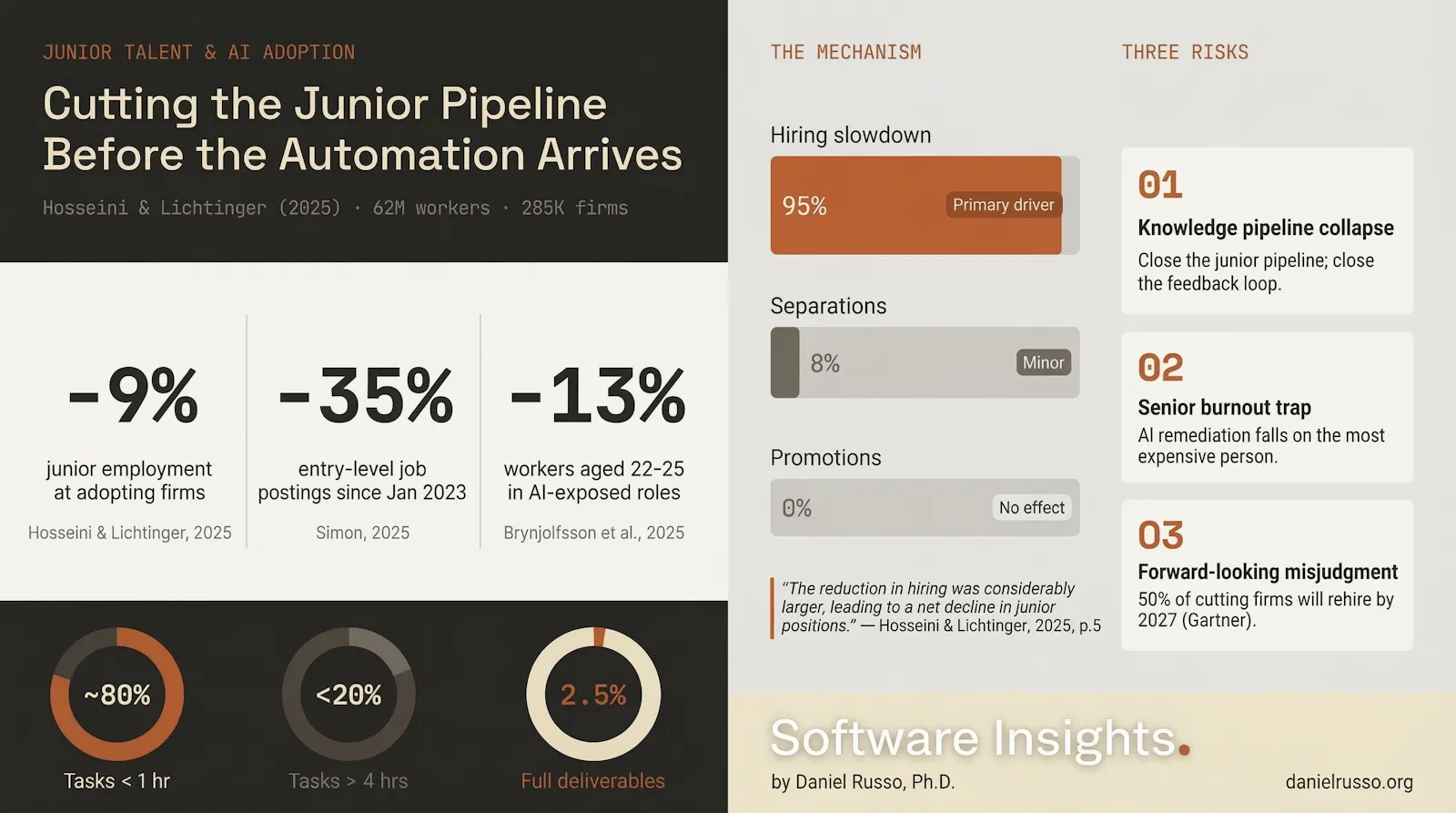
The numbers from Harvard are unambiguous: junior employment at GenAI-adopting firms fell roughly 9 percent relative to comparable non-adopters in less than two years (Hosseini & Lichtinger, 2025). The mechanism behind that decline is slower hiring, not displaced roles or accelerated departures. Firms are pre-emptively sealing the junior pipeline in anticipation of automation capabilities they do not yet possess.
That timing matters for every engineering leader making workforce decisions right now. Firms are acting on expectations about the future state of AI. The organizational costs of that bet are accumulating quietly, in the form of knowledge pipelines that are narrowing, senior cognitive loads that are climbing, and a talent architecture that may fracture before the anticipated automation arrives.
Software engineering is a socio-technical system. Technical capability without the human architecture to govern, contextualize, and correct AI output does not produce efficiency. It produces invisible debt.
What the data actually shows
Hosseini and Lichtinger (2025), working from résumé and job-posting data assembled by Revelio Labs, built one of the most comprehensive firm-level datasets yet applied to this question: 284,974 U.S. firms, 156 million employment spells covering roughly 62 million unique workers, and 198 million job postings spanning 2015 through early 2025. They identified GenAI-adopting firms by detecting postings that explicitly recruited "GenAI integrator" roles, positions dedicated to implementing or operating GenAI technology in the firm's workflow. By that criterion, 10,599 firms had adopted GenAI by March 2025. Those firms represent only 3.7 percent of the sample by count, but account for 17.3 percent of total employment, reflecting the concentration of adoption among large, technology-intensive organizations.
Prior to late 2022, adopting and non-adopting firms tracked each other closely on junior employment. The divergence began in 2023 Q1, shortly after the release of ChatGPT. Using a difference-in-differences (DiD) design that controls for time-invariant firm characteristics and aggregate period shocks, the study found that junior employment in adopting firms fell approximately 9 percent relative to non-adopters after six quarters. Senior employment showed no comparable break in trend; adopting firms continued expanding their senior headcount more aggressively than non-adopters throughout the sample. A more demanding triple-difference specification, comparing junior versus senior employment changes within the same firm and period relative to non-adopters, produced a roughly 10 percent decline in the junior share after six quarters (Hosseini & Lichtinger, 2025).
These findings are associational rather than strictly causal. The parallel pre-trends from 2015 to 2022 reduce the plausibility of simple confounding explanations, and the staggered event-study design, which traces employment dynamics around each firm's individual adoption date, shows no divergence in the eight quarters before adoption. The post-adoption decline emerges approximately two quarters after the first GenAI integrator posting and reaches an 8 percent reduction after eight quarters. Unobserved firm characteristics correlated with both adoption and junior employment decisions cannot be ruled out entirely, and the analysis covers a short window during which longer-run adjustments in training, task design, and internal career structures remain unknown.
What the study establishes with considerably more confidence is the mechanism.
"We find that the decline in junior employment at adopting firms is driven primarily by a substantial reduction in hiring. Separation rates for juniors in adopting firms also decreased relative to non-adopters, but the reduction in hiring was considerably larger, leading to a net decline in junior positions. Promotion rates, by contrast, remained broadly stable after early 2023."
(Hosseini & Lichtinger, 2025, p. 5)
Relative to non-adopters, GenAI-adopting firms hired on average five fewer junior workers per quarter after 2023 Q1. The pipeline is not draining through attrition; it is being sealed at the top through deliberate hiring decisions.
The decline is concentrated in roles with high GenAI exposure, as measured by Eloundou et al. (2024). Junior employment in low-exposure occupations at adopting firms showed no significant change, indicating the contraction is targeted at the roles GenAI is most expected to eventually automate rather than representing a broad headcount correction. A further heterogeneity finding sharpens the picture: juniors from mid-tier universities, specifically tiers 2 and 3 in the study's five-level prestige classification, experienced the steepest relative employment declines. Graduates from the most elite institutions and from the least selective schools saw smaller reductions. The group most associated with the "interchangeable knowledge worker" profile is bearing the largest adjustment.
Convergent evidence from adjacent work reinforces the pattern. Brynjolfsson et al. (2025a), analyzing U.S. payroll data, found that employment of workers aged 22-25 in the most AI-exposed occupations fell approximately 13 percent relative to trend since late 2022, while more experienced workers in those occupations saw stable or rising employment. Simon (2025) documented that entry-level job postings declined more than 35 percent since January 2023, with a 10-point increase in GenAI exposure predicting an 11 percent decline in entry-level demand and a 7 percent rise in senior-role demand. At the September 2025 FOMC press conference, Federal Reserve Chair Powell observed: "You are seeing some effects... A particular focus on young people coming out of college" (Federal Reserve Board, 2025).
Why this is not just a labor market story
These findings would be consequential as labor economics. They become urgent when read as an organizational engineering problem. Three risks compound each other in ways that quarterly Profit & Loss (P&L) reports are structurally unsuited to detect.
Risk 1: The knowledge pipeline collapse
Junior roles in engineering organizations serve a function that productivity metrics do not capture directly. They are the mechanism through which tacit architectural knowledge transfers across generations of practitioners. Junior engineers ask the questions that senior engineers stopped asking years ago, the questions that force implicit assumptions into the open. They surface inconsistencies in legacy systems precisely because they have not yet absorbed the organizational habits that make those inconsistencies invisible.
When the pipeline closes, that function closes with it. Argyris (1982) identified the failure mode that follows as a breakdown of double-loop learning: organizations whose governing assumptions are never surfaced or interrogated because no one in the system is positioned to ask why the system works the way it does. In AI-augmented engineering contexts, that failure compounds. Governing assumptions are increasingly embedded in generated code and automated workflows. Without a junior-level presence to interrogate them, those assumptions enter production as invisible architectural debt, visible only when the system breaks in ways no one on the remaining team can explain.
Risk 2: The senior burnout trap
The implicit calculus behind junior hiring reductions holds that a senior engineer paired with GenAI can absorb the work formerly distributed across a junior-to-senior ratio. The Remote Labor Index puts a precise number on why this calculus fails: AI achieves 70 to 80 percent success rates on tasks humans complete in under one hour, but the success rate drops below 20 percent for tasks requiring more than four hours of human-equivalent labor. The professional-standard automation rate for complete deliverables is 2.5 percent (Center for AI Safety & Scale AI, 2025).
The gap between what AI completes reliably at the sprint level and what it delivers at the project level is the work that falls to the most expensive human resource in the system. Without junior engineers to absorb the tractable, high-volume portions of the workload, senior engineers carry both the complex problem-solving that has always been their domain and the AI remediation work that juniors once handled. That reallocation does not appear on quarterly productivity dashboards. It surfaces six to eighteen months later as unexplained senior attrition, declining architectural quality, or the quiet decision by experienced engineers to leave for organizations where their time is used at its full value. Research on psychological capital establishes that self-efficacy, the psychological anchor of sustained high performance, erodes specifically when professional identity is subsumed by remediation work (Luthans & Youssef, 2004). The burnout is slow, cumulative, and organizationally invisible until it becomes a retention crisis.
Risk 3: The forward-looking misjudgment
Hosseini and Lichtinger (2025) are explicit about the interpretive boundary of their findings. The speed of the junior employment decline, beginning just two quarters after GenAI adoption, is too abrupt to reflect actual task automation, which typically materializes gradually. The most plausible explanation is that firms are making forward-looking adjustments, scaling back junior hiring for roles they predict will be automated in the near future, treating reduced hiring now as less costly than layoffs later. The authors formalize this mechanism: expectations of future labor-saving productivity gains depress current hiring through what they model as a "firing wedge," raising the effective marginal cost of employing workers who may later need to be separated.
If those expectations prove accurate, the current junior hiring contraction may ultimately be economically rational at the firm level. If those expectations are wrong, and the Remote Labor Index strongly suggests current GenAI capabilities fall well short of professional-standard project completion, the damage is not symmetrical. Gartner predicts that 50 percent of companies that reduced headcount in the name of AI will be forced to rehire by 2027, often under different titles, to recover lost service quality and institutional expertise (Gartner, 2026). Klarna's experience illustrates the asymmetry: premature replacement of human staff with AI systems led to service quality decline and customer revolt, requiring a strategic reversal more expensive and disruptive than the original reduction (Forrester, 2026). The savings from closing the junior pipeline are front-loaded; the costs are back-loaded and compounded by a talent market that does not quickly regenerate the mid-career engineers that junior programs were producing.
A 30-minute junior pipeline audit
The following eight questions are designed for engineering leaders who want to assess their organization's current exposure to the risks identified above. Each question is tied to a specific failure mode identified in the research.
1. What percentage of your current engineering headcount sits at the junior or entry level, and how has that figure changed in the two years since your organization began adopting GenAI tools?
2. When did a junior engineer last participate meaningfully in a live architectural conversation with a senior: not an AI-assisted review, but a genuine dialogue about design decisions and their rationale?
3. What fraction of your AI-generated output requires remediation before it meets production standards, and who is performing that remediation work?
4. If your three most senior engineers left tomorrow, which architectural decisions and design rationale could you reconstruct from your codebase, your documentation, and the people who remain?
5. What is your current onboarding time for a new hire to reach independent productivity, and has that figure changed since you reduced junior hiring?
6. Do your AI-efficiency metrics capture cycle time at the task level, or total team cognitive load across a sprint or quarter?
7. Do you have a documented process for surfacing and interrogating assumptions embedded in AI-generated code before it enters production?
8. Have you stress-tested your "senior plus AI" productivity model against what current GenAI systems can deliver on projects longer than four hours, rather than against vendor capability claims?
Next moves
For the Builder
Begin externalizing the tacit knowledge you carry. The architectural rationale, the constraint history, the decisions that were almost made differently: none of that exists in your codebase. Write it down in decision records, record technical walkthroughs, or teach it directly to others. The medium matters less than the act of getting it out of your memory and into a form that survives your departure.
Track your own AI remediation load. For one sprint, log the hours you spend fixing generated output versus hours spent on work that stretches your capabilities. If remediation is consuming more than a quarter of your cycle, that figure belongs in your next conversation with your manager.
When your team plans work, advocate for junior involvement in AI-augmented workflows rather than routing all junior touchpoints to the AI. The engineering learning that prepares someone for a senior role happens in interaction with the work and with senior practitioners, not in reviewing generated output.
For the Manager
Maintain the junior pipeline infrastructure even when full-time headcount is frozen. Structured apprenticeship tracks, rotation programs, and internship pipelines preserve the knowledge transfer function under headcount constraints, at a fraction of the cost of rebuilding from scratch in 2027.
Build a senior burnout signal dashboard before you need one. Track proxy indicators: pull request turnaround times, the ratio of architectural work to remediation work in senior engineers' weekly activity, and whether senior engineers are spending time in the quadrant their skills justify. Treat rising signals as early warning rather than confirmation of a crisis that has already arrived.
Establish explicit knowledge capture rituals. Architecture decision records, post-mortems that document not just what failed but why the system was designed to enable that failure, and recorded technical onboarding sessions are the organizational immune system against the knowledge pipeline collapse described in Risk 1.
For the Roadmap Owner
Add junior pipeline health to your technical debt accounting. A codebase accrues debt when engineering practices degrade; an engineering organization accrues equivalent structural debt when the talent pipeline that renews its capability is closed. Neither shows up on a quarterly P&L until the reckoning arrives, and both are substantially cheaper to prevent than to remediate.
Require that AI productivity claims used in workforce planning be benchmarked against the Remote Labor Index rather than vendor pilot results. An AI system that succeeds on 80 percent of sub-one-hour tasks and 2.5 percent of full-project deliverables is a useful assistant. It is not a replacement for a junior engineer who is three years from being a senior one.
Build now for the Gartner 2027 scenario. The organizations that maintained their junior talent pipelines through 2023-2027 will access a recovering talent market from a position of capability. The organizations that closed those pipelines will compete for a smaller pool of mid-career engineers at a premium, from a position of institutional knowledge deficit.
The Harvard study establishes something the current industry narrative has obscured: the junior employment decline in GenAI-adopting firms is a deliberate hiring choice, made in response to expectations about future automation rather than evidence of automation already occurring. The organizational consequences of that choice are already accumulating in the form of narrowing knowledge pipelines, rising senior cognitive load, and structural fragility that will not appear on quarterly reports until 2027. Whether those consequences become a crisis depends less on where AI capabilities land than on whether leaders treat them as a risk to be managed now or a problem to be solved later, when Gartner predicts half the firms that made the same bet will be rebuilding what they chose to eliminate.
Which description fits your organization?
About the author
Daniel Russo, Ph.D., is a Professor of Software Engineering whose research examines the intersection of human cognition and artificial intelligence. Through "Software Insights," he translates empirical research into actionable guidance for software practitioners and organizations.
Partner with Daniel to transform your organization through evidence-based approaches that bridge academic rigor with practical implementation. His consulting work helps organizations to adopt scientifically validated practices that improve software development outcomes, team performance, and innovation capacity.
Learn more about his approach to evidence-based organizational change: https://www.danielrusso.org/evidence-based-organizational-change/ (Öffnet in neuem Fenster)
References
Argyris, C. (1982). The executive mind and double-loop learning. Organizational Dynamics, 11(2), 5-22.
Brynjolfsson, E., Chandar, B., & Chen, R. (2025a). Canaries in the coal mine? Six facts about the recent employment effects of artificial intelligence. Working paper.
Center for AI Safety & Scale AI. (2025). Remote Labor Index (RLI): Measuring AI automation of remote work.
Eloundou, T., Manning, S., Mishkin, P., & Rock, D. (2024). GPTs are GPTs: Labor market impact potential of LLMs. Science, 384(6702), 1306-1308.
Federal Reserve Board. (2025). Transcript of Chair Powell's press conference, September 2025. Federal Open Market Committee Press Conference Transcript.
Forrester. (2026). Predictions 2026: Artificial Intelligence.
Gartner. (2026). Predicts half of companies that cut customer service staff due to AI will rehire by 2027. Gartner Research.
Hosseini, S. M., & Lichtinger, G. (2025). Generative AI as seniority-biased technological change: Evidence from U.S. resume and job posting data. SSRN Working Paper.
Luthans, F., & Youssef, C. M. (2004). Human, social, and now positive psychological capital management. Organizational Dynamics, 33(2), 143-160.
Simon, L. K. (2025). Is AI responsible for the rise in entry-level unemployment? Revelio Labs, Macro Section.
Datum
24.03.2026


