March 2026
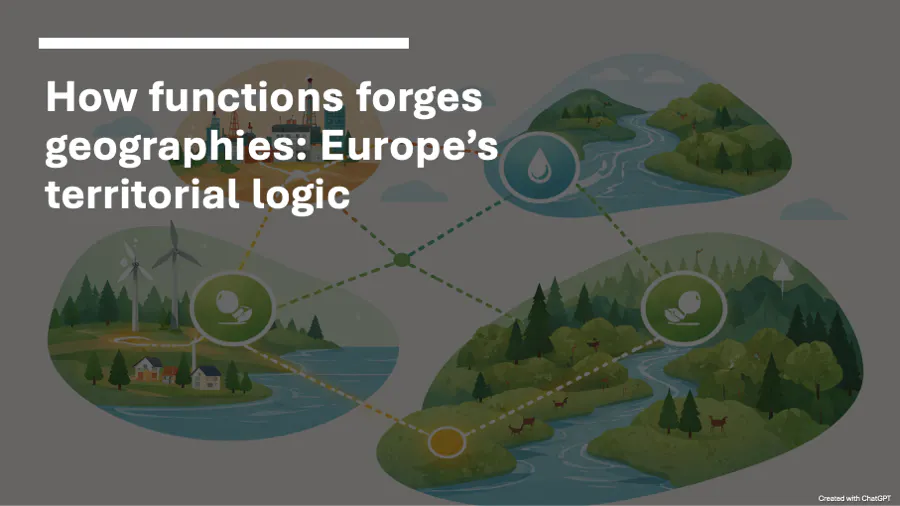
Europe’s territorial map is changing, not through redrawn borders, but through shifting functions. The ESPON NoStaGeo project (Öffnet in neuem Fenster) encourages us to look beyond administrative units and classical Functional Urban Areas. Many of today's structural transitions, such as climate adaptation, industrial decarbonisation, biodiversity protection and energy reconfiguration, are organised through spatial logics that do not neatly align with municipal, regional or national boundaries.
The result is an increasingly non-standard functional geography of Europe: territories defined by interdependencies, flows and shared risks rather than commuting patterns or political borders.
This is not new, and the shift is not merely analytical. It challenges how territorial policy is designed, funded and governed.
Traditional spatial policy treats territories as containers, e.g. administrative regions within which issues are addressed and budgets allocated. Functional thinking reverses that logic. It starts with the process – e.g. water flows, energy systems, industrial value chains and ecological networks – and then asks: in which geography does this function operate?
The mismatch between administrative containers and functional geographies is becoming increasingly visible across several domains.
Water: catchments over boundaries
Climate stress has exposed the limitations of water governance that is bound by administrative borders. For example, metropolitan regions depend on water abstraction and watershed management that extends far into rural areas. Droughts and flood risks do not recognise regional boundaries. Hydrological systems bind upstream and downstream territories into shared risk structures.
These catchment-based functional areas often cross regional and national borders. However, funding, planning and accountability remain territorially segmented. The result is a governance paradox: ecological interdependence without fully aligned institutional authority.
If investment decisions continue to follow administrative logic while risks follow hydrological logic, adaptation efforts will be fragmented and duplicated.
Industrial transition: ecosystems over clusters
The green and digital transitions are reshaping Europe’s industrial geography. In most cases clusters are anchored in a single region, but evolving into broader ecosystems that span multiple territories. Renewable energy supply chains, battery value chains, and decarbonised steel systems rarely remain within one planning unit.
These functional industrial territories may connect specialised regions across borders, linking research capacity in one region, manufacturing in another and logistics corridors elsewhere.
However, funding, state aid frameworks, and industrial policy instruments are still largely dealt with on a territorial basis. This raises the challenging question of whether policy should follow the scale of industrial ecosystems rather than regions. And if so, how should benefits and responsibilities be distributed?
While functional industrial geographies promise efficiency gains, they may also intensify territorial asymmetries if leading nodes consolidate advantages.
Ecological connectivity: corridors over containers
Biodiversity and climate resilience are increasingly dependent on ecological connectivity. Protected areas alone are insufficient when ecosystems remain fragmented. Species migration corridors, river basins, and green infrastructure networks cut across land uses and jurisdictions.
In this context, functional geographies are not optional constructs. They reflect ecological necessities. However, governance remains divided by sector. For instance, environmental protection, spatial planning, agriculture and forestry often operate with separate mandates and incentives.
The challenge lies not only in spatial coordination, but also in institutional integration. Without this, ecological corridors may be mapped but not effectively governed.
Energy systems: networks over borders
The energy transition adds another functional layer. Decentralised energy communities, district heating systems and smart grids operate across neighbourhoods or clusters of municipalities. The way energy is consumed is shaped by the built environment, the way settlements are formed and socio-economic conditions – not administrative borders.
The territory in which an energy system operates may follow infrastructure loops rather than political borders. Aligning local initiatives with national regulatory frameworks requires governance arrangements that can bridge different levels.
This introduces a further tension, i.e. how to enable functional experimentation with new energy solutions without undermining regulatory coherence or fiscal stability.
Governance tensions
Across these examples, a pattern emerges: the governance tension. Europe’s structural transitions are producing overlapping functional geographies. For example, a single municipality may belong to a hydrological basin, an industrial ecosystem, and an ecological corridor simultaneously.
This complicates territorial governance in three ways.
Functional areas rarely have democratic legitimacy in their own right. They are analytical constructs, not elected jurisdictions. While acting at a functional scale can improve effectiveness, it can also create accountability gaps if decisions bypass established democratic structures.
Functions overlap. Water, energy, biodiversity and industrial systems intersect spatially, but not necessarily institutionally. When objectives conflict, which functional geography takes precedence? The scale of energy infrastructure may not align with ecological priorities.
Funding logic becomes contested. Cohesion policy, for example, is based on redistributive transfers between recognised territorial units. If resources increasingly follow functional ecosystems, how can we ensure fairness and transparency? Will funding shift from regions to networks?
Functional alignment could improve efficiency. However, it may also generate new territorial tensions.
A functional turn with caution
The emerging functional logic does not render administrative regions obsolete. Regions remain crucial for representation, accountability, and fiscal governance. However, ignoring functional geographies can result in policies being designed at the wrong scale.
The real challenge is not to replace territorial governance with technocratic functionalism. Rather, it is about developing institutional capacity to recognise when functions require coordination beyond administrative borders; and when they do not.
This implies:
Flexible governance arrangements layered onto existing institutions.
Cross-border and cross-sector cooperation mechanisms.
Funding models that can support ecosystem-level initiatives without undermining territorial cohesion principles.
Clear accountability frameworks are needed to prevent functional governance from becoming opaque or exclusionary.
Europe may be entering a functional phase of spatial thinking. The question is whether policy can adapt without eroding democratic legitimacy or exacerbating territorial inequalities.
Ultimately, territorial cohesion in an era of transition may depend less on redistributing resources between fixed regions, and more on aligning governance with the spatial logic of the systems that sustain them.
However, this alignment is not neutral. It reshapes power, resource flows, and institutional authority.
The emerging geography of Europe is forged by functions. The political task is to decide how, and by whom, it is governed.
If you want to dive deeper into the findings of the ESPON NoStaGeo project (Öffnet in neuem Fenster):
Trends and Drivers of Change Infographics (Öffnet in neuem Fenster)
European Territorial Governance Dashboard (Öffnet in neuem Fenster)
 (Öffnet in neuem Fenster)
Datum
24.03.2026
Kategorie
Territories
0 Kommentare
Möchtest du den ersten Kommentar schreiben?
Werde Mitglied von spatialforesight und starte die Unterhaltung.