What I have learned in the past two years and a half, being a caregiver for a person with a neurodegenerative disease and what I have yet to learn.
But first, I know what you are thinking
Not another newsletter on minority languages!
I may have been guilty of thinking the same thing way too many times.
Why does this guy has to share his own thoughts, too?
Does he really think he is THAT special?
What do I care about Lombard and Piedmontese, I don’t even know or want to know more about these languages!
Well, I may have something to add to this whole thing, too
Just follow a couple of my posts and you may change your mind. If not, thank you for reading and following me to this point.
So, as I was saying, learning a minority language is carework.
For sure, there is a direct comparison: you learn a language that is endangered due to language policies which have shifted speakers’ attitudes towards it. By learning it, you show other people that you care about the language itself and that it is worthy to be read, written and spoken again.
There is also something exquisitely patient about learning a language that lacks an “official” grammar, dictionary or even written standard. Whoever is learning a standardised and/or protected language won’t know this feeling (lucky them!) but at the same time it gives the neo-speaker much more freedom of choice, but also freedom of making mistakes and improving constantly along the way.
You have to be patient for sure within this unregulated framework resulting from the non-protected status of too many regional languages in Italy.
There is also a side of caregiving that other people do not see
The constant trial-and-error, the fear of making mistakes, the despair, the feeling that you are not going anywhere and that you are not doing enough, as if saving (the memory of) these languages it is your sole responsibility.
When it came to my caregiving experience, it was about making my own research, see what and if my dad was eating, how I could help him lift him up, how I could help him getting out of the shower without hurting him, what light was better for him to at least enjoy a bit of TV, how he was feeling around certain healthcare professionals, as by the time he could not voice his thoughts that much anymore. It also took a good amount of encouragement to cheer him up, distract him and enjoy the company of his wife and son who were there for him everyday. It is not much to feel cheerful about when your body becomes a cage but I hope that it gave him a glimpse of joy (if not hope) in these past years.
There is a perk that language learning has got and caregiving for a patient with a neurodegenerative disease hasn’t:
you will eventually improve your language skills, one step at a time, and your language will have a new energy boots, small or big, because of you.
This is not a luxury that caregivers are blessed with
In the time I have spent taking care of my father I lost count of those people who were asking me if he was “doing better”. I don’t know if this is due to our tendency to seek improvement in anything but I realised that it is very hard to conceive the fact that someone may lose all his abilities that make them an independent individual. Slowly, but steadily, one by one, day after day.
Luckily, language learning is nothing of that sort, no matter how much time you can actually dedicate to it.
So what’s left after this half-depressing realisation?
Learning a minoritised language is itself a methodology and a practice. It requires patience. It requires deconstructing all your previous ideas on languages and negotiating everything you knew already about the language you are learning. Maybe, after all, there is a certain smell of freedom when it comes to learn an “unregulated” language that helps me to feel compelled about going on this path day after day.
Moreover, in the same way I had to accept that the person I was taking care of, whom I saw wither and starve day after day on a hospital bed, at the same time was and was not my father (anymore), one must accept that the language we are learning it is and it is not, at the same time, the same language our family speaks or once spoke.
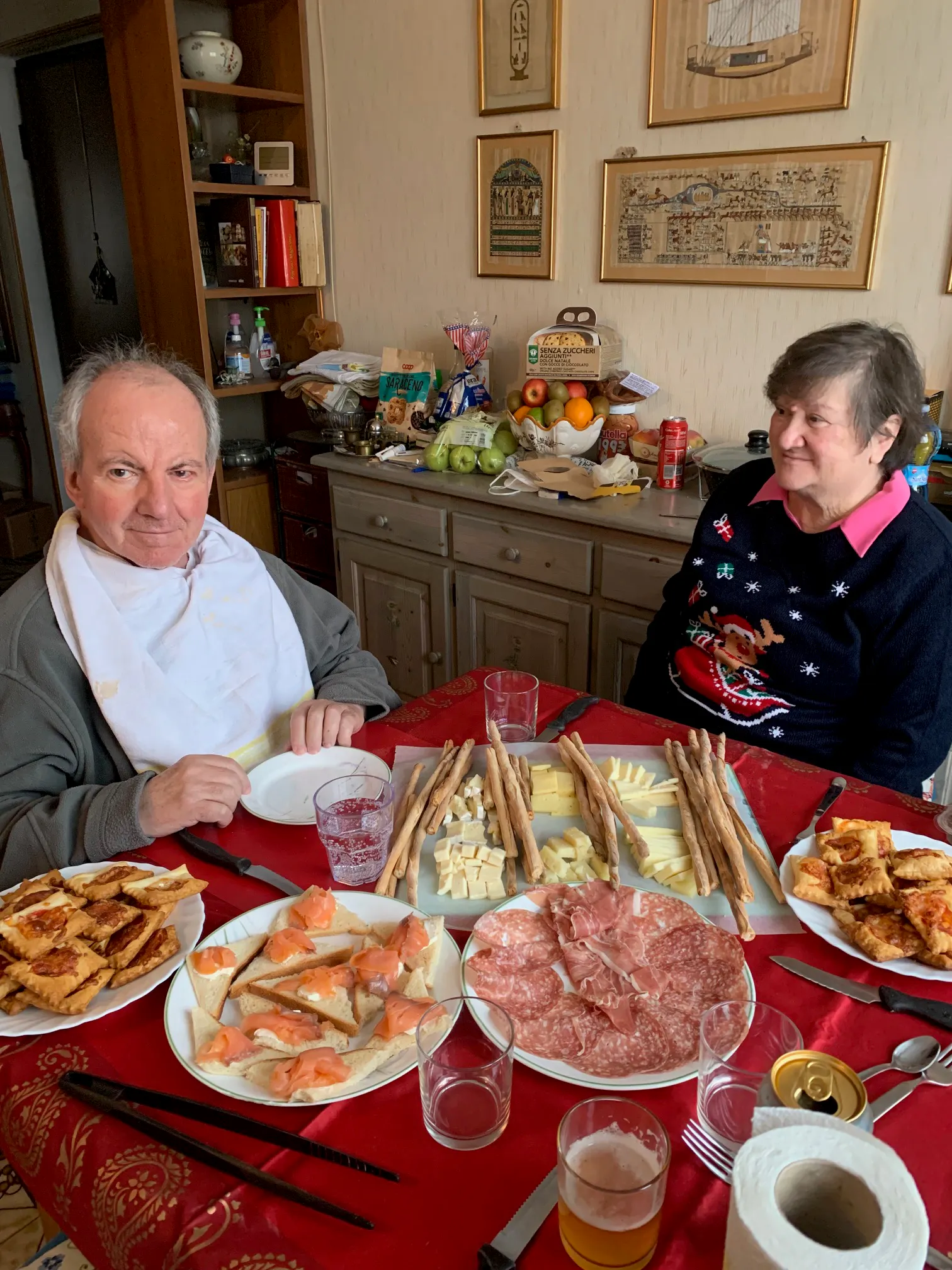
Eventually, as I watched and held my father’s hand at the hospital for 21 nights, I knew that learning the language he grew up with, Piedmontese, which was not any of his family languages, meant something else altogether. It meant to reconnect myself to long-gone memories.
Memories of us two speaking in a similar but also different accents.
Memories of him teaching me about language diversity in Italy. Memories of him teaching me sentences and a bit of Piedmontese grammar.
Memories of him waving me arvëdse.
Now that it has almost been two months since he passed
I can see for myself why I bother to learn these two languages (Lombard and Piedmontese). Even though I am not proficient in any of them (and probably I never will). Even though I am not much knowledgeable on all their dialects and peculiarities. Even though I may have not (yet) found a welcoming space to practice them.
I keep doing this because there is something inexplicable about seeking comfort in our own roots and history.
I keep doing this because, by doing so, my dad is alive and healthy everytime I read something in the language he learned playing with his friends on the streets of Susa.
I ët veuj bin, papà
Some vocabulary related to this post
PMS : Piedmontese
LMO: Lombard
To learn = amprende /amˈprɛnde/ PMS
imprender /im'pre(:)ŋda/ LMO
Language = lenga /ˈlɛŋga/ PMS
lengua /ˈleŋgwa/ LMO
Disease = mòrb /mɔrb/ PMS
malatia /malaˈtia/ LMO
Father = pare /ˈpare/ PMS
pader /'padar/ LMO
To care = amporté /ampurˈte/, but also
sté a cheur /'ste a kør/ PMS
infà /iŋ'fa/ , but also
stà a coeur /'ʃta a køːr/ LMO
To take care = soagné /suˈaɲe/, but also
ansossiesse /aŋsuˈsjese/ PMS
stà adree /'ʃta adreː/ , but also
incuràss /iŋky'ras/ LMO
To teach = mostré /musˈtre/ PMS
insegnà /iŋseˈɲa/ LMO
Memory = arcòrd /arˈkɔrd/ PMS
regord /reˈgɔrd/ LMO
Datum
23.03.2026


