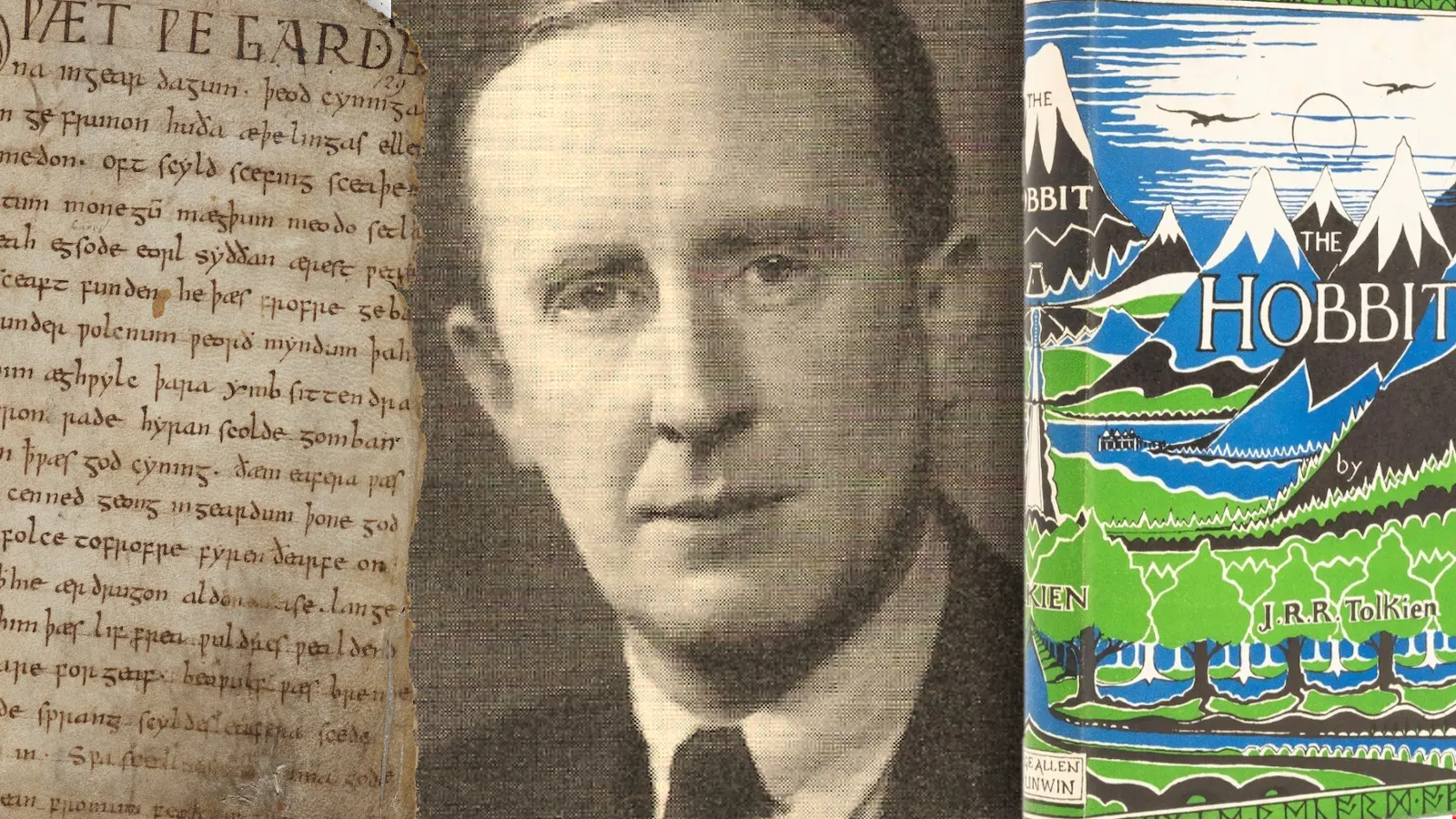
On this day in 1936, Tolkien received a financial boost for his academic research that also, indirectly, seems to have helped him in his work on Middle-earth. We have long known about the Leverhulme Fellowship he was awarded that year, but not the announcement date. It gives me this opportunity to thank my marvellous crowdfunding supporters for the financial boost they’ve just given me – and to set the next stage.
On 7 June, I broke the news that I’m starting a pioneering Oxford DPhil on The Lord of the Rings. But there’s no bursary or grant. In just over three weeks (when I was busily blogging, emailing, and posting on social media), subscriptions to my crowdfunder more than doubled. By 1 July, 30 new supporters had joined and 7 existing supporters had switched to a higher plan. Thanks to this, and stalwart support from 35 others, I can now afford to begin the DPhil project.
This is the first step, not the last. I still need time to do the research, free from the need to earn as a freelance. So my new goal is to crowdfund three months of doctoral research – half what I’ve undertaken to do over the next year as a part-time DPhil candidate. After hitting the first target, and with 11 more supporters joining since then, I now believe we can achieve the new goal before I begin in October.
Tolkien’s case shows how valuable such help can be. But in his case, the chief beneficiary turned out to be literature rather than academic scholarship.
In June and July 1936, Tolkien was buried in marking exams. Besides Oxford, he did this for the universities of London, Manchester and Reading, and for the School Certificate. To meet the cost of a growing family, he’d been busy as an outside examiner in this way since 1922.
He wrote of this period:
‘I have spent nearly all the vacation-times of seventeen years examining, and doing things of that sort, driven by immediate financial necessity (mainly medical and educational). Writing stories in prose or verse has been stolen, often guiltily, from time already mortgaged, and has been broken and ineffective.’
The work was also wretchedly dull – though that had at least one major payoff, when he doodled the random line ‘In a hole in the ground lived a hobbit’ in his tedium. If it hadn’t been for that, most of us would never have heard of him and the world would be poorer.
But relief was on its way.
Industrialist and philanthropist Lord Leverhulme had died in 1925 leaving part of his legacy to scholarships for research. In May 1933, his trustees announced they would annually be handing out £12,000 in research fellowships.
In July they announced 17, followed by 2 more in December. Among the 12 new fellowships for the sciences and humanities in 1934 were historiographer A.J. Toynbee, paleoanthropologist Louis Leakey (the prehistory of East Africa), and Basil Liddell-Hart, military critic for the Telegraph (the viability, or otherwise, of an international peace-keeping force).
Among the 20 fellowships awarded in 1935 was Tolkien’s Oxford English Faculty colleague, Percy Simpson, for his longstanding edition of Ben Jonson’s works.[1] (Opens in a new window)
The Oxford University Gazette relayed the next call for applications in its 29 January 1936 issue, warning that they must be sent to the Leverhulme Trust by 1 March.
Fellowships were earmarked ‘for the assistance of experienced workers’, because other financial help already existed for early-stage researchers. The trustees would give preferential consideration ‘to subjects in which the existing provision is inadequate’ and particularly to ‘men and women who are prevented either by pressure of routine duties any other cause from undertaking, or completing, an investigation of value.’
This was exactly Tolkien’s predicament. As it happened, he suddenly had plenty of time to think about applying and, indeed, to see how free time might help him.
 (Opens in a new window)
At the end of January, he had torn a ligament in his leg while playing squash. He was now in bed under doctor’s orders for at least ten weeks. Though he offered classes at home to replace his lectures, he could not attend the many university and faculty meetings that usually filled so much of his day.
By June he was back on his feet – and back to marking exams. The renewed drudgery would not be over until about the end of July. But by then the good news of the Leverhulme Research Fellowship must have made the annual ordeal much more bearable. He was one of ten successful applicants announced on 10 July 1936 – putting him among the first 49 of all the fellowships to date.
As reported in The Times, the Times Educational Supplement and elsewhere, the award was for work on ‘Old and Middle English with special reference to western alliterative tradition’.[2] (Opens in a new window)
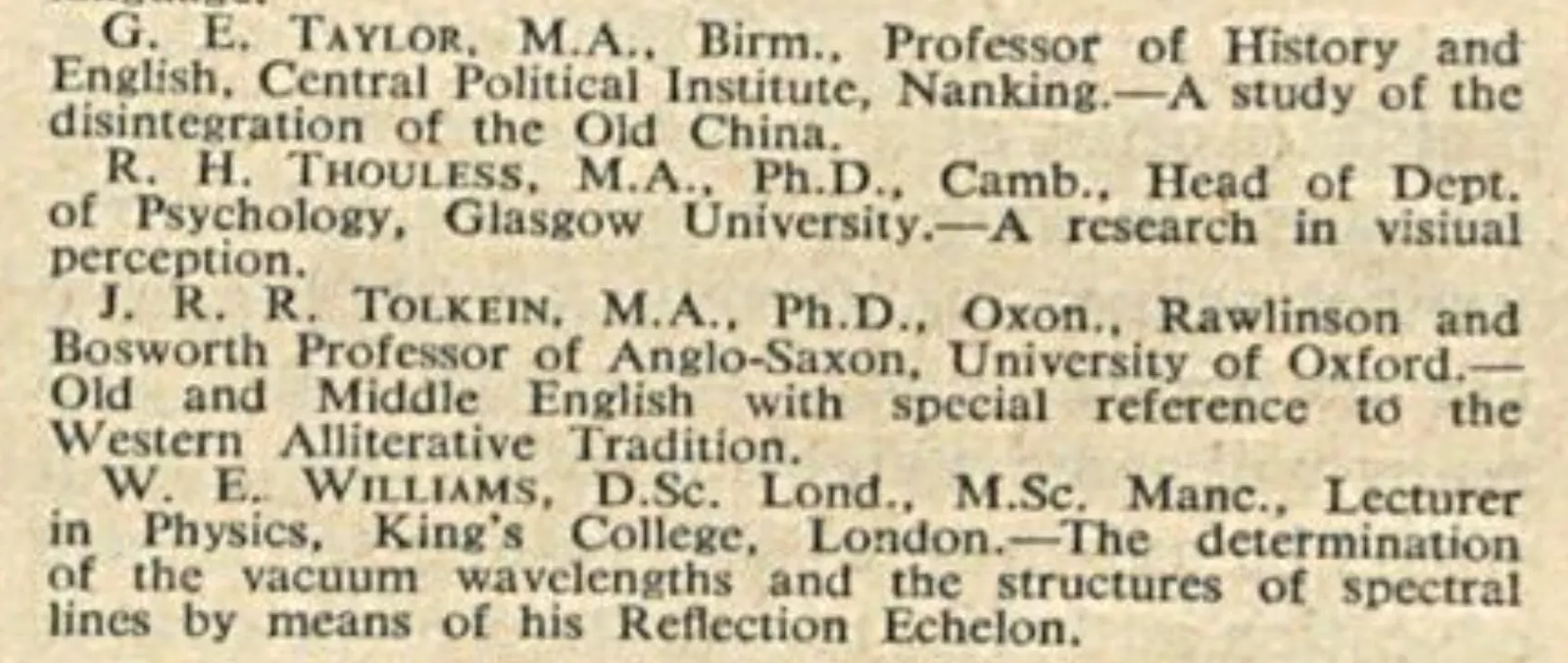
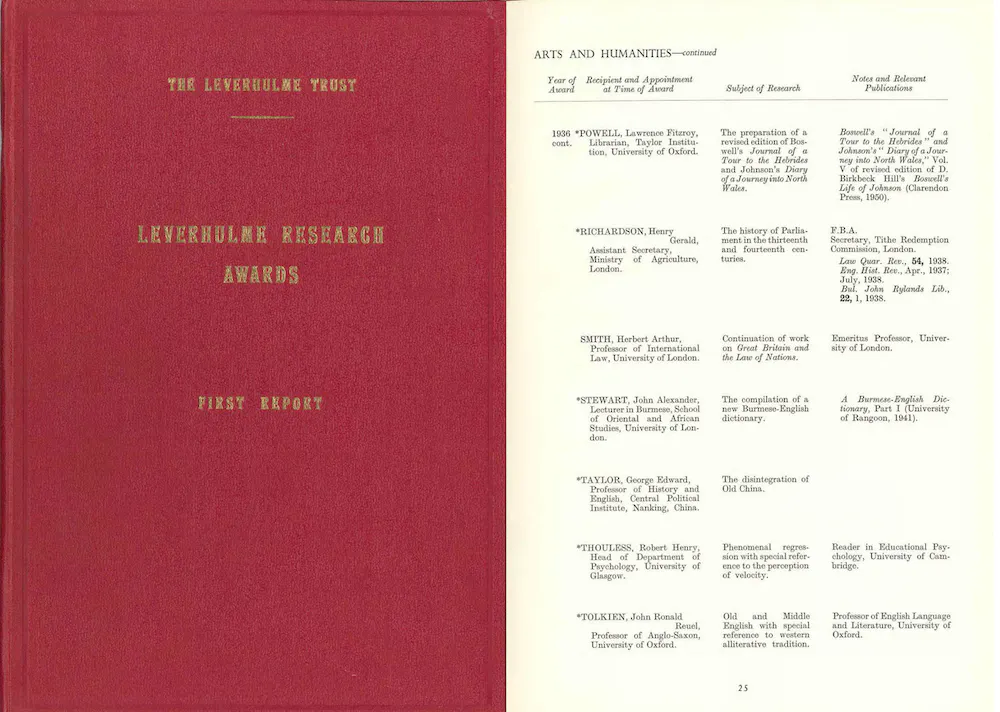
The amount of each grant was meant to match the circumstances; they would not usually be given for more than two years.
Enquiries with the Leverhulme Trust reveal that Tolkien’s fellowship was worth £400, spread over two years. (I asked if relevant correspondence still existed, but was told, ‘There isn’t a great deal of information for our grants going that far back. Many of the earlier records were lost as a result of the bombing of London.’)
A substantial figure, £200 in 1936 had the same buying power as £19,000 today. Presumably this was how far his £1,000-a-year Oxford University salary fell short of his needs.
The salary – his stipend as Rawlinson & Bosworth Professor of Anglo-Saxon – had stood still ever since he was appointed in 1925. But it looks as if Tolkien had made a two-pronged attack on the financial problem, appealing to the university authorities even while he applied for a Leverhulme Fellowship. The university increased his salary to £1,200 from 1 October 1936, alongside a few other select cases.[3] (Opens in a new window)
 (Opens in a new window)
The numbers, however impressive, look dry. And it’s often been asked what exactly Tolkien achieved with his Leverhulme Fellowship money.
On paper, the award would seem to have come too late to assist with preparation of his game-changing November 1936 lecture ‘Beowulf: The Monsters and the Critics’. He still had to complete any exam marking commitments for that summer. The fellowship didn’t kick in until October and term-time. Even so Tolkien, surveying the time ahead, could now justifiably postpone some other summer or autumn tasks until the Christmas vacation. At any rate, he managed to transform his undergraduate Beowulf lecture series into one lecture fit for the British Academy.
Yet by the time the fellowship expired in summer 1938, he had published no further academic research of his own. And beyond that, he only published sporadic articles and an unadorned text of the Ancrene Wisse. Perfectionism was to blame, but so also were illness, split commitments and, I suspect, procrastination. But the large body of his academic papers at the Bodleian Library includes some intensely worked projects. I wouldn’t be surprised if some of this material dates from the Leverhulme Fellowship period.
Tolkien himself was painfully conscious of his lack of Leverhulme output and what colleagues would think. On the other hand, he admitted privately that his creative projects might benefit from the absence of exam-marking. He told Charles Furth of George Allen & Unwin:
‘I am at present endeavouring to earn a grant for “research”, in addition to my ordinary duties, but I may find some odd moments in the near future, especially as I am freed from the burden of examining for two years.’[4] (Opens in a new window)
Who can say how many ‘odd moments’ this freedom afforded him?
In summer 1936 Allen & Unwin were already ‘clamouring’ for The Hobbit, which had come to their attention recently. He had retyped it by the end of the Long Vacation and made further revisions later that year. Just after the British Academy lecture, he signed the Hobbit contract and then sent his publisher a publicity paragraph. I guess this is what he sent to his friend R.W. Chambers on 8 February 1927 with the comment, ‘The enclosed does not announce Leverhulme firstfruits – I wrote this ridiculous story some years ago.’[5] (Opens in a new window) Preparing The Hobbit for publication involved not only checking proofs but also providing illustrations inside and on the cover – which also carried the publicity paragraph as the book’s ‘blurb’.
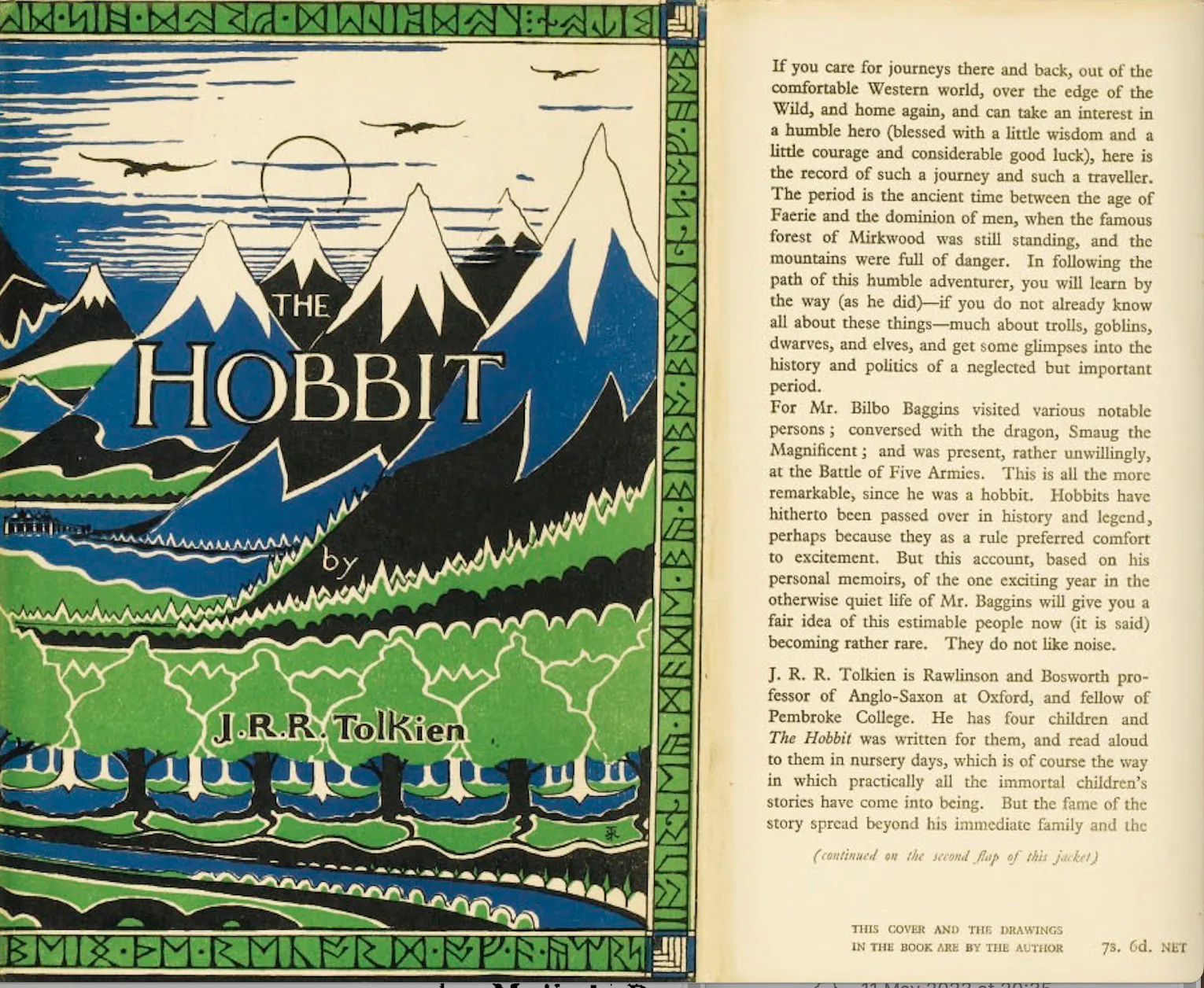
As I’ve pointed out elsewhere, one of Tolkien’s later letters states clearly that the Númenor stories ‘came out of the “blurb”’ for The Hobbit – which means they could have begun occupying him during the Christmas vacation. By autumn 1937, he had written and rewritten The Fall of Númenor as well as four chapters of his time-travel companion story The Lost Road. He was also at work on his Etymologies and Quenta Silmarillion, his Alphabet of Fëanor and perhaps more.
But this is not the place for detailed evidences for this kind of chronology. The most prominent landmarks of this Leverhulme Fellowship period are, of course, the publication of The Hobbit in September 1937 and the plunge into The Lord of the Rings that December. Would he ever have made that start if exam-marking had swallowed up the Christmas vacation of 1937–8 as usual? It seems doubtful.
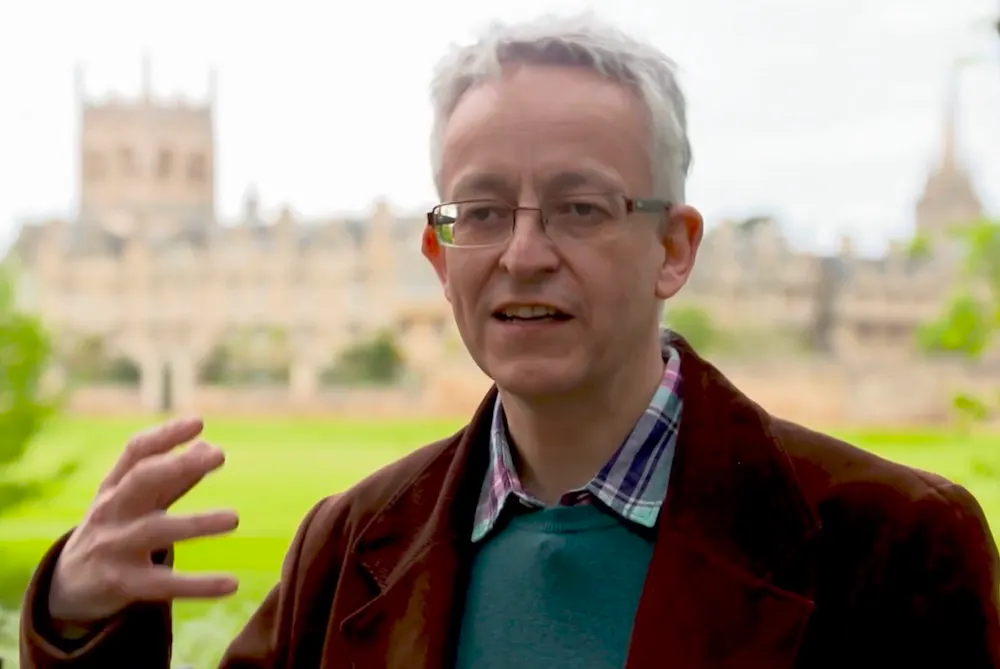
I don’t have a private mythology bursting to escape into the wider world. Instead I have years of research, expertise and insight about Tolkien. That’s why I’m doing my DPhil on how the wars and crises of his times influenced The Lord of the Rings. And in the absence of official funding, that’s why I’m crowdfunding.
I’d like to welcome and thank all my new supporters here – in chronological order:
John Farrell, Carol Zaleski, D. Scott Fortner, Matthew Thompson-Handell, Oleh Feschowetz, Cindi Szymanski, Alistair Stewart, Paul Friend, Daniela Friedewald, David Charlton, DMae Binnkley, Charles Beckmann, Clive Shergold, Pekka Rautajoki, Alina Żochowska, Larry Street, Michael Nardini, Lucy Greenwood, Helaine Katz, Ian Hargrove, Ralph Sidway, Tammy Schlemmer, Bea Davies, Lukas and May Ritzel, Juan, Vincent Bryson, Adam Schwarz, Amy Pass, Mark Middendorf, Carole Keene, Katherine Ponganis, Luanne V, Emma Davies Day, and Malcolm Baalman.
I’d also like to thank existing members who’ve boosted their subscriptions to help with the DPhil:
Marilyn Pukkila, David Doughan, Bruce Leonard, Edmund Weiner, Jennifer Morris, Troels Forchhammer, Peter Rubinstein, and Alison Mable.
And I thank all the others giving me their stalwart support here:
Shaun Verrinder, Paul Taylor, James Moffett, Holly Ordway, Cathy Koenig, Todd Mayo, Giuseppe Pezzini, Christopher Sparrow, Lynn Schlesinger, Philip Burton, Patrick Curry, Annika Röttinger and Tobias M. Eckrich, Shawn Marchese, Sean Lucas, Alison Mable, John Cofield, Nancy Raines, Juli Thompson, Peggy Layne, Alan Baxter, Rob Pinkerton, Alan Sisto, Kate Neville, Trevor Brierly, Anette Lauen Borg, Andrew Wells, Chiara Siasat, Christopher Gilson, Ed Pierce, Bonnie Marques, Lukas Bajgar, Mi Ann Bennett , Ibid 11962, and Nirnaeth Galwe.
With more support like this, the new crowdfunding target is surely within reach. Every new or increased subscription will help. Please take a moment to look at the plans and rewards.
 (Opens in a new window)
[1] (Opens in a new window) Strictly as an in-joke, Tolkien would mock Percy Simpson in a parodic 1938 exam for C.S. Lewis and Owen Barfield. Question 1 requires comment on the line, ‘It is no good setting them that. They would know it.’ Simpson had once said this to Lewis, who had written to his brother about it: ‘Percy Tweedlepippin is my colleague and his principles as an examiner are perhaps worth recording. In answer to a suggested question of mine he retorted “Its no good setting that. They’d know that!” (C.S. Lewis to W.H. Lewis, 14 June 1932, and endnote 74, Collected Letters, Vol. 2.)
[2] (Opens in a new window) ‘The Leverhulme Fellowships: Awards for Research’, The Times, 10 July 1936, 8; Leverhulme Trust to John Garth, 11 February 2016; Leverhulme Trust, Leverhulme Research Awards: First Report (London: Office of the Advisory Committee, 1957), 25.
[3] (Opens in a new window) Oxford University Gazette 21 October 1936, 29.
[4] (Opens in a new window) Letters, no. 10, 17 January 1937.
[5] (Opens in a new window) Caroline Chabot, ‘Raymond Wilson Chambers’, Moreana no. 94 (June 1987), 87–8.
© John Garth, 2026. All rights reserved.
Date
July 10, 2026
Topic
Biography
2 comments
Would you like to see the comments?
Become a member of John Garth on Tolkien’s life and works to join the discussion.