I had originally planned to review Elegy’s version-4 playtest this month, with a play report out today for my subscribers and a review next week for the public. Alas, after a series of delays and iterations on the basic designs, that isn’t happening this month. Which is good! For Elegy, anyhow. It’s the point of a playtest!
I relate a lot to that this month, because I recently orchestrated the first playtest for my game, Faewander, and it was both well-received and a (good) catastrophe.
And as an aside — instead of the dark vampire tales I had planned, I am playing & reviewing Fox Curio’s Floating Bookshop next week. Stay tuned!
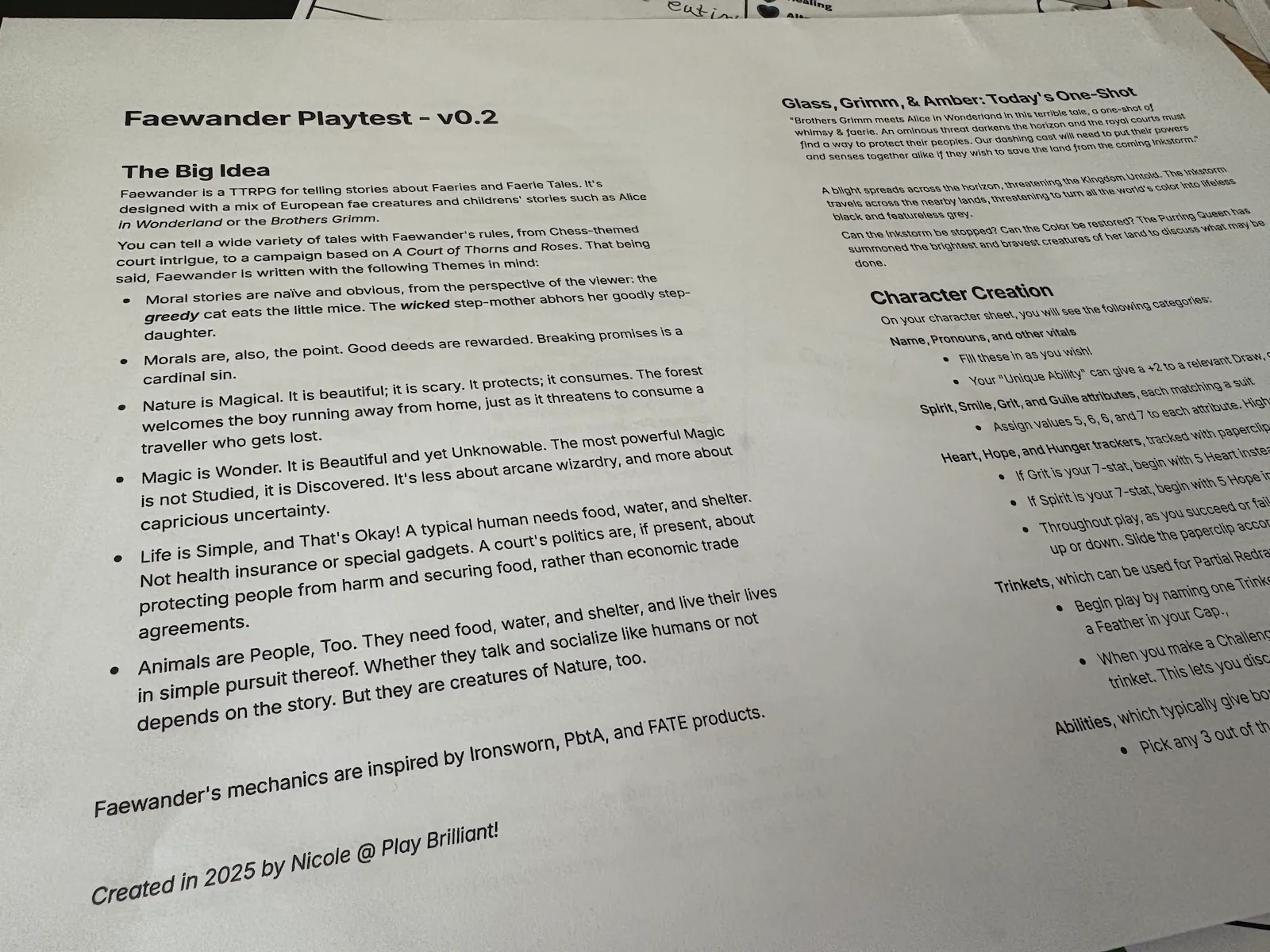
Faewander First Playtest
Last weekend I booked a table at the D&D Amsterdam (Opens in a new window) meetup and rolled a story with faerie-tale and faefolk themes, playtesting my game and showcasing my new dice-replacement primary resolution mechanic for the first time. The one-shot was admittedly mediocre, and the rules were in their infancy. And yet, the players loved it!
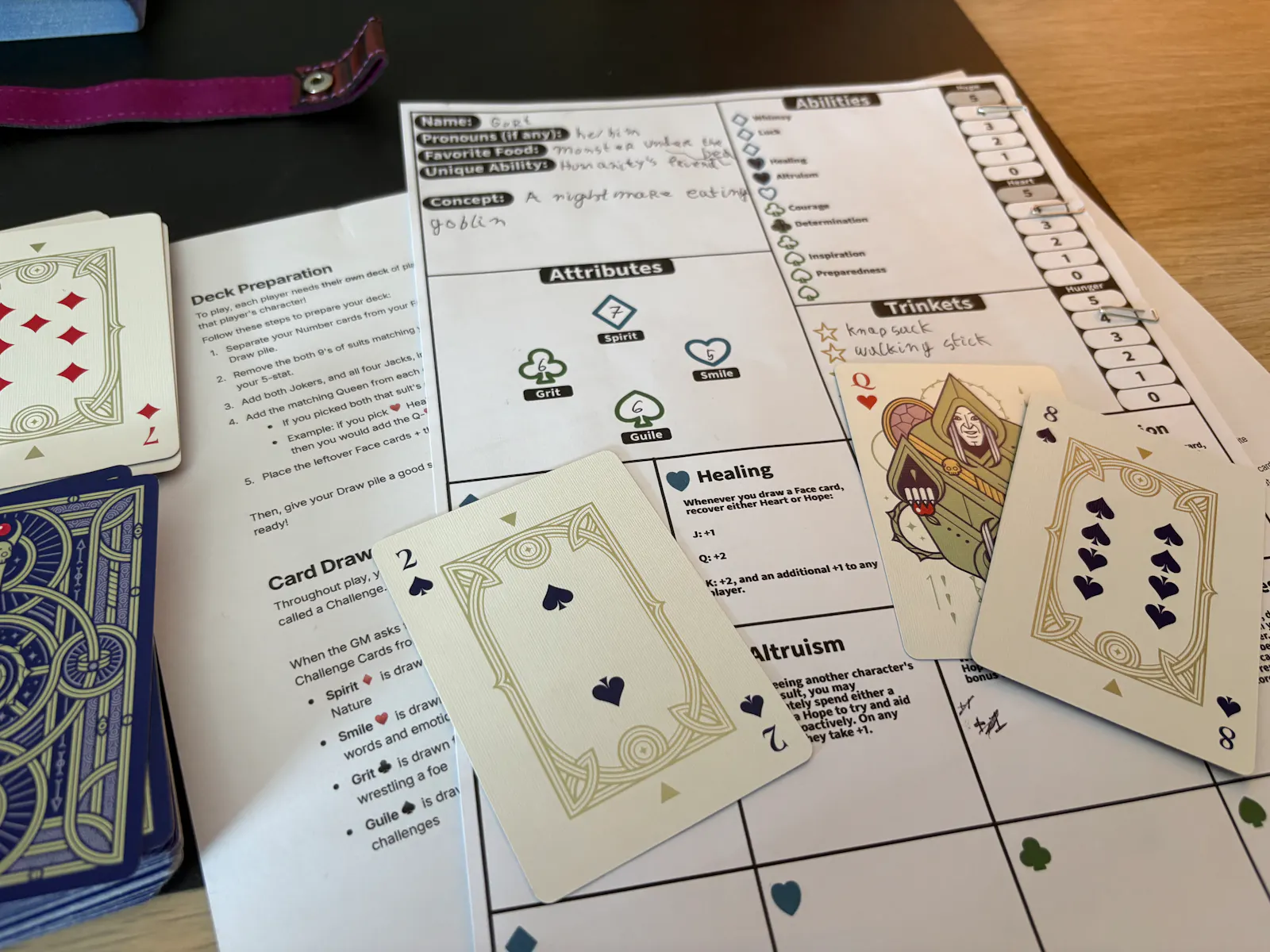
Everyone brought their own deck of speelkaarten, and as part of character creation at the table, each player added specific royals per their special abilities, and removed number-pips per their numeric attribute choices.
Inspired by the “roll-under” designs of Ironsworn and Elegy, players in the Faewander playtest would, when challenged (or in this case, asked by the GM), draw two cards and hope they came in lower-than the relevant stat. On at least one success, you Get What You Want, and on at least one failure, Something Bad Happens.
After the adventure, I spent a while collecting feedback, which the players were thrilled to do. That felt nice! It’s my first time running a complete experience for several hours for strangers I didn’t know for a game I made from scratch.
The feedback was great. And most of it is headed for the recycle bin.
Today, I want to talk about the feedback, how it relates to game design, what I want to deliver for Faewander, and what I learned and how I want to take it forward.
First, the good!
Across the whole table, these concepts were praised:
Cards are fun! There’s a great handfeel to them. Plus, the tangible benefit of being able to see your draws play out is really nice. It’s tangibly different than D&D, which the players were more familiar with.
When you “draw bad cards”, there’s a consolation feel-good knowledge of knowing that those cards are now out of the draw until the next shuffle. Baldur’s Gate 3 actually does something similar to this, but it’s hidden from the player. Basically, when you roll low, you’re less likely to keep rolling low. Same with rolling high.
Conversely, I gave players a partial choice of when-to-reshuffle. When the first Joker is drawn, the player is allowed to shuffle. If they’ve already drawn a lot of royals or low numbers (good cards), they have the choice then-and-there to put them back in the deck and reshuffle. This feels great.
Lastly, the game wasn’t too mechanics-heavy, which everyone seemed to enjoy. And by that, I mean character setup made sense, and during play, people didn’t have to pause and look through too many rules to interpret results.
The first three points felt awesome to hear because getting the core resolution mechanic to immediately “feel good” is important to any game. I tried running a new system for my weekend group a couple years ago, and after four sessions the group was still confused about how to make certain checks. For Faewander, people “got it” after the first example.
And the fourth point meant I was at least on the right track for keeping mental overhead low, for what I intended to be a solo-first narrative experience that you could also play with a group. In a solo game, it detracts from the game when you’re constantly flipping through a book or PDF to find a specific mechanic for every little thing.
Solo vs. Group Play
That praise is great and all, but designing a solo-first TTRPG has different requirements than designing for group play. It sounds obvious, and yet, this definitely caught me on a snag.
Ironsworn is written with Solo, Duet, and Group-play all in mind. Elegy is primarily intended to be a singleplayer experience; in fact, it’s widely regarded by fans as Vampire: the Masquerade for Solo Play.
I had wanted to make Faewander into a game like those two titles, where the rules provide a framework and the player wanders off to tell their own story about fair-folk. But, I realized there wasn’t going to be nearly enough identity on its own. Had I continued down that path, I would be selling a set of card mechanics and abilities, with a Build-Your-Own setting for a genre that isn’t mainstream-enough for BYO to really work.
Consider the following:
In Ironsworn, the default setting is a bleak, dark-fantasy setting of human villages, exploration in the hostile wilderness, and iron-sworn vows. Your encounters are typically hostile forces of nature, dark spirits, or other people. You can tweak the setting, but Ironsworn is designed around gritty fantasy, which the player is expected to have some ideas about.
In Elegy, the default setting is Some Urban City, year 2025 AD, where you play a vampire (with some World of Darkness inspiration). Most people have ideas about what vampires are and what they do, and in play, your typical encounters involve surviving urban life, dealing with mortals, and surviving politics with other vampires. You can tweak the setting, but Elegy is designed around urban fantasy, which the player is expected to have some ideas about.
In a faerie game, the default setting is Celtic Wilderness from 1200 years ago. If you’re a human, your experience is different than that of a faerie. But what is a faerie? What are the different types? What stories do they create? And most importantly: What does the player do?
I realize there are fairfolk enthusiasts who already know a thing or two about faerie mythology and could grab some cards and take off running, but to share the game with newcomers, I would need to devote a huge chapter of the book to just explaining what faeries are. That would be followed by a huge chapter about different types of faeries (there are lots). Followed by a huge chapter of example encounters. Just for the basic premise to make sense.
All of that is fine, but it’s outside the scope of what I’m looking for. I don’t want or need to create Changeling: the Lost. Besides, I’m looking to tell stories, not turn history into stat-blocks.
Which brings me to the most significant lesson from the playtest.
My game felt “too easy”, they said.
They weren’t wrong, either. The penalties for failure were too little, and in a group, there were too many options to help one-another achieve at least a basic success, via Trinkets (partial redraws) or Altruism (an ability that let a character spend resources to give someone +1). Proposed solutions included increasing failure penalties, decreasing player stats, making Trinkets personal-only, and reworking Altruism.
I follow Skeleton Code Machine (Opens in a new window), a game design blog by Exeunt Press that focuses on all types of tabletop games, whether they’re board-games or roleplaying games. On an essay about playtest questions (Opens in a new window), a user named Sean Smith added this golden tidbit (Opens in a new window):
[W]hen people say what's wrong about $THING, they're almost always correct; when they say how to fix it, they're almost always wrong.
Faewander was unbalanced because cooperation makes things easier than going-it alone. That part was undeniably true. But I think that’s a symptom of far more than just numeric balance. By focusing on making a game playable by both individuals and groups, it’s going to struggle to deliver the same stories for either.
Focusing on the Solo Experience
In June I wrote about Caught in the Rain (Opens in a new window), and while I haven’t written about Cartograph, the same studio made that game as well. For July, I’m working on Fox Curio’s Floating Bookshop, and I have several other singleplayer-RPG’s lined up as well.
Each of these games is unique in their own rights because they tell — or rather, enable the player to tell — a specific type of story.
Caught in the Rain guides the player through noir-mystery investigations, where you uncover clues through discrete scenes to solve a mystery. And, although you can use any generic scene-system like Mythic GME to tell a mystery, CITR’s mechanical focus gives a particularly valuable structure.
Cartograph explores an unknown fantastical land alongside the player, with a stated objective of creating a map of an entire region. Procedural land-creation in gaming has been around for well-over 50 years now, but the creators designed a system that feels more authentic and purposeful than any set of published formulas.
Fox Curio’s Floating Bookshop entertains with a casual, slow life of a bookseller, romanticizing an honest trade and captivating the player in a calm life where weather, creaky hinges, maintenance, and casual correspondence keep you busy and free.
Thousand Year Old Vampire, a staple in every soloist discussion (and many people’s first-ever solo RPG experiences), enraptures the player through guided prompts to endure risky survival, accrue skills and resources, and endure the heartbreaking trauma of watching the humans you know and love die around you — and then, in a viscerally literal sense, forgetting they ever existed.
Each of these guides a player through telling a story that is heartfelt, unique, and genuine. They don’t attempt to emulate fantasy combat simulation in any capacity (in fact, CITR is the only entry I list that even has combat rolls). Instead, they focus on a rhythm, a vibe, a set of inspirational ideas, and they craft a game experience around them. Three of the above titles have multiplayer rules, but they’re optional, bolted-on as advice for co-operative storytelling. By and large, they are primarily intended to be enjoyed solo.
A game designer can do a lot more with that design philosophy.
For Faewander, I was trying to balance Singleplayer vs. Multiplayer, but I believe that’s the wrong idea to go for entirely. The themes and identity will come through far better if there is more structure built around the solo adventurer, which is what I want for my players.
It’s frustrating, because it feels like a lot of design work is getting tossed. But it’s also exciting, because the playtest inspired me to turn it around completely.
July & August
Next week I will compose my play report and my review on Fox Curio, and after that, I will have the July minigame to publish. I also want to start writing about solo TTRPG’s at a faster pace (2x/month rather than 1x). I have several games queued in the play-list, but if you’ve got suggestions, come drop me a note! I’d love to hear your thoughts and ideas in the Play Brilliant Discord server (Opens in a new window).
If you aren’t subscribed, join today! And if you are — I’m glad you’re here 😎
Date
July 4, 2025
Topic
Blog


