December 2025
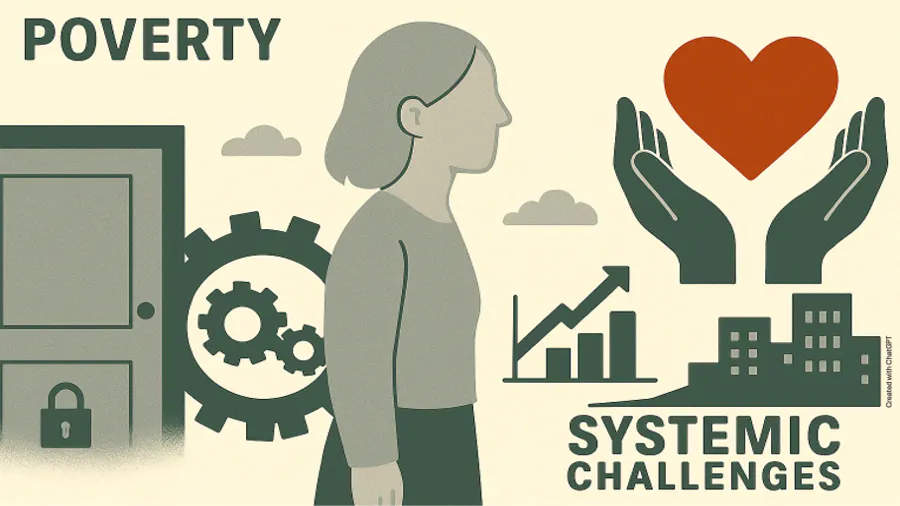
In 2020, Michael Sandel, in The Tyranny of Merit, stressed that the stories we tell about success and failure matter. For long, prosperity has been framed as the fair reward of talent and effort, while those left behind are too easily told it’s on them. Sandel’s twist was not a revolution so much, as a shift of attention from the individual to the systemic allocation of opportunity and reward.
On a similar note, it is easy to believe that poverty stems from personal failure: from not working hard enough or not saving enough. Yet poverty is far more than a lack of money in someone’s bank account. It is embedded in the system, be that of education, housing, taxation, labour, care, that shape who gets a fair chance. Read through that lens, poverty becomes a collective and structural condition, not always a personal flaw. A condition that reflects how society is organised and that can only be changed by rethinking the system itself.
A reality check in the EU: What evidence says about poverty today
Poverty does not have a single definition, but has many dimensions. At EU level, poverty is measured in ways that hint at its structural nature, i.e. not only as low income, but also as material and social deprivation and very low work intensity. The EU AROPE (at-risk-of-poverty and social exclusion) indicator defines being at risk of poverty by looking at the share of people with an equivalised disposable income below the at-risk-of-poverty threshold set at 60% of the national median equivalised disposable income after social transfers), people severely materially and socially deprived (i.e. people with enforced lack of essential and desirable items necessary for an adequate life) and people living in households with very low work intensity (where working age members of a household work 20% or less of their total work-time potential). Hence this indicator points to a crucial argument: poverty is not just about earnings, but also about what people can convert work, public services and social protection into a stable life.
Here is where an uncomfortable paradox appears. Europe is wealthy, yet poverty remains still widespread with over 90 million people remain at risk of poverty or social exclusion today, while inequality also remains significant in several EU member states. The recently published report of the Committee of the Regions Towards an EU anti-poverty strategy (Opens in a new window), highlights that in 2024, about 24% of children in the EU are at risk of poverty, 22% of women are at risk of poverty, and 6.4% of the EU population faces severe material and social deprivation.
What makes this numbers meaningful is the structural drivers that lie behind them. Unstable work conditions, precarious jobs, low wage growth relative to the high living costs, unequal access to services, such as limited availability of affordable housing, childcare and healthcare. To these, one should add digital exclusion, education and skills gaps, gender and family structures, migration and discrimination, rising rents, energy costs, inflation, homelessness and weak coordination policies exacerbate the situation. At the same time, several trends and developments, such as increasing wealth concentration, shrinking public resources, demographic trends, increased migration, intergenerational poverty necessitate urgent measures to expand social support.
This combination of factors also explains why poverty is not only a labout-market and income problem, but a wider challenge linked to the cost-of-living and public-services problem, making it eventually, an institutional one.
As poverty is unequally distributed across social groups, poverty is also unevenly distributed territorially, across EU member states and regions, with vulnerability taking different forms depending on the place. In fact, the Committee of the Regions Towards an EU anti-poverty strategy (Opens in a new window) report shows that poverty affects cities and rural areas almost equally on average, following the AROPE indicator. Looking at capital regions, the report identifies an important East-West EU distinction: people in capital regions in eastern EU member states are less likely to be at risk of poverty, compared to the western EU members where poverty hits more the capital regions than the national average. Regarding rural and peripheral regions, the challenges lies less in access to employment and more to proximity to essential services and services of general interest, like transport, healthcare, education, childcare, digital access.
The above boils down to the conclusion that although EU Cohesion Policy funding has helped reducing disparities, it has not managed to reverse them. Regional inequalities persist demonstrating disadvantages across population groups and types of territories.
The role of local and regional authorities: where policy meets people
The social fabric of the EU is woven in its regions, in its municipalities, communities, neighbourhoods, in places where policies meet daily life and inclusion takes shape. Poverty risk at regional level varies across EU members states and is highly uneven. About 40% of EU regions are above average when it comes to at risk of poverty and only three regions are below 10%. Despite this, the general government expenditure by EU member states to combat poverty has on average decreased. In addition, the share of expenditure to combat poverty covered by local and regional authorities tends to be slightly higher in those member states where the at risk of poverty of social inclusion rate, is higher.
Local and regional authorities play a central role in delivering essential services and coordinating support underscoring the need to recognising the importance of multi-level governance for putting policies to action. The report highlights several examples of regions that have implemented schemes to address challenges related to poverty. They cover different interventions targeting different groups and covering various dimensions of poverty. These regard for instance unemployment, social exclusion, homelessness, energy poverty, food poverty, all synthesising the complex picture of poverty. The interventions focus on building trust relationships and integrated services, offering social counselling and mentoring, supporting and coordinating job training, creating local jobs, developing housing projects, income support, energy, reducing food poverty through schemes by repurposing food surplus. However, they mainly help with soft measures, such as improving access, coordination and take-up of support through cooperation and ‘people-first’ approaches, trust building, awareness raising.
A Europe that chooses opportunities
The EU is already taking big leaps towards preventing poverty, instead of only managing it. A combination of legislation, soft policy instruments and financial support are already in place, while funding is also supporting initiatives to improve access to essential services, like healthcare, education and housing. But prevention can only become real when policies meet and connect across fields and levels of governance. At the same time, poverty has many dimensions and is very subjective towards places and places. It goes beyond jobs, income or welfare, but how all these interact and how policies actually shape opportunities. Thomas Piketty has for long argued that inequality is not an accident of the market, but a result of political and institutional choices and how they decide to tax, redistribute and invest. Ending poverty takes more than good intentions. It needs structure, coordination, the courage to change and adapt.
An EU anti-poverty strategy should insist on a holistic approach. It should call for a coordinated action across policy fields that creates the capabilities of people to live in dignity. Steps towards this include strengthening the minimum income to guarantee adequate living standards, ensuring fair and progressive taxation, accessible housing, affordable childcare, quality education, use EU funding strategically to support long-term investments.
A Social Europe is a Europe that creates opportunities. Poverty is not personal, but rather a structural challenge built into the ways societies have been organised. It is sustained in the systems we built in the past and inherit in the present – and can just as well be reversed by the ones we build for the future.
The full report Towards a new EU anti-poverty strategy is available here (Opens in a new window).
by Maria Toptsidou
 (Opens in a new window)
Date
December 11, 2025
Topic
Resilience & transition
0 comments
Would you like to be the first to write a comment?
Become a member of spatialforesight and start the conversation.