November 2022
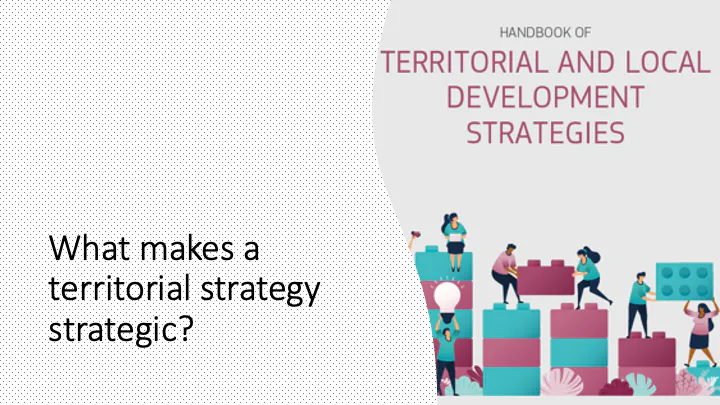
In November 2022, the Joint Research Centre of the European Commission published a handbook on territorial and local development strategies (Opens in a new window). The focus is on integrated and sustainable territorial development in the context of EU cohesion policy. This concerns e.g. strategies which are implemented through territorial tools such as Integrated Territorial Investments (ITI) or Community Led Local Development (CLLD).
Most parts of the handbook are also relevant for other types of territorial strategies. In particular the first two chapters are of a broader interest as they discuss what a makes a strategy strategic and how to define the territorial focus.
As for the strategic dimension, the handbook stresses among others the need for strategic capacities, policy innovation and the coordination of strategies. As for the territorial focus, the handbook emphasises the role of a functional area approach. A few reflections following the reading of the hand book:
What makes a strategy strategic?
The main characteristics of a strategic dimension are rather context dependent. However, in essence a strategy is considered strategic when it has a transformative character opening-up new pathways and is of societal relevance. This includes breaking or rather bridging silos of individual sectors, players and governance levels, and doing so with a clear future perspective allowing for adjusting to changing circumstances and learning. This sets the bar for a ‘strategic’ strategy rather high and requires that the stakeholder have ‘strategic capacities’, as it is called in the handbook.
What are strategic capacities?
Important characteristics of strategic capacities comprise the ability to integrate diverse thematic areas, to mobilise resources and people for a common course, and to navigate under uncertainty. Usually this also requires leadership capacities, willingness to change, and knowledge on the subject and the area addressed by a strategy. It may also concern the ability to punch above the own weight, and the formal decision-making competence in a field, incl. access to implementation tools and devices. In the best of all worlds, this will lead to policy innovations, rather business as usual strategies.
What is a policy innovation?
In many cases ’traditional’ approaches to policy making and policy processes struggle to identify new pathways or deliver transformations etc., which mark a strategic dimension. Therefore, innovations within a policy making process are important to help changing and improving. They allow to experiment with novel processes, tools or practices which can lead to better solutions to tackle complex territorial development issues. Given the complexity and multi-stakeholder dimension of territorial and local development strategies many policy innovations concern collaborative processes. They can also help to better link the ‘what’ and ‘how’ of a strategy, i.e. what the strategy is about, and how it is elaborated, implemented and revised.
What is coordination between strategies?
In most cases a place is not only subjective to one strategy, but there are several strategies with different geographies and different policy objectives. In the best case, regional and local strategies which affect the same territory can develop synergies and mutually reinforce each other. However, they can also counteract or hinder each other’s impacts, and thereby hamper local and regional development. To make best use of scare public resources – both administrative resources for the development and management of the strategies, and human and financial resources for implementation activities – and to maximise the effectiveness of the strategies, coordination is needed. Coordination can take different forms, depending on the geographical, institutional and governance context. It can range from an outspoken division of labour or demarcation concerning topics or geographies, which still does not fully avoid contradicting impacts on local development, to various forms of aligning objectives, implementation measures or governance processes.
What defines the territorial focus?
Finding the appropriate territorial focus for a strategy is essential. If the territorial focus does not match the strategic dimension, a successful implementation of the strategy is jeopardised. The definition of the territorial focus is the result of an iterative process between defining the objectives of the strategy, setting up the partnership and finding the appropriate delineation of the strategy. This involves also questions concerning the critical mass, i.e. how big or small the area covered should be to best address the objective of the strategy and how big or small should the partnership for the strategy. In most cases this leads to discussions about functional areas.
What makes a functional area?
In most cases, a functional area does not align with an administrative entity. In some cases, local authorities are too small to address challenges that are bigger than their administrative scope and capacities. In others cases, regions are too broad for the strategic issues to be addressed. This complexity is amplified by the large variety of administrative traditions in Europe, the size of local and intermediate authorities, and attitude to cooperate among them. The choice of the territorial focus and the definition of the appropriate strategy area are not trivial, having both a technical dimension (what data, what methods, what expertise, etc.) and a policy dimension (strategy objectives, interests at stake, cooperation mechanisms, etc.). This may sound as an extremely cumbersome extra burden to the development of a strategy. However, it is worthwhile the effort. An inappropriate territorial focus of a strategy can easily jeopardise the success of the strategy and thus make the entire effort of developing and implementing a strategy a waste of time and resources.
What is a functional area approach?
Functional areas address the co-existence of functional relationships, cooperation mechanisms for achieving joint objectives and governance systems. Functional areas can be delineated according to one or more defining criteria, e.g. social criteria, economic criteria, geographical criteria or heritage and landscape criteria. To a certain degree, territorial analysis can help to define a functional area, based on available data. In many cases already a rough analysis of relevant information available on the area can help. This is not at least, because the definition of a functional area is more than a technical exercise scrutinising data. In many cases, the tacit knowledge of the stakeholders of a strategy is essential. It allows to understand spatial interdependencies, local development needs and potential as well as on the prospects of smooth collaboration on a strategy beyond what is visible in the data.
These and many other questions concerning a strategy’s strategic dimension, territorial focus, governance arrangements, cross-sectoral integration, funding and monitoring are addressed in the handbook. Rather than providing blueprints or ‘to do lists’, the handbook explains the issues at stake and presents experience from a wide range of examples.
The handbook is available here (Opens in a new window).
by Kai Böhme
https://steadyhq.com/en/spatialforesight/posts/494b40c2-b209-4163-acfc-d7b4f3b2d5d0 (Opens in a new window)
Date
November 24, 2022
Topic
Territories
0 comments
Would you like to be the first to write a comment?
Become a member of spatialforesight and start the conversation.