November 2023
In Michael Sandel's thought-provoking book ‘The Tyranny of Merit’ (Sandel, 2020) a powerful idea is explored - the concept of the Tyranny of Merit. It sheds light on the negative consequences of a merit-driven economy and politics. The core message of this concept is that meritocracy, as it exists today, often marginalises certain social groups and ignores the systemic challenges they face. Sanders critiques meritocracy, particularly in relation to success: The idea of meritocracy often demoralises the less successful who have not managed to rise to the top, attributing this to personal failure rather than general structural problems, unlike the successful ones, who believe their success is primarily due to their own efforts, disregarding the systemic advantages that helped them.
In many foresight studies, the tyranny of merit is seen as a trend shaping future developments. This raises the question, what it means for spatial development in Europe.
This blog post delves into the tyranny of merit as a development trend, its various components, and its implications, highlighting the increasing income inequality, inequality of opportunity, and inequality in the labour market. We will also discuss the potential impact on land use and how it intersects with other trends and policies. This is based on a study currently conducted for Ministry of Interior and Kingdom Relations of The Netherlands (Opens in a new window).
To get a better grip on possible spatial implications, let´s focus on three elements of this trend and their possible implications for land use changes.
Trend Element 1: Income Inequality
Income inequality is a pressing issue on both a national and global scale. The merit-based system often perpetuates the economic divide. Social groups with better economic prospects, such as upper-middle- and higher-class families, continue to accumulate wealth while those from disadvantaged backgrounds struggle to make ends meet. This division can manifest territorially, creating pockets of poverty in specific regions or neighbourhoods.
As a result, individuals from poorer regions or countries might seek opportunities in wealthier regions, further exacerbating the demand for residential land in these areas. This migration can put additional pressure on housing markets, driving up prices and excluding disadvantaged social groups from accessing decent housing.
In places where this migration may not happen, one may observe the exacerbation of places that do no matter or are left behind, resulting in social unrest and dissatisfaction of certain social groups who may seek social recognition and representation by populistic parties and narratives.
Trend Element 2: Inequality of Opportunity
Inequality of opportunity has far-reaching consequences, affecting access to housing, social services, and overall life prospects. Basically, it can be assumed that the tyranny of merit increases the clustering tendencies of social groups with similar merits. As people of the same kind prefer to stick together in the same way as ‘birds of a feather flock together’. Besides the social consequences, this implies rising cost of housing in affluent regions which may prevent systematically disadvantaged groups from affording homes. Concentration of poverty in specific regions strains social security systems and public budgets.
Wealthier social groups continue to enjoy better services and housing options, primarily in developed regions and cities. The trend towards viewing housing as a commodity and financial asset further drives the construction and densification of high-end residential areas, which are only accessible to the privileged few.
Trend Element 3: Inequality of Labour
The tyranny of the merit also affects the differentiation in economic activities and labour market hierarchies, influencing the social mobility of different groups. In the labour market, the concentration of capital in highly profitable industries creates disparities in job prospects. Workers in lucrative sectors, like finance and real estate, have better employment opportunities, while blue-collar workers face limited options due to their backgrounds and education. Disadvantaged social groups struggle to access quality education, limiting their social mobility.
This economic and social divide extends geographically, as more investment and labour opportunities concentrate in prosperous regions. This further increases the demand for industrial and office space in these areas while less-developed regions continue to decline.
Consequences
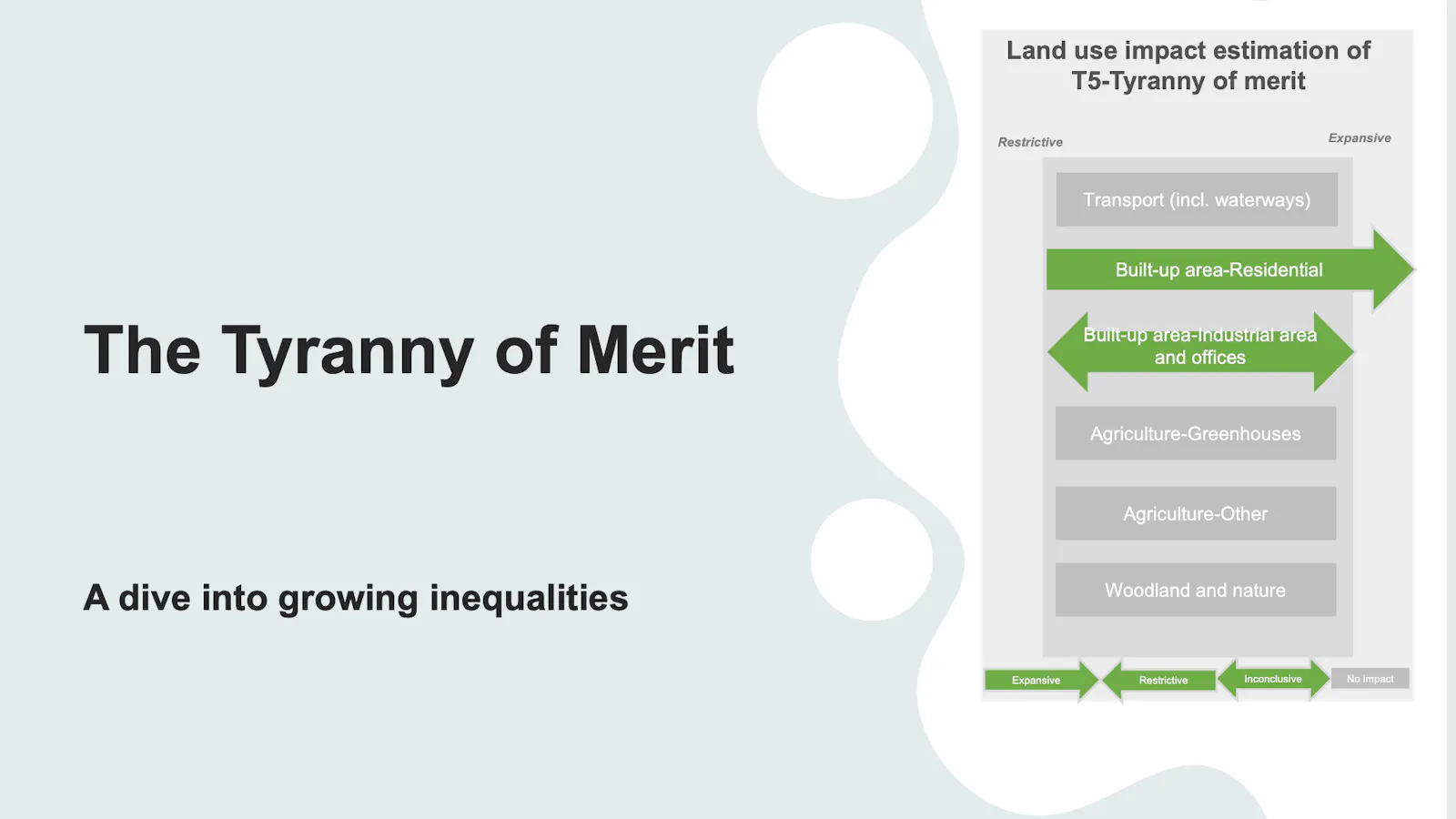
The cumulative effects of these three trend elements lead to the growth of thriving cities and regions, but these opportunities remain largely inaccessible to the wider population. This goes together with the risks of an increasing territorial concentration of poverty, which can result in reduced social mobility and increased migration to growth-pole areas. The heightened demand for housing in these regions, combined with real estate investment, exacerbates the problem. The overall impact on land use is expansive, primarily in built-up residential areas.
In addition, the social effects are high and social inequalities increase, as certain groups feel marginalised, non-respected and left behind due to the tyranny of merit, making failure personal and disregarding systemic links effects. The latter may be linked to the ‘inequality regime’ as analysed by Thomas Piketty, arguing that the structure of inequality and the institutions, like the legal, educational and fiscal systems help sustain a certain level of equality or inequality in society. Such systemic links may result in anger against several educational or media elites, further resulting in social unrest and dissatisfaction of certain social groups who may seek social recognition and representation by populistic parties and narratives. Such dynamic has already shown its consequences in the Trumpism and BREXIT era, raising awareness for places left-behind or places that do not matter.
The tyranny of merit is closely interlinked with other trends and policies currently affecting Europe’s economic, social and territorial development. Among them are the digital divide, discussed in relation to policies like Europe Fit for the Digital Age and trends such as accelerated digitalisation. Also they can disproportionately affect disadvantaged groups who lack access to digital solutions. As society becomes increasingly dependent on e-health and e-education, this divide may worsen. Furthermore, the green transition, and a shift to renewables, could lead to higher costs for essential services like food, transportation, housing, and energy. These increased costs might disproportionately burden disadvantaged social groups, fuelling social pressure and dissatisfaction. For this, overarching policies such as the just transition and the Territorial Agenda, aiming for a just Europe for all places and people are pivotal for the future of Europe and its values.
Overall, the tyranny of merit risks to paint a grim picture of the socio-economic landscape. It highlights the widening economic disparities, unequal access to opportunities, and the concentration of wealth in specific sectors and regions. Understanding the intricate interplay of these factors is crucial for policy-makers, as it has far-reaching consequences for society, land use, and the overall well-being of its citizens. Addressing these issues is not just a matter of economic equity but also a vital step towards creating a more inclusive and just society and why not, of a new social contract.
More details on this analysis are available in the study on potential land use impact of EU policies and global trends on the Netherlands (Opens in a new window).
by Kai Böhme and Maria Toptsidou
Date
November 6, 2023
Topic
Trends
0 comments
Would you like to be the first to write a comment?
Become a member of spatialforesight and start the conversation.