and how to sit on them
Fran’s father, George, had been an army man and knew the weight of things just by looking at them. But when it came to chairs, his was another way of sitting, always.
For him, an armchair of the old-fashioned, stuffed variety would be sat on in the following manner, one leg in front in a natural sitting-in-a-chair position; the other leg over a chair-arm; one elbow resting on the raised knee; a finger stuck sideways into his mouth. This was the thinking position.
On a long couch George would lie down but contrive to be “sitting”, resting on the cushion with his feet up on the back. Thus, he would sleep comfortably after meals.
Later he developed an illness that caused him to fall asleep at the table just as he was halfway through a plate of food. George never fell forward. It was as though the chair he sat on had, through long and constant use, grown to love him and at these times sought to hold him erect. Gracefully, he would lean to one side while a hand propped up his head. Guests always thought he was awake behind the light reflected off his reading glasses. His family protected him by answering any questions, always interjecting, “Isn’t that right, Dad?” – to which Fran’s mother, Emily, would say, “Of course it is.”
Perhaps because of this, Fran grew to womanhood distrusting chairs, food and sleep. This distrust had only been encouraged by the accident. Fran, six at the time, had discovered she could balance her chair on its two back legs, which, for some reason, gave her an immense feeling of security.
Balancing had become a way of making mealtimes exciting. How long could she prevent herself from falling forward, with a dreadful jolt, causing water to leap from glasses, cutlery to spin, salt and pepper shakers to fall over, and her mother to say, “Now dear!”
Her mother was afraid that if she said anything, Fran would wilfully continue this practice into adulthood and perhaps, even worse, graduate to hard drugs. Her father, meanwhile, had observed that if he kept a whole stream of jokes going throughout the meal, his daughter would lean forward in her chair to hear every word. He had also observed that neither of them ate any food at such times. So he had started eating most of his meals at the restaurant, which he owned, to make sure that both of them ate, and to avoid having to look, with his heart in his throat, at his balancing daughter.
The accident happened on a Sunday morning. Sundays were for boiled eggs and hot rolls dripping with melted butter. George was usually out at Sunday breakfast and didn’t come home until just before lunch. Sam, Fran, Bella, and Emily were all seated around the square kitchen table. For years afterward, Fran would remember the bright light coming in through the huge kitchen window, because from where she sat she looked out at a luminescent, grey sky.
Fran would remember the red-and-white checked tablecloth. The eggcup with her egg in it, the top already taken off. The soft yellow yolk dripping down one side in a thick yellow line. The toast already cut into fingers. The chair. And a cupboard door with a dent in it.
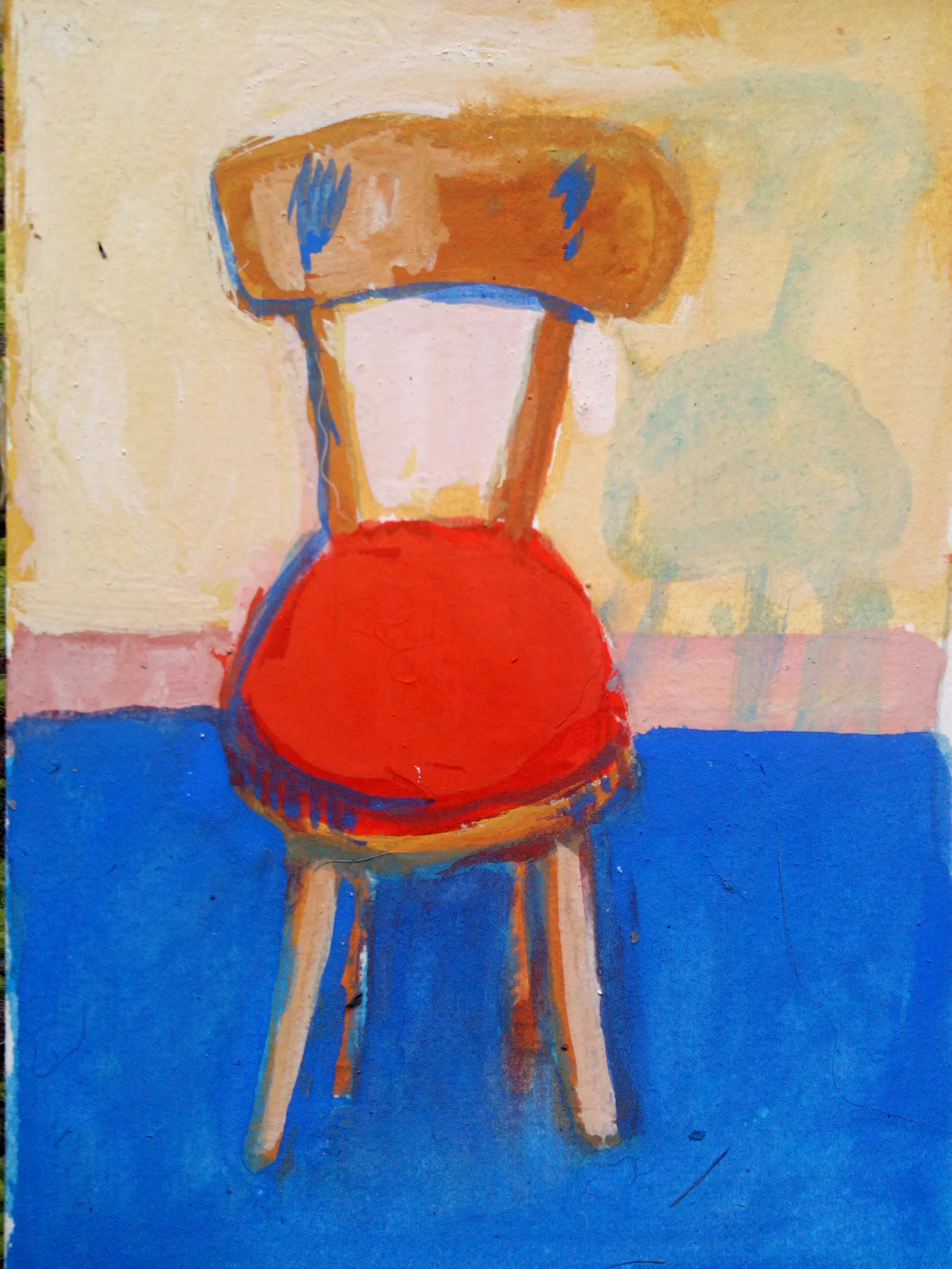
The chair was wooden with a red, soft, plastic seat. The back thickened, and curved inwards, where it would cut just below the shoulder blades of an adult. Fran, as she had done hundreds of times before, braced her arms in front of her, tilted back the chair to its comfortably precarious, 45° angle, and shifted her body ever so slightly so that she was balanced in the chair as if in the crook of someone’s arm. From this position she was now ready to eat her egg, and leaned forward to reach with her spoon for the cooling, solidifying yolk. It was at this precise moment, when spoon made contact with egg yolk, that everything happened.
George’s early return from the restaurant was a wedding anniversary surprise for Emily. He was one week early. Holding a bunch of garish, mixed flowers, he burst through the door. Everyone turned to look at him as he shouted: “Surprise, surprise! Happy anniversary!”
Fran looked up, too quickly, as her spoon slashed down onto the egg, knocking it over. The chair slipped on the red tile floor and fell backwards with a crash.
Fran was lucky. She was saved by the proximity of the wooden broom-cupboard behind her. Hitting her head on it, instead of the red tile floor, she saw the world swirl around her.
Sam swallowed his breakfast in one gulp, leapt from his chair, ran to his sister’s side and tried to lift her off the floor. “Frannie! Frannie! Frannie! He screamed. Then he knelt down beside her to listen to her breathing and feel her pulse, just as he had seen it done on TV the night before.
“Frannie’s going to be all right,” he said.
Twenty-five years later, Fran would remember the next moment. She was lifted from the floor by her father, who was wearing a grey woollen suit. She would remember the real-man-cologne and bakery smell of him, the way the wool scratched against her face, at once uncomfortable and comforting. She would remember his holding her to him and rocking her in his arms.
The whole family, with Bella, the aupair climbed into the family car and went to first-aid at the local hospital, where Fran was pronounced safe from serious head injury and given a fifteen-minute lecture on the hazards of leaning back in chairs.
“Why, for heaven’s sake, have you not read her Strewelpeter?” asked the head nurse.
“Well,” said Emily. The nurse reached down into the depths of a large black bag hanging from a hook behind her office door. She thrust a photocopied book, moral tales for girls and boys, into Emily’s hands. Emily immediately gave the book to Fran, who later coloured the pictures and suffered screaming nightmares, causing Emily to read the book and have nightmares herself before allowing the dog to rip it up during a game.
From the hospital the family went to visit Aunt Nelly.
Aunt Nelly was crisis management. It was to her that children were taken when they had fevers, toothache, scratched knees, or broken toys. And then there was always the comforting presence of Uncle Harold, seated, silent, on his high-backed, high-armed chair, like an Egyptian pharaoh on his throne, straight up and down. Aunt Nelly’s house was calm, full of dark browns, greens, earth-tones. The windows were covered with net curtains. But there were sweets and goldfish in large tanks to distract frightened children. Fran would only ever remember the fish tank and the many mints her Aunt Nelly fed her.
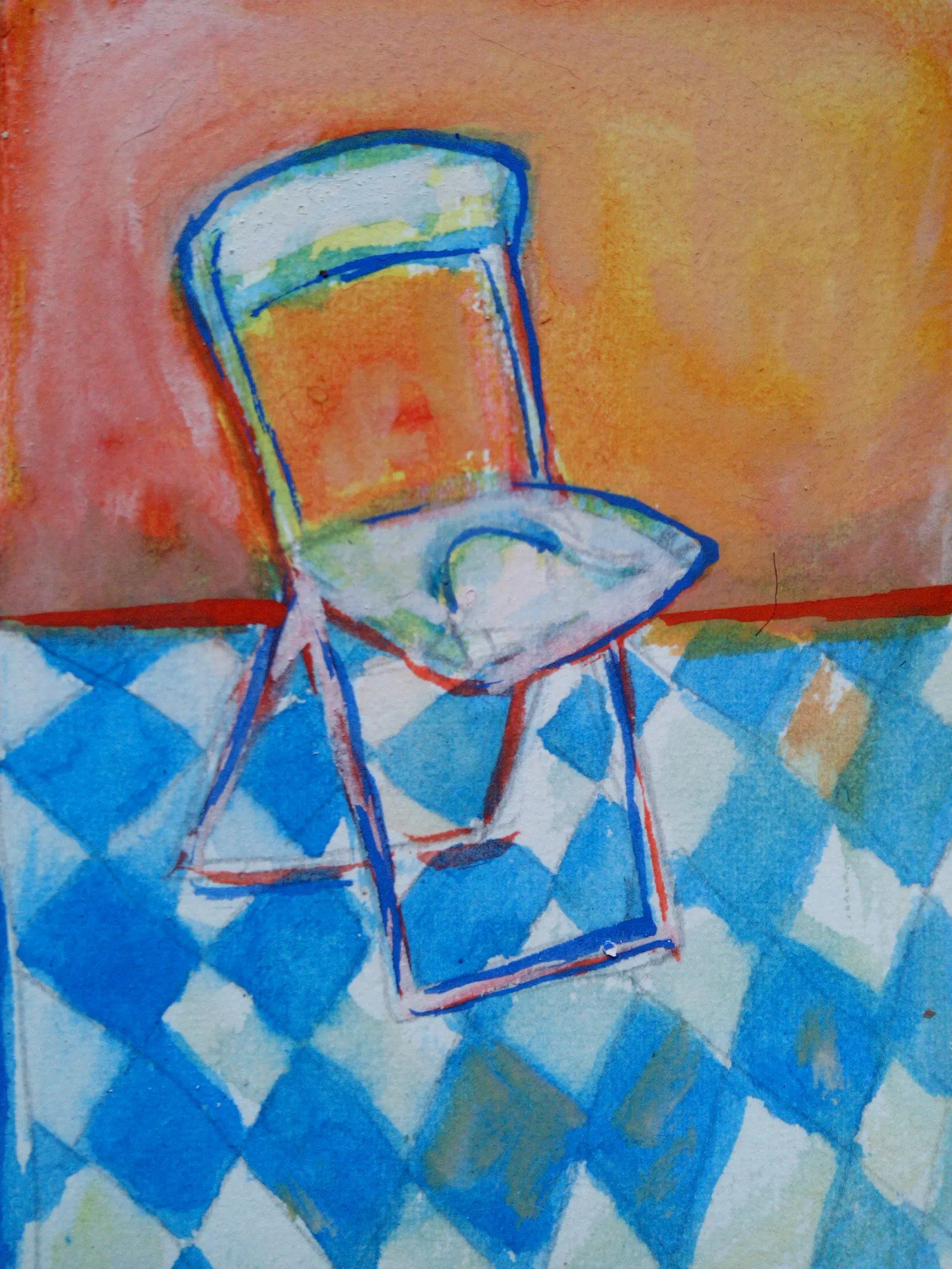
Fran had other adventures with chairs but none worth relating, except the last one. It was about a week after her father died. Fran was sitting on one chair – clear, plastic, folding – while restoring another – Italian, ornate, gold-leafed, from the Renaissance. She was tired having, as usual, skipped lunch. Groaning a little, in a satisfied way, she shifted to a better position, to reach a difficult angle of the carved chair. But she pushed her weight too far back on the plastic chair and was snapped up, like a shrimp in a trap, her legs and arms waving. Gold leaf scattered everywhere.
She took immediate revenge and carried the plastic chair to the wheeled rubbish bin outside her small, street-level shop. Standing beside the bin was a simple wooden chair with a soft, brown, plastic seat cover. She recognised something in its thick, rounded, upper backrest, which she knew would dig under her shoulder blades. “But when,” she thought, “do I ever lean back?” She carried the wooden chair into her shop, noting that it had been made about the year she’d been born. In a few years, in America, it would be an antique.
A pile of her father’s clothing was heaped up by the door, patched by the strong white afternoon sunlight. Fran absent-mindedly hung one of her father’s suits over the back of the newfound chair and sat down. She then carefully returned as much as she could find of the gold leaf to the wooden box. Sitting up, she pulled a chocolate bar out of her bag and ate her lunch.
That evening she worked hard. Her client had sixteen more chairs waiting to be restored in a spacious apartment near the Coliseum. This was the test chair and she worked into the night. It was quite late, then, when she dropped the paintbrush. It rolled under the chair she was sitting on. She fished around for it from where she sat, but she couldn’t reach it. Sighing, she knelt down. She smiled as she glanced at the clock. She hadn’t noticed how accustomed her body had grown to the one position; now it was painful to move.
Then it happened. Just as she was putting her hand on the plastic seat, she leaned forward. She stopped: her cheek had brushed the thick woollen cloth of her father’s jacket. She inhaled and leaned a little closer, so that her cheek was now resting on the collar.
Someone walking by her shop at that moment would have seen a slight woman on her knees beside an unremarkable chair; her right cheek on the lapel of an ordinary grey wool suit Jacket; her eyes closed. They would have thought she was praying. They would have looked down at their feet and then looked up, because they had seen something they wanted to see again. They would have admired the glow of the light from the work lamp on her skin and her hair. And then they would have walked on, pleased that someone still cared enough to pray for the world.
But for Fran it was like this: She was remembering how her father had picked her up from the floor, how her head had rested against his jacket and been filled with the warm, secure smell of him, how he had held her and rocked her in his arms.
That is what she was remembering.
First published in Paperplates, A Magazine for Fifty Readers. Vol.3, No.1. 1996. Canada
Data
18/03/2026
Tópico
Memories


