October 2023
Regional cross-border cooperation projects and programmes can contribute to the prosperity and quality of life in the region. By cooperating across borders, challenges can be addressed that are not stopped by administrative or physical borders like labour market dynamics, migration, healthcare provision and environmental impacts. Regions can learn and benefit from each other, align policies and make governance more efficient, fostering a stronger cohesion and common identity in the EU.
In the heart of Europe, the cooperation area Eifel-Ostbelgien-Éislek brings together municipalities from Belgium, Germany and Luxembourg. Its landscape includes the Eifel National Park, the Ardennes Mountains, and the Moselle Valley.
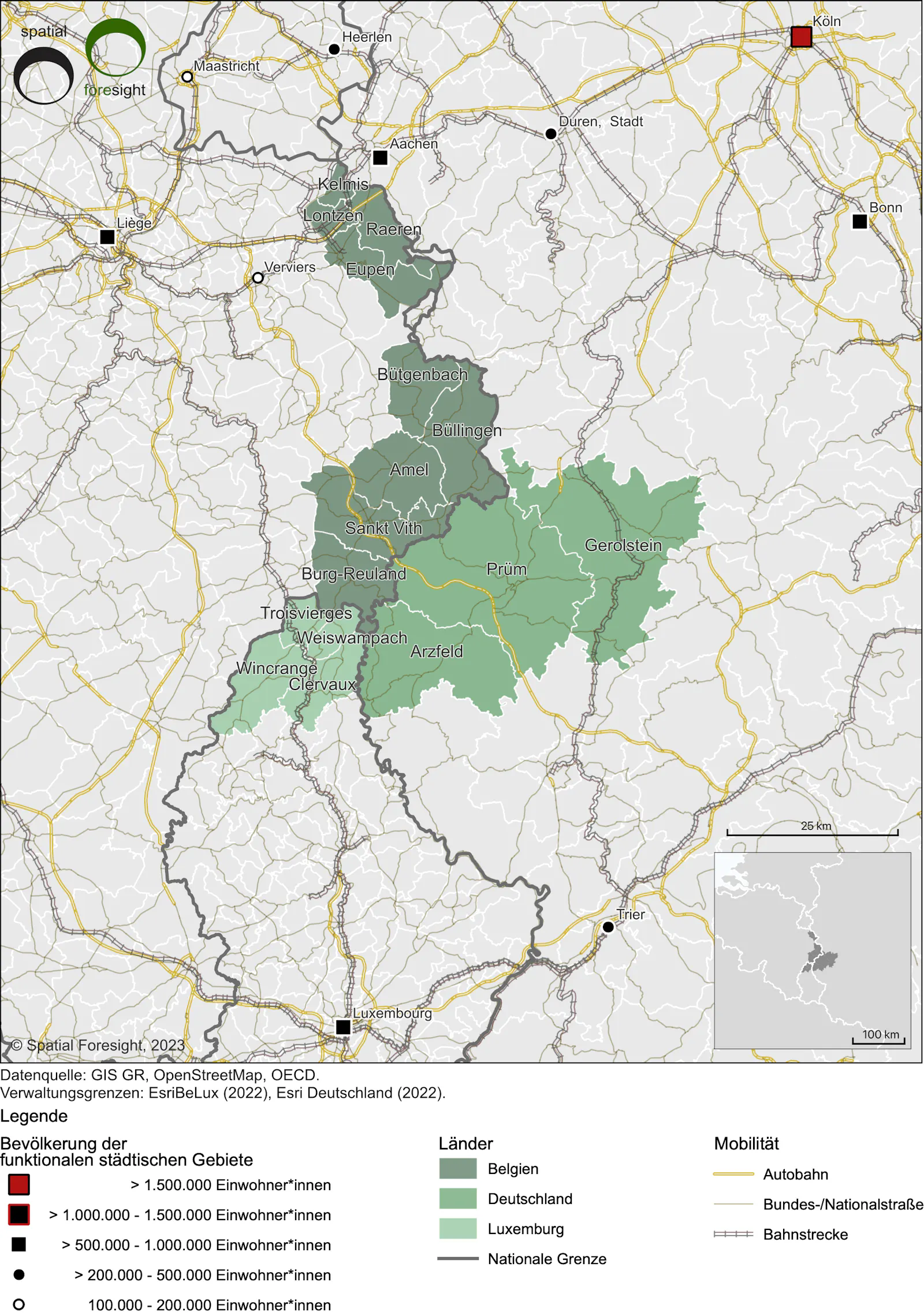
As an initiative of the Ministry of the German-speaking Community Belgium, the Ministry of Energy and Spatial Planning of Luxembourg, and the Ministry of Economics, Transport, Agriculture and Viticulture Rhineland-Palatinate and supported by the funding opportunities of the Interreg Programme Greater Region, a spatial analysis of the Eifel-Ostbelgien-Éislek was conducted. It was developed in exchange with local stakeholders and fed into the participatory development of a common strategy for the region. The goal of the analysis was to support a sustainable and harmonious cross-border spatial development in this functional area. It provides a comprehensive examination of the region's spatial dynamics, outlining actionable insights for the future development strategy, based on a meticulous analysis of the region's strengths and challenges.
The spatial analysis covers a wide spectrum of topics to gain an understanding of the cross-border and its sub-regions. Those include demographic developments, labour market dynamics, linkages in tourism, language and culture as well as services of general interest and healthcare provision. Additionally, the analysis investigates mobility, land use, flood management and the potential for renewable energy production in the region Eifel-Ostbelgien-Éislek. You can access the full spatial analysis here (Abre numa nova janela).
Rich cultural heritage and recreational diversity make the region appealing, but challenges include seasonal fluctuations, competition, and a service professional shortage. The region has a rich cultural heritage, offering a diverse range of cultural and recreational activities, along with a sense of regional identity, based on the common language. The presence of numerous cultural venues and leisure facilities contributes to the region's appeal. However, there is a need to address the seasonal fluctuations and general volatility in the tourism industry. Additionally, the competition from neighbouring tourism regions and a shortage of service industry professionals pose challenges. To capitalise on its cultural strengths, the region should focus on promoting sustainable and year-round tourism while investing in professional development to maintain and enhance its appeal to visitors.
A positive demographic shift in the region presents growth opportunities, but there are disparities among the municipalities. The Eifel-Ostbelgien-Éislek region is experiencing a positive influx of residents, particularly those in the working-age population. This demographic shift presents an opportunity for growth and vitality. However, challenges persist in the form of disparities between growing and shrinking areas, necessitating a balanced approach to development that addresses both.
High workforce participation and low unemployment rates coexist with a shortage of local jobs, leading to significant outbound commuting. While the region presents low unemployment rates and high labour force participation, it faces the challenge of a relatively low number of jobs per resident as most jobs are outside of the area. This indicates that despite a strong workforce, there is a shortage of employment opportunities within the region and a significant number of outbound commuters. These move in two dominant directions: outside of the cooperation area into neighbouring municipalities and from the Belgian and German sub-regions to Luxembourg. How commuting patterns link to integrated cross-border labour markets has also been discussed in a previous blog post (Abre numa nova janela).
Heavy reliance on private cars for travel presents an opportunity to enhance commuter flows and promote sustainability. Due to the commuting flows within the region and with its surroundings, there is a significant demand for interregional and cross-border transport. At the same time, the region Eifel-Ostbelgien-Éislek shows a heavy reliance on private car transportation, both for local and cross-border travel. This presents an opportunity to redirect and improve the commuter flow within the area. Developing cross-border public transportation infrastructure can enhance connectivity and encourage a shift towards more sustainable modes of transportation, which has been discussed in an earlier blog post (Abre numa nova janela).
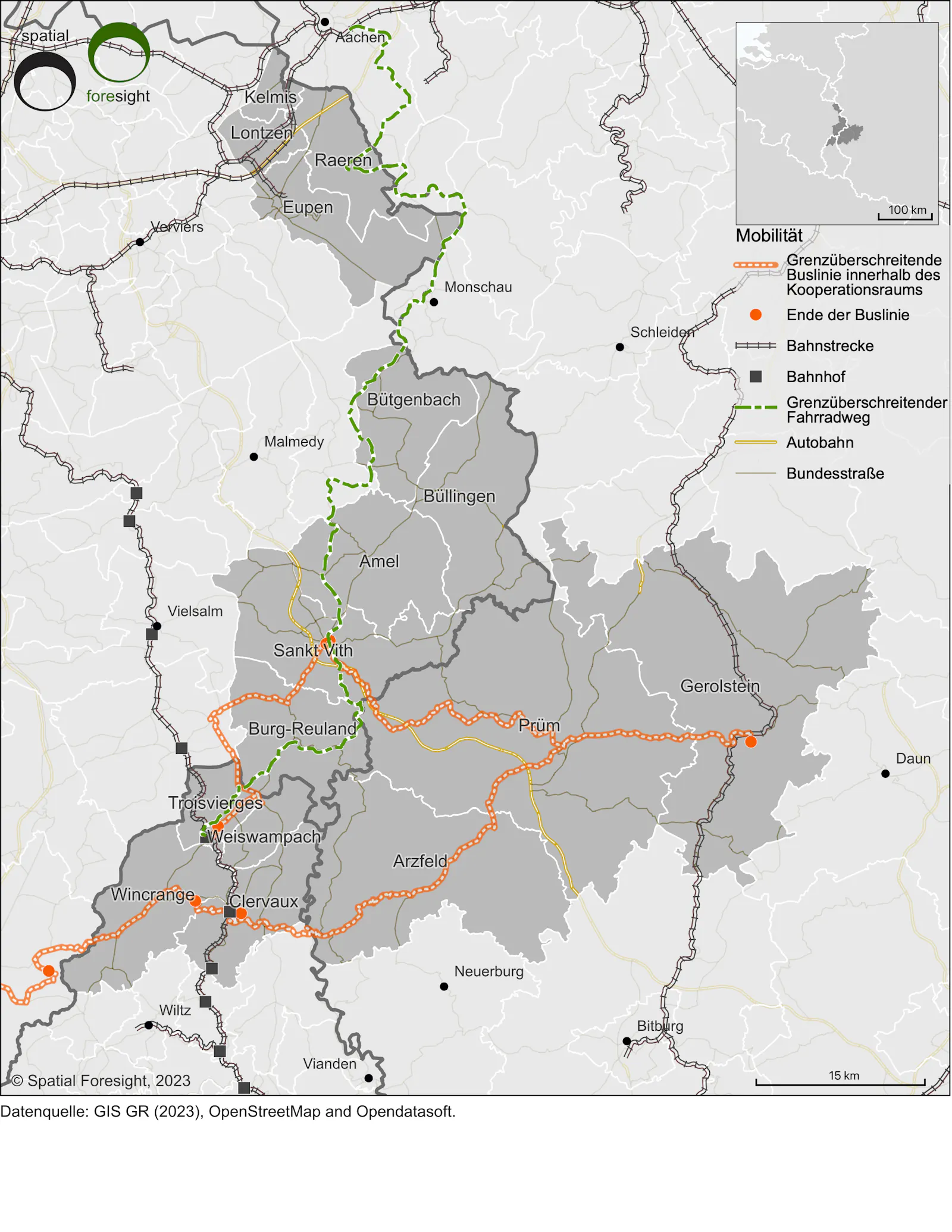
The region offers convenient access to daily services and healthcare, but reliance on motorised transportation raises accessibility and sustainability concerns. The mobility patterns in the region Eifel-Ostbelgien-Éislek also influence the access to general services, educational opportunities and healthcare. The region generally benefits from convenient daily supply options, including supermarkets and bakeries, and accessible healthcare services in neighbouring medium and large centres, such as Lüttich, Maastricht, Aachen, Bonn, Trier und Luxemburg city. However, reliance on individual motorised transportation for daily needs poses challenges. Soft mobility for fulfilling daily needs such as groceries is possible within local centres also due to the local topography. An aging and partially declining population raise concerns about the long-term sustainability of local businesses and healthcare providers.
The discussion above illustrates the added value of spatial analyses informing participatory processes for strategy development, offering insights that can benefit similar regions facing cross-border challenges. Effective cross-border spatial development requires strategic coordination among stakeholders from all regions involved, with a shared vision and strategy to address common challenges. Through collaboration, Belgium, Germany, and Luxembourg can unleash the region's potential, fostering a more prosperous and sustainable future. The story of the Eifel-Ostbelgien-Éislek region is one of transformation guided by the delicate balance between challenges and opportunities.
In conclusion, regional cross-border cooperation is about forging connections, and enhancing the well-being of communities. By fostering economic, social and environmental progress and by creating a sense of unity among diverse regions, cross-border collaboration remains a fundamental pillar of the EU’s mission to create a stronger, more integrated and aligned Europe.
by Kirsti Hagemann and Marcela Mäder Furtado
Data
24/10/2023
Tópico
Territories
0 comentários
Gostaria de ser o primeiro a escrever um comentário?
Torne-se membro de spatialforesight e comece a conversa.