March 2023
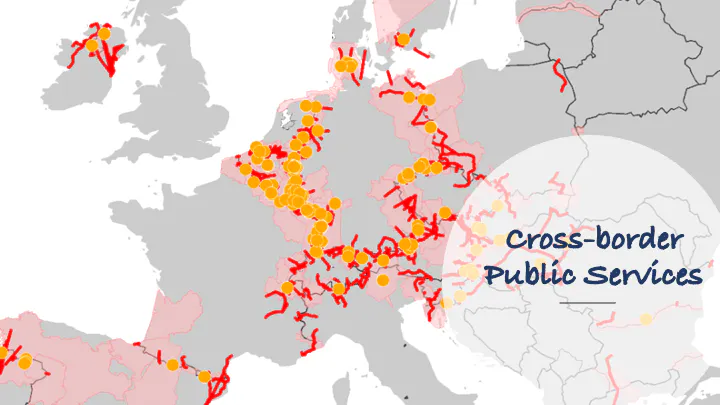
In the EU approx. 150 million people or roughly 1/3 of the population live in border regions. In many cases they need to travel longer for accessing public services, such as health care or education, or live with lower quality or more expensive public services, e.g. in the fields of public transport or environmental protection, than people in non-border regions. The provision of cross-border public services can help in these cases.
Cross-border public services are long-term (or permanent) public service provisions in a cross-border region. They respond to a joint problem or development opportunity in the cross-border area with public involvement and target people or enterprises on both sides of the border in a non-discriminatory way.
Ideally, cross-border public services are established, provided and financed in cooperation between players from both sides of the border. However, the variety of provision and financing solutions is wide as is the degree of involvement of entities from both sides of the border.
A recent analysis of cross-border services in the EU, funded by ESPON (Si apre in una nuova finestra)and DG REGIO (Si apre in una nuova finestra), identified and analysed 1,551 cross-border public services in the EU covering a wide range of fields, including transport, disaster management, education, health care etc.
Transport cross-border public services stand with 966 service or 61.5% for the lion share of all cross-border public services in the EU. Except for a few cases which date back to the 1960 or even earlier, they started to emerge in the 1990s and have been growing in numbers since then. In most cases they concern cross-border public transport, which has already been discussed in an earlier blog post (Si apre in una nuova finestra). This concerns mainly regional bus and rail services, and in a few cases also tram or ferry services crossing national borders. One of these tram lines runs between Strasbourg in France and Kehl in Germany. Furthermore, some cross-border public services simplify cross-border ticketing systems to facilitate the use of cross-border public transport. One of a growing number of examples – and probably the most advanced one – is the full cross-border tariff integration for all journeys within the Greater Geneva metropolitan area. Altogether, public cross-border transport services help to improve mobility across national borders.
Environmental protection services come second with 135 cases, or 8.6%. They have been evolving since the 1960s and grew substantially in numbers between 1990 and 2015. Most of them are found along internal borders of the EU, but about 17% work along external borders, e.g. with Switzerland, Norway, Ukraine and IPA countries on the Western Balkan. Thematically, many of them deal with restoring, protecting and managing valuable terrestrial ecosystems, cross-border green infrastructure, or climate-related risks. One example is the Tatra Transboundary Biosphere Reserve at the border between Poland and Slovakia. Another thematic field concerns joint sewage water treatment and the provision of drinking water between border municipalities. This is among others rather common in the Luxembourg Greater Region. More recently also cross-border public services dealing with renewable energy and solid waste are emerging. All of them work to protecting nature and improving environmental conditions for a greater public well-being.
Civil protection and disaster management stand with 133 cases for 8.5% of all cross-border public services. There are a few cases dating back to the 1960s, but most of them have been established between 1990 and 2015. They concern mainly stand-by services to be activated in cases of major emergencies or disasters. They can also concern joint firefighting and mutual assistance in case of accidents and stretch from mutual assistance to joint bodies. One example is the merger of the municipal fire brigades of Belgian Baarle-Hertog and Dutch Baarle-Nassau under the responsibility of the joint cross-border body. There are also a few cross-border public services working with flood management, including e.g. disaster protection through a joint use of amphibious vehicles by the German-French civil protection forces.
Education and training is provided 81 times as cross-border public services, which equals 5.2%. They haven been emerging slowly since the 1960s, and there has been a wave of new cross-border education and training service around 2010/15. Although, this can cover all phases of education as well as the recognition of degrees, most of them concern tertiary or early childhood education. Cross-border public services in the area of early childhood and primary education aim to stimulate language learning at a very early age and promote cultural exchange and communication between pupils from neighbouring countries. One example is the bilingual elementary school Prosenjakovci in the Slovenian-Hungarian border region. Secondary education and vocational training are less frequently covered. Services in the field of secondary education concern mainly binational and bilingual grammar schools or high schools established on one side of the border but targeting pupils from both sides.
Healthcare and social inclusion services stand with 77 cases for 4.9% of all cross-border public services. They have been emerging since the 1970s, but most of them have been established after 2000. They usually aim to overcome difficult access to domestic health care service resulting from border location disadvantages. In many cases these services improve emergency medical care and rescue services in the cross-border area. One example is the cross-border emergency, mountain rescue and patient transfer services in the German-Czech cross-border region. Increasingly, solutions improve access to primary or in-hospital health services across the border, either for all available healthcare treatments or for selected specialist medical services (e.g. cardiology, cancer treatment etc.). So can e.g. people from Valka in Latvia receive healthcare treatment in the hospital of Valga in Estonia.
The remaining cross-border public services identified concern fields such as spatial planning, tourism, culture, labour market and employment, citizenship, justice and public security, communication, and information society. Altogether there is a huge diversity of cross-border services offered in the EU and an equally huge diversity of administrative and legal arrangements for making this possible.
Conclusions
All in all, cross-border public services make life better for people living in EU border regions. Furthermore cross-border public services are often more cost effective than (parallel) domestic public services in border regions, as they can serve a larger number of people.
Still, given the number of cross-border regions in the EU, their geographical concentration along some borders and the number of people living there, the 1,551 cross-border public services identified suggest that many more such services are needed to equally improve living conditions in all European border areas.
The reasons why there are not more cross-border public services are manifold. They range from administrative and legal hurdles and governance structure to vested interests over mismatch between geographical coverage . As shown in the studies conducted for DG REGIO and ESPON, there is also no simple fix for this. Depending on the policy field, EU competences and national frameworks vary. Often there are no substantial EU competences, e.g. in the areas of civil protection, disaster management and emergency medical services. Due to this variety of hurdles and frameworks nearly all cross-border public service solutions are tailor made, bringing together different elements of solutions in a specific way.
Despite all hurdles, cross-border public services are possible and important for a good services provision to European citizen and for European integration. More on this can be found in the studies conducted for DG REGIO (Si apre in una nuova finestra) and ESPON (Si apre in una nuova finestra).
by Kai Böhme & Sabine Zillmer
https://steadyhq.com/en/spatialforesight/posts/68b8f735-202a-4bb7-ae94-5500bfb6bf87 (Si apre in una nuova finestra)https://steadyhq.com/en/spatialforesight/posts/739b80e9-e9a8-4db2-b9c6-6879f9cb7c7c (Si apre in una nuova finestra)
Data
13/03/2023
Argomento
Territories
0 commenti
Vuoi essere la prima persona a commentare?
Abbonati a spatialforesight e avvia una conversazione.