Beren is a name etched in the memories of Middle-earth fans. And it is literally carved beneath Tolkien’s own name on his Oxford gravestone. There was never a clearer statement of an author identifying with a character of his creation. But what does the name Beren mean?
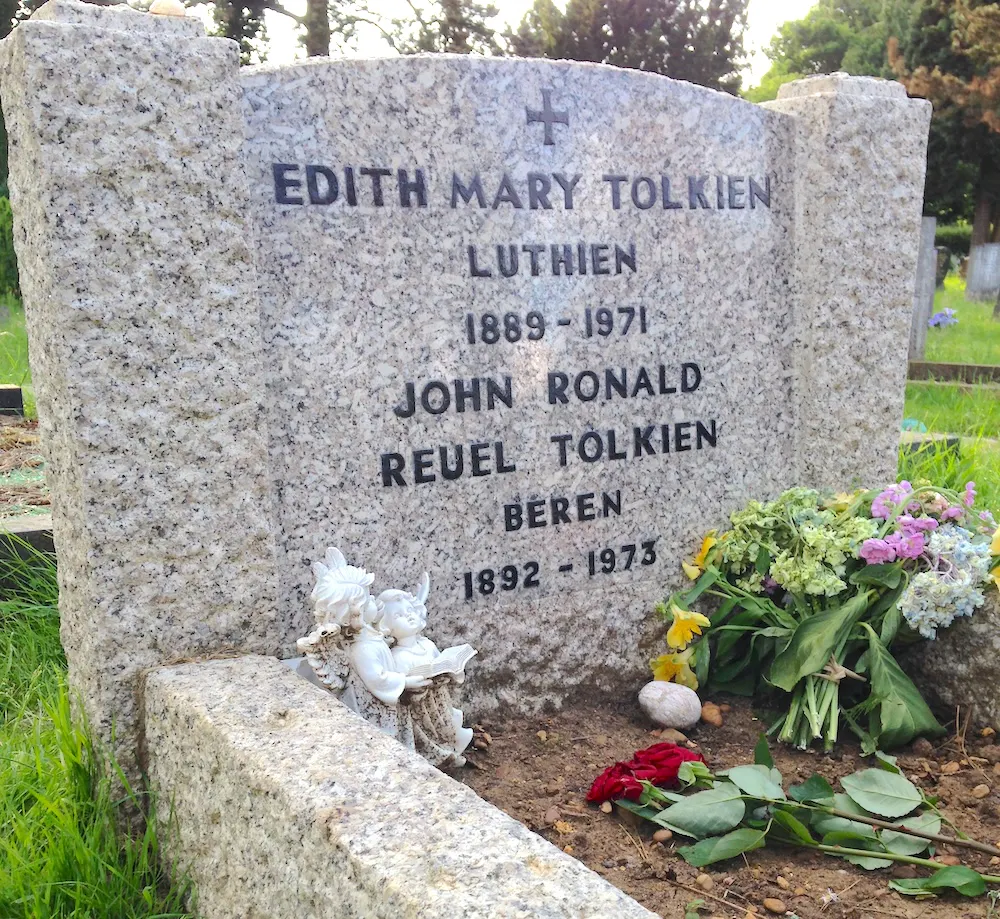
The mythology began as a home for Tolkien’s invented Elvish languages. So you might expect him to record a meaning for the name he gave to the hero of the central story of The Silmarillion. From a lifetime’s work, we have evidence of just one clear explanation.
Tolkien’s Etymologies, a 1937 lexicon of Elvish word-roots and their derivatives, glosses beren as ‘bold’, related to a verb bertho meaning ‘to dare’.[1] (Opens in a new window) Very fitting for the hero who goes to the heart of the enemy’s realm and cuts a holy jewel from his iron crown.
However, Tolkien is unlikely to have had ‘bold’ in mind when he first coined the name in 1917. His Elvish lexicons from that earliest period of his invention have nothing similar to it. And anyway, one motivation of the Etymologies was to provide philologically cast-iron derivations for some his earliest names, which he had come to see as slapdash.
Appropriately, one example of this is the name Lúthien, which Tolkien gave in the 1920s to Beren’s elven lover (previously just called Tinúviel). Tolkien had earlier intended Lúthien to mean ‘friend’, and his plot notes show he tried it as a name to a succession of male characters. But the Etymologies derives Lúthien from a root meaning ‘magic, enchantment’ and translates it as ‘enchantress’. By the time he had it carved beneath his wife Edith’s name on her gravestone in 1972, he had decided it meant ‘daughter of flowers’.[2] (Opens in a new window)
So beren ‘bold’ in 1937 may well tell us nothing about the meaning of (or motive for) Beren when Tolkien first used the name in 1917.
Now a chance encounter with a book in the Bodleian Library has led me to a plausible and intriguing possibility.
Date
March 22, 2024
Topic
Inspirations
0 comments
Would you like to be the first to write a comment?
Become a member of John Garth on Tolkien’s life and works and start the conversation.