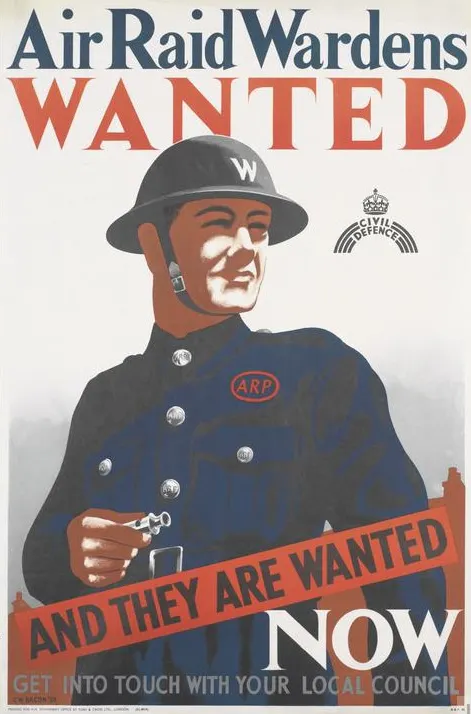
A dive into Oxford’s wartime archives means I can now put to rest any question over when Tolkien enrolled as an air raid warden. As a bonus, it also suggests he did not join up alone.
I visited Oxford City Archive in the town hall to look at the Second World War enrolment register for air raid wardens there. The Air Raid Precautions Register, spanning 1937–1945, confirms that Tolkien joined the service on 29 September 1941.
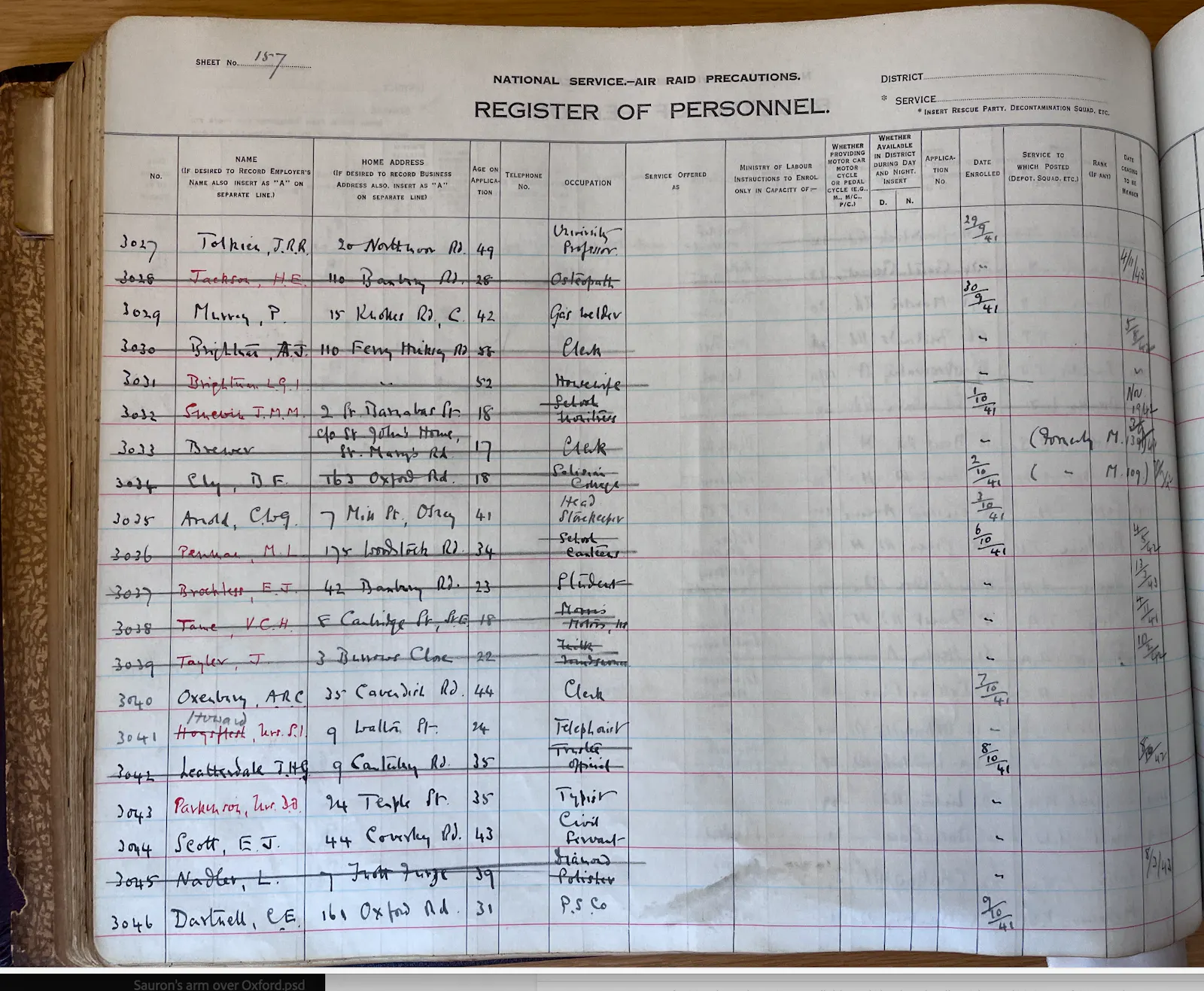
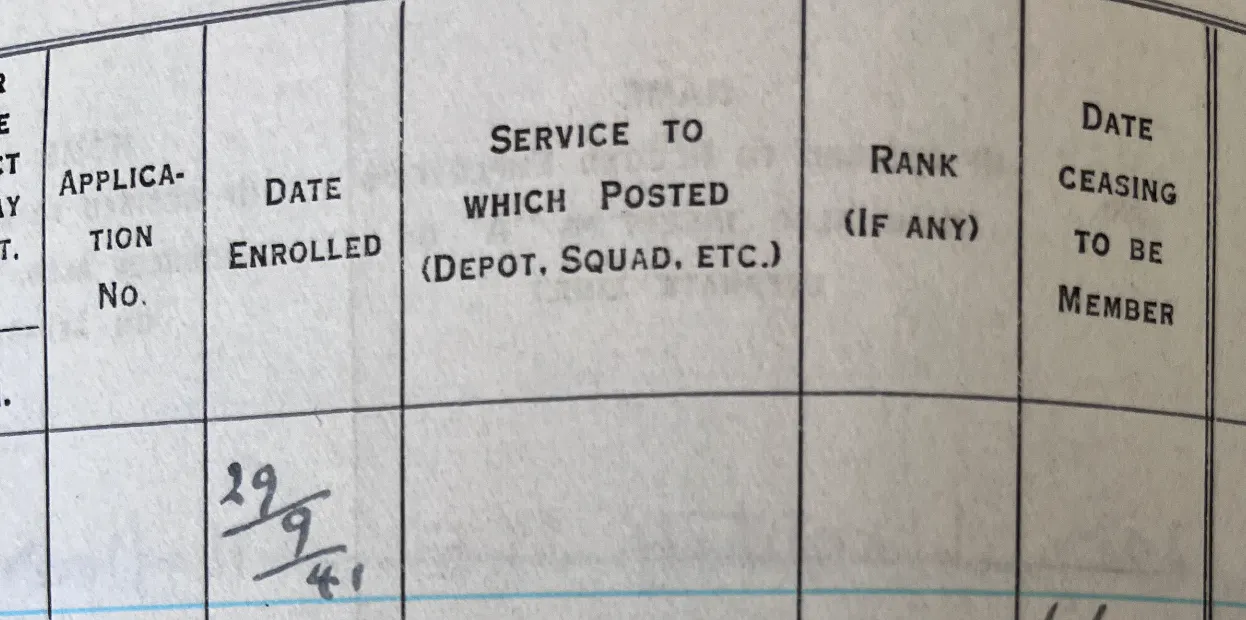
That’s as I posted previously. But it was at least nine months later than his children came to remember it. The register entry illustrates the fragility of biography that rests on even the most sincerely held memories.
The date was first revealed in a register image published on the Oxford Museum website last year. I amplified it in this blog and on social media. It contradicts two items in the standard reference work, Christina Scull and Wayne G. Hammond’s Chronology: that Tolkien became a warden ‘by January 1941, and probably during 1940’ and that he went to the scene of a 4 May 1941 bomber crash in that capacity.
 (Abre numa nova janela)
Just after I wrote my original post about the register entry last year, Tolkien scholar Kristine Larsen revealed that Scull and Hammond’s information came from firmly held Tolkien family memories and some unidentified unpublished evidence.
Priscilla Tolkien had witnessed the bomber as it made its fatal plunge when she was 11. At 70, she wrote to the Oxford Times about it, saying: ‘My father J.R.R. Tolkien was an air raid warden and was soon on the scene with other wardens and fire-watchers in the neighbourhood.’ She later reaffirmed this belief to Scull and Hammond. Her brother Christopher had evidence their father was a warden at least as early as January 1941, she added.[1] (Abre numa nova janela)
Scull and Hammond’s work is indispensable, and their access to family memories is the richest since Humphrey Carpenter’s 1977 biography. But I have closer and more regular access to Oxford – where I’m about to begin a doctoral (DPhil) research project on how modern war shaped The Lord of the Rings (Abre numa nova janela). So I felt bound to go and check the official records.
What I found illustrates now even the most firmly held memory can be disproven by primary and contemporary evidence. We don’t know what evidence Christopher had, but an error has clearly arisen somewhere along the line.
For both the family and the September 1941 register entry to be correct, Tolkien would have had to enrol earlier and then leave the service before enlisting again that September. Any earlier entry would have been struck through, with a date when he left the service.
But I’ve now scrutinised every page from the beginning of the war up to the end of 1941. There is no earlier entry for Tolkien.
My photographs of the register (reference number OCA8/1/PL1/2 in the Archive), much clearer than the only earlier image available, also provide extra information. They are reproduced here by permission from Oxford City Council.
Among some interesting sidelights is the entry for Cecil Roth, the Jewish historian with whom Tolkien later shared air raid warden duties. He joined on 12 September 1941, just a couple of weeks before Tolkien. H.T. Wade-Gery, the Oxford classicist with whom Tolkien had once dined during the Battle of the Somme, volunteered on 29 May 1940.

Catholic professor Francis de Zulueta (Priscilla’s godfather) enrolled on 14 May 1940. Inklings member Colin Hardie, of Magdalen College, enrolled on 23 May 1940. Could either of their examples have inspired Tolkien to join? If so, the inspiration took nearly a year and a half to take effect.

But the register evidence suggests another plausible factor.
Entries on consecutive pages show that Tolkien enrolled between two men who lived round the corner from him in north Oxford – zoologist P.B. Medawar and osteopath H.E. Jackson, both of 110 Banbury Road. Medawar lived at 110a (one of three flats at the address).[2] (Abre numa nova janela) Jackson’s address is simply 110.
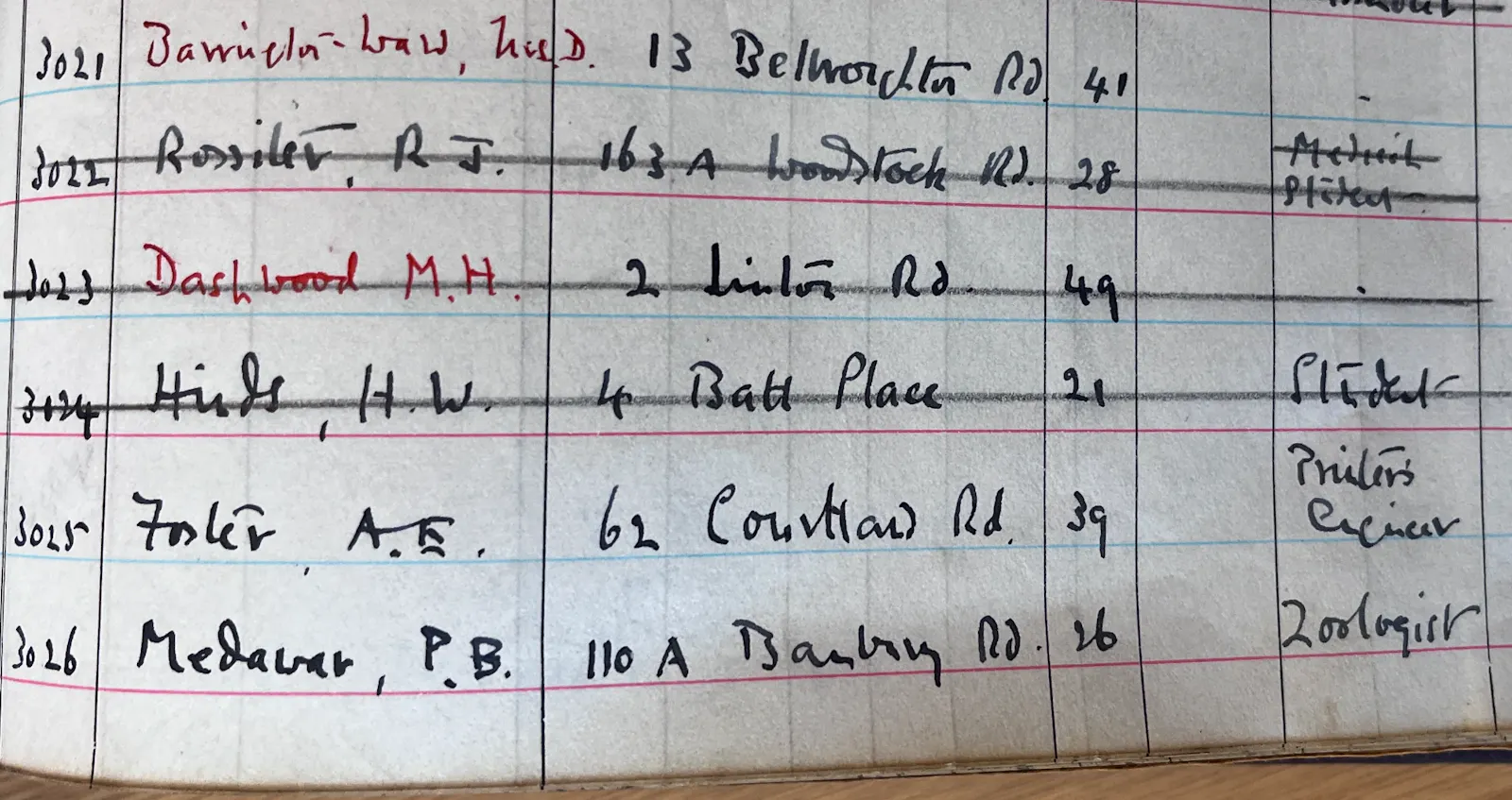
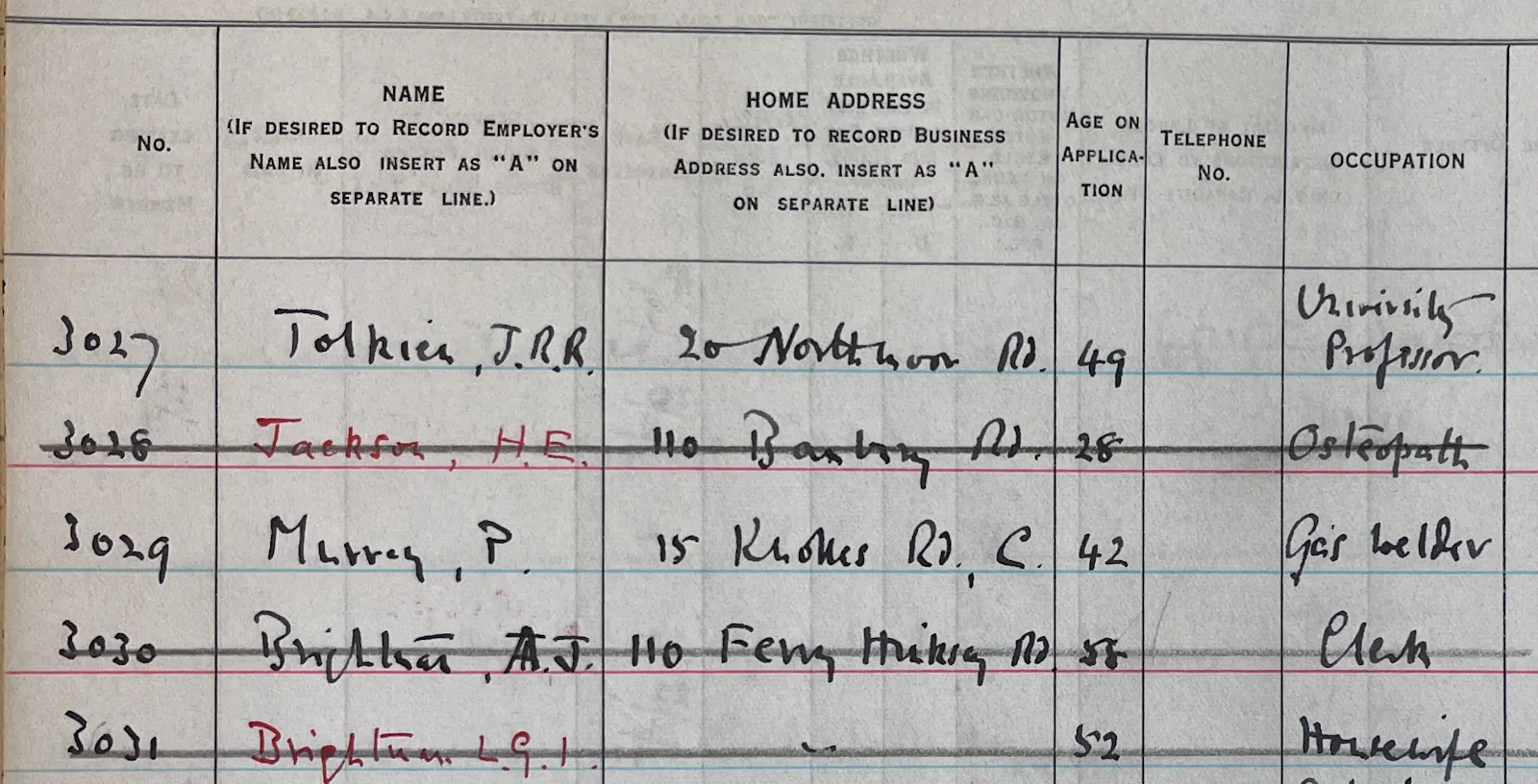
It’s unlikely to be coincidence that Medawar and Jackson, who lived under the same roof, turned up to enrol on the same day as each other.
What about Tolkien? There are good reasons to think he knew the zoologist.
First, Peter Medawar was a fellow of Magdalen College like C.S. Lewis. Lewis was a friend to both men – and also (as the existence of the Inklings attests) a social magnet who loved to bring interesting people together.
Second, Tolkien and Medawar were both among the north Oxford locals who had rushed to the scene of the Linton Road bomber crash in May 1941.
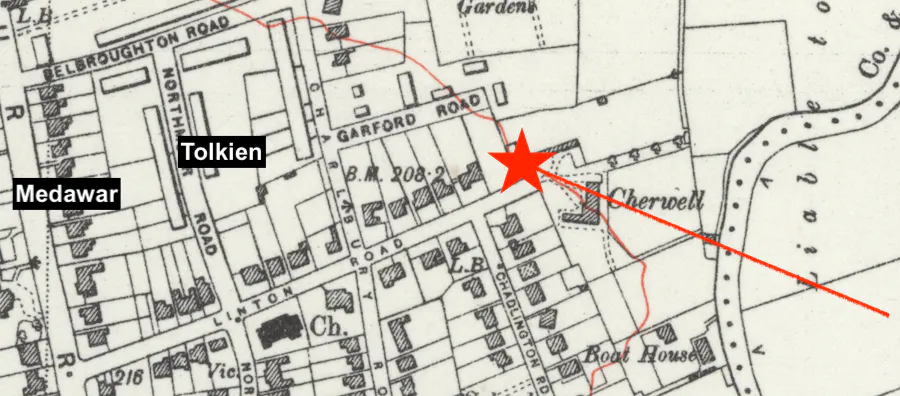
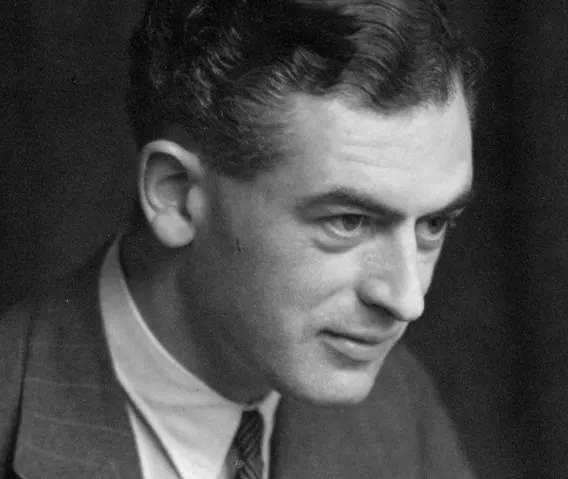
For both Medawar and Tolkien, the end of September was almost the last chance to take on a fresh commitment before academic duties resumed the following week ahead of the autumn (Michaelmas) term.
Taken together, all this suggests that Tolkien, Jackson and Medawar went along to the city hall to enrol together, with Medawar acting as the link and linchpin.
It reminds me of how Tolkien had striven to join the same battalion as his friend Geoffrey Bache Smith in the First World War; and how Smith himself had joined that battalion, the 19th Lancashire Fusiliers, in company with Wade-Gery and other Oxford men.
As characters in The Lord of the Rings know, there’s courage in companionship.
Even before I read her paper, I was wondering whether Tolkien’s experience of the bomber crash spurred him to enrol as an air raid warden. In her memoir of her brother, Priscilla says it was seeing the crashing bomber that ultimately led Christopher to join the Royal Air Force. Actually attending the horrific scene of the crash can hardly have failed to affect Tolkien senior.
On my visit to the archives, I gathered more information to c0nsider from Oxford’s Air Raid Precautions bulletins and a scrapbook of relevant local newspaper cuttings.
But for now, the additional evidence from the enrolment register suggests that the May crash was the joint spur for him and Medawar at least.
❖ I’m writing this blog to raise funds for my Oxford DPhil on modern war and The Lord of the Rings. If you’ve enjoyed this post and want to read more from me about Tolkien, please consider lending me your support by subscribing to one of my membership plans (Abre numa nova janela).
[1] (Abre numa nova janela) Kristine Larsen, ‘A Plane, a Plaque, and a Prize: J.R.R. Tolkien and Peter Medawar’ (Journal of Tolkien Research, vol. 2, no. 2, 2025). I thank Wayne Hammond and Christina Scull for a helpful reply clarifying their rationale. Priscilla’s letter appeared in the Oxford Times, 20 October 1989.
[2] (Abre numa nova janela) Medawar and his biologist wife Jean are also recorded at 110a Banbury Road in the 1939 Register of England and Wales, a population census carried out in preparation for the expected war. In her essay, Larsen points out that Medawar and Tolkien joined the same day, but does not go so far as to suggest that they may have enrolled together, nor note that Jackson lived at the same address as Medawar.
Read more…
The day Tolkien became a WW2 air raid warden (Abre numa nova janela)
The bomber crash that sent Tolkien racing from his home (Abre numa nova janela)
 (Abre numa nova janela)
© John Garth, 2026. All rights reserved.
Data
22/06/2026
Tópico
Biography
4 comentários
Gostaria de ver os comentários?
Torne-se membro de John Garth on Tolkien’s life and works para participar no debate.