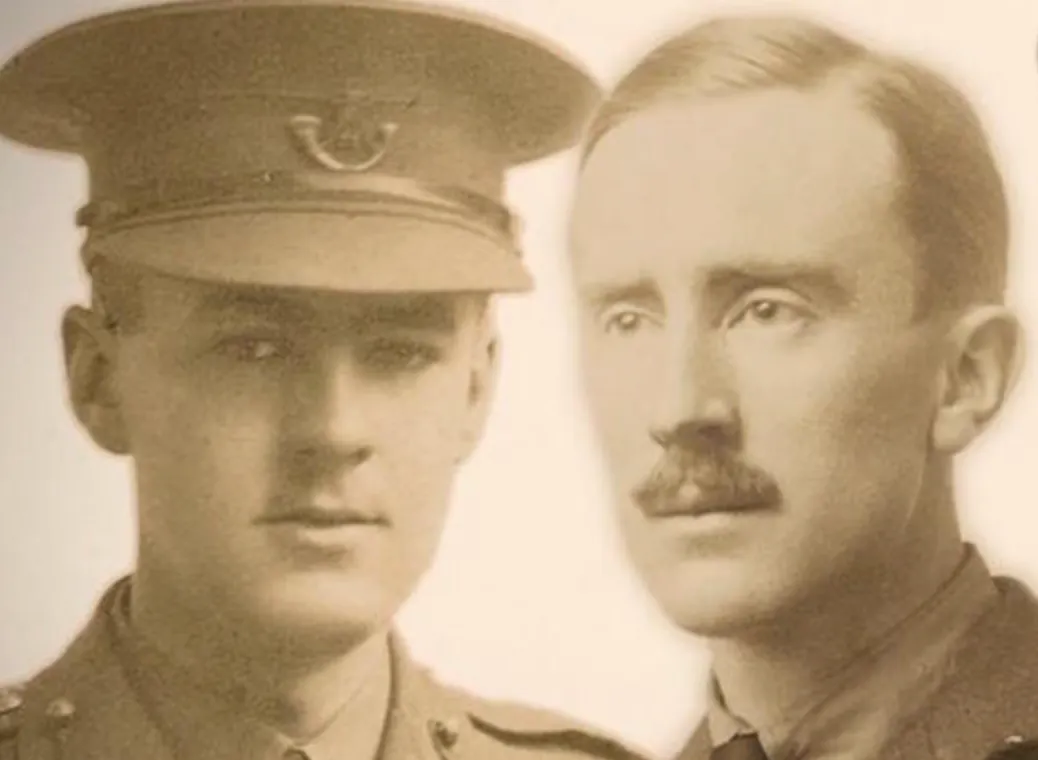
This week we welcome a pioneering collection of essays on the friendship most responsible for laying the path to Middle-earth.
J.R.R. Tolkien and G.B. Smith: With Wind in our Ears takes its subtitle from Tolkien’s 1915 poem ‘Courage Speaks to a Child of Earth’, dedicated to the T.C.B.S:
In boundless course
On a wingéd horse
We’ll dare the outer splendour
With the wind in our ears
Of the seven spheres
And the lost Earth faded slender.1
In writing Tolkien and the Great War, I felt I got to know the almost irrepressible Smith, in all his comic thrusts and passionate candour. So I’m genuinely moved to see this book come to fruition. And I’m delighted to introduce Smith anew, in a chapter on his origins, background, and growth into the young man who inspired Tolkien.
 (Opens in a new window)
Edited by Professor Giuseppe Pezzini of Smith’s Oxford college, Corpus Christi, this book contains the rich and various fruits of the conference he hosted there in 2023.
I provide the opening chapter, ‘“A Perfect Genius”: G.B. Smith among Family and Friends’. Grace Khuri uncovers Smith’s activities at the Oxford Union debating society and reproduces his final published words. Oronzo Cilli provides a publication history of Smith’s poetry, including previously unknown or forgotten items. That wraps up the section on ‘Life, Context, History’.
A section on ‘Genres, Resonances, Criticism’ examines Smith and Tolkien as war poets (Stuart Lee) and as vessels of classical tradition (Pezzini). Mark Atherton examines the influence of one Smith poem, Rime, on Tolkien. Kris Swank traces a single medieval motif through Longfellow to Smith and finally (with amazing effect) to Tolkien. Federica Calabrese looks at the friends’ response to the Glastonbury legends. And Allan Turner soberly assesses Smith as an ‘apprentice poet of his time’.
As an epilogue, Ivano Sassanelli reflects on the friends’ 1916 letters to each other about death and the T.C.B.S. His aim is to determine ‘if Tolkien remembered and (perceived himself to have) fulfilled the mission of the T.C.B.S. in the terms imparted to him by his friend G.B. Smith before his death’.
An appendix provides the full text of Smith’s posthumous volume of verse, A Spring Harvest, edited by Tolkien with Christopher Wiseman.
I’m still reading and absorbing the papers, but so far it’s a feast. Clearly, contributors have put in much valuable work beyond what they were able to prepare for the excellent 2023 conference. I certainly have.
 (Opens in a new window)
Smith’s family roots – old agrarian on one side and new industrial on the other – reflect the dominant divisions in the area of West Bromwich, where he lived, and Birmingham, where he schooled. The tragic death of his father ushered in a creative awakening as a poet. His deceptively simple poem ‘It was all in the Black Countree’ can be revealed as an elegy for his father, drawing from the symbolism of the football club he had passionately supported.
If young Geoffrey Bache Smith came to the notice of the older Tolkien and friends in his first few years at King Edward’s School, it was probably only because his big brother, Roger, was in their ‘house’. Remarkably, he probably first made a real impression on them on the very day Tolkien left for good – Speech Day, July 1911, when he vied with them for English prizes.
Smith became an energetic contributor to the school’s cultural life and its quarterly Chronicle – including one serious poem omitted from A Spring Harvest. Despite lack of attribution by the Chronicle, several comic verses also seem to carry Smith’s fingerprints.
But when it came to literature, Smith was in earnest.
A school literary society talk on ‘Early English ballads’ in 1911 shows Smith engaging with contemporary critical thought on the topic – and foreshadows ideas that would only emerge for Tolkien in 1914–15.
Smith’s interest in Celtic myth and legend – also crucial to Tolkien – has roots in location and family. But it may well go back to the influence of an older boy at King Edward’s, Denis Macwiney, of Irish parentage. Smith acquired a small collection of books that passed ultimately to both Tolkien and Wiseman. While still at school, he had a poem, To the Ancient Heroees of the Cymry, published in Wales: A National Magazine. (Revised as ‘Dark is the world our fathers left us’, this one did appear in A Spring Harvest.)
When addressing the school literary society on the Arthurian legends, he argued that everything from the French romances to Malory to Tennyson was ersatz in comparison with the original glimpses since in the Welsh Mabinogion tale of Culhwch and Olwen. This talk, too, anticipated several of Tolkien’s founding creative principles.
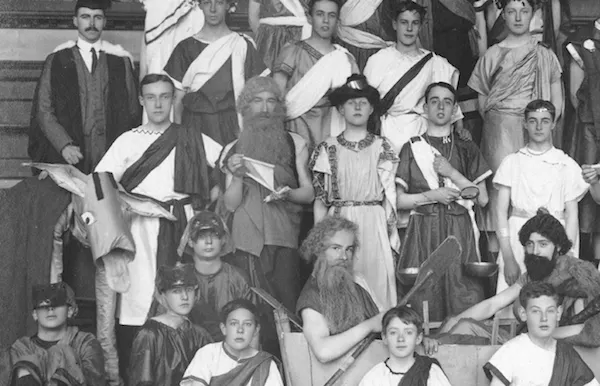
Smith rounded off his school career with Speech Day, 1913. He won more literary prizes and gave two contrasting stage performances – one a ‘characteristically energetic’ role in French, the other in a non-speaking part as an ass.
And then it was off to Oxford – where Tolkien and the Great War takes up the story.
My thanks and congratulations to Giuseppe Pezzini for conducting this book into being, and to all the contributors for playing their parts.
Read an excerpt from my chapter here. (Opens in a new window)
J.R.R. Tolkien and G.B. Smith: With Wind in Our Ears is published by Palgrave Macmillan. You can view the contents here (Opens in a new window). Fortunate people with the right academic institutional subscriptions can read the book there too. Right now, it is available in hardback for a cool £120. But next year’s paperback edition will be a much more affordable £30.
© John Garth, 2026. All rights reserved.
 (Opens in a new window)
Collected Poems, 149. ↩
Date
May 23, 2026
Topic
News
0 comments
Would you like to be the first to write a comment?
Become a member of John Garth on Tolkien’s life and works and start the conversation.