February 2023
As a result of the Russian invasion of Ukraine, almost one-third of Ukrainians have been forced from their homes, making it one of the largest human displacement crises in the world today. In December 2022 there were more than 7.8 million refugees recorded across Europe and more than 4.7 million refugees from Ukraine registered for Temporary Protection or similar national protection schemes in Europe (UNHCR flash update 36 (Öffnet in neuem Fenster)).
Around 90% of the refugees are women and children and most of them hope to only stay temporarily in their host country. However only 13% expected to return within the next three months following their arrival (UNHCR Regional Intentions Report). For those who plan to stay permanently, a lack of safety and access to basic services as well as inadequate living conditions are the main reasons to not to return to Ukraine.
The war is changing the migratory situation in many EU countries significantly and the distribution of refugees across member states is imbalanced. Poland is playing the most important role in receiving refugees from Ukraine due to the common border and the long-lasting dynamics of labour migration between the two countries. Most of the 7.6 million refugees recorded across Europe, are in Central and Eastern Europe, as recorded in Map 1 which shows the share of Ukrainian refugees of the total population in EU countries as of 16 December 2022.
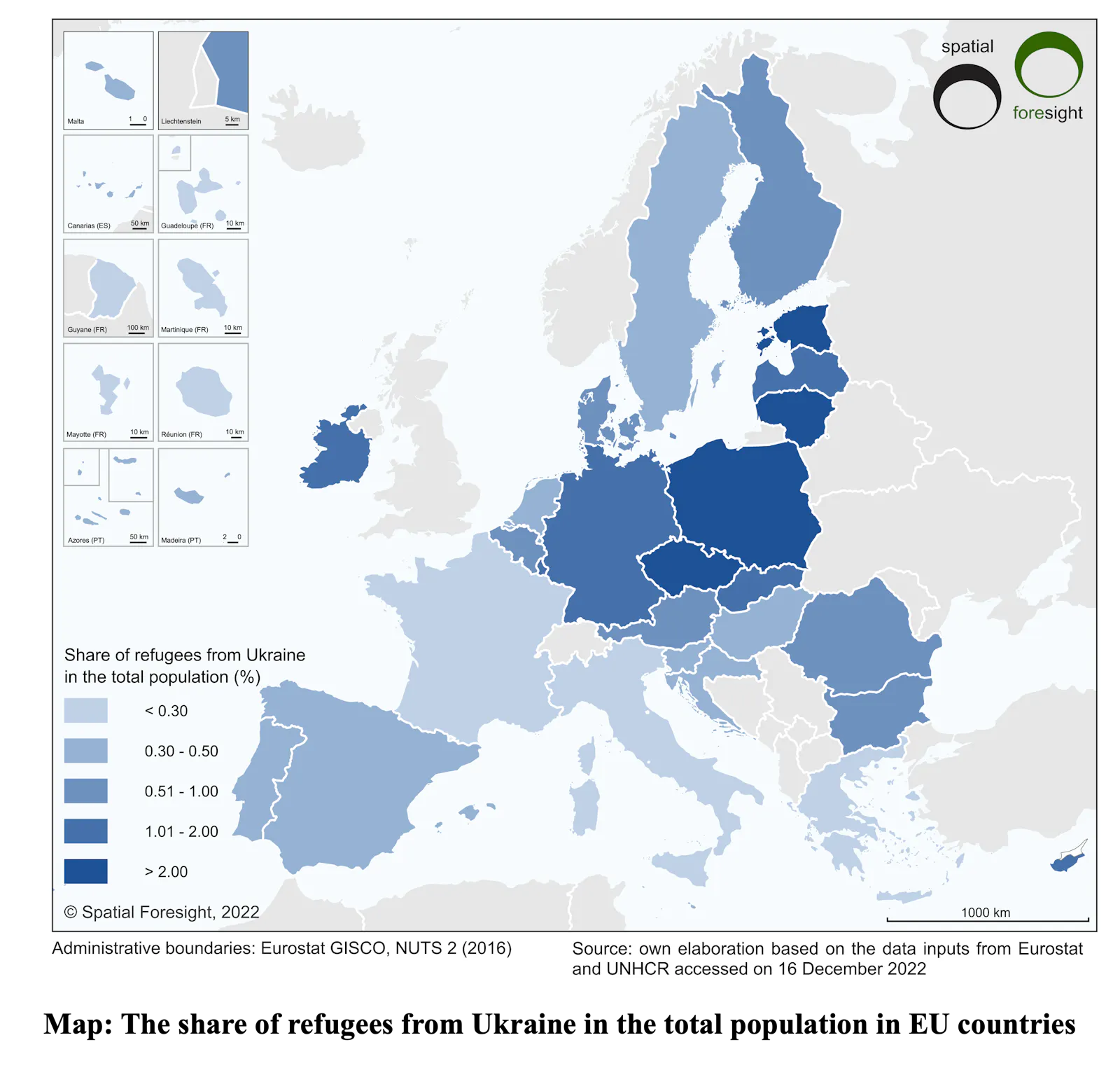
In transit countries such as Romania, Hungary and Slovakia refugees are only staying for a short duration. On the other hand, in destination countries such as Poland and Czechia, Ukrainian refugees mainly plan temporary stays. The differences in the numbers of refugees are even more pronounced at local and regional level, especially between urban and rural areas.
What are the effects for the receiving countries?
The influx of refugees poses many challenges for areas receiving refugees from Ukraine regarding emergency support, accommodation, medical care, education and employment.
Accommodation: the demand for housing varies among the receiving countries. Transit countries (e.g. Romania, Hungary) mostly need to provide short-term accommodation, while destination countries like Poland and Czechia are providing more possibilities for long-term stays. In addition, the response of local authorities is challenged by the uncertainty of the duration and intensity of the war. However, most refugees from Ukraine have been accommodated by volunteering actors and through private social networks, exposing them to the risk of trafficking, exploitation and violence.
Social services: Especially cities experience the pressure of overloaded and insufficiently financed social services like psychological care and first step assistance. Therefore, many governments attempted to encourage a move to more rural areas to rebalance the social care systems.
Healthcare: The provision of equitable access to adequate healthcare depicts a challenge for the hosting countries, especially in densely populated regions in which the healthcare systems are already under pressure.
Education: Providing access to the educational system is challenging for the local and regional authorities due to skills shortage. Some countries are organisingprogrammes with Ukrainian teachers (e.g. Czechia), while others are establishinglanguage courses so they can integrate into the country’s education system (e.g. Romania).
Labour market: The lack of recognition of qualifications is one of the key reasons why the integration of refugees in labour market is challenging. To facilitate labour market integration, it is important to cover the entire process from recognition of pre-existing qualifications and experience to training, job-search support, to workplace integration.
Language barrier: Especially for the last three challenges mentioned above, language barriers impede their provision since they involve a long-term support and integration into complex systems directly connected to personal lives.
How did the EU react in terms of cohesion policy?
In order to equip member states, regional and local authorities according to these various needs and help them tackling the challenges entailed by the influx of people, the EU level responded swiftly, particularly related to financing. Although the Multiannual Financial Framework 2014- 2020 has already been replaced by the current one (2021-2027), the allocation of the former budget still impacts local capacity of responding to migration flows, due to the delay of spending the money. EU cohesion policy has already partially addressed the admission and integration of refugees through the European Regional Development Fund (ERDF) and the European Social Fund (ESF).
31 March 2022: The Cohesion’s Action for Refugees in Europe (CARE)was adopted, extending the possibility of 100% EU-funding and enabling member states to transfer resources between the programmes and funds (e.g. ESF and ERDF) to make more projects eligible for funding. It also facilitated that national expenditure for supporting refugees became eligible for financing and reporting processes were simplified.
07 April 2022: CARE+ was adopted on the 7th of April, increasing the pre-financing from the Recovery assistance for cohesion and the territories of Europe programme (REACT-EU) from 11 to 15% for all member states and up to 45% for member states bordering Ukraine or member states with a significant share of refugees (> 1% of national population). In addition, the introduction of Simplified Cost Options enabled easier and faster support. By reallocating previously unused cohesion policy funding within CARE and CARE+, € 17 billion were mobilised.
20 July 2022: The Flexible Assistance for Territories (FAST-CARE) package was adopted aiming at a solution with more long-term vision and amending both funding periods. It includes further flexibility and increases Simplified Cost Options and strengthens the position of local and regional authorities.
TThe amendments concerning increased flexibility, simplified processes as well as the adapted co-financing rate and pre-financing measures were also applied to the new funding period 2021-2027. Additional sources for funding are the Fund for European Aid to the Most Deprived (FEAD), the Asylum, Migration and Integration Fund (AMIF) and sectoral funds (e.g. Erasmus+).
Since the original purpose of cohesion policy is reducing disparities and creating social, economic and territorial cohesion on the long term, discussions have occurred about its application and suitability as an instrument for short-term crises response. In addition, since a major share of the mobilised money derives from unused but already allocated funding, the amount is limited to a certain extent. Although the quick response is highly appreciated by local and regional authorities, there are concerns that the resources were neither sufficient nor appropriate to tackle these types of crises in their entirety.
Russia’s invasion of Ukraine will have significant economic consequences for the European Union. Cohesion policy aiming to promote economic, social, and territorial convergence is increasingly used as a crisis response tool which could go against achieving its long-term goals such as digital, green and just transition. Should cohesion policy act as a support for different territories tackling emerging crises and becoming more flexible or should cohesion policy be dominantly focused on achieving its long-term goals?
by Kirsti Hagemann and Paola Marinović
https://steadyhq.com/en/spatialforesight/posts/499e2eee-886e-4ebe-9a41-ff752327ea1f (Öffnet in neuem Fenster)
Datum
06.02.2023
Kategorie
Cohesion (policy)
0 Kommentare
Möchtest du den ersten Kommentar schreiben?
Werde Mitglied von spatialforesight und starte die Unterhaltung.