The cohort graduating into software work in 2026 enters a labour market in which the entry-level rung has been quietly compressed by AI, and the empirical record on what happens to displacement cohorts is unambiguous.
When Eric Schmidt (former CEO at Google) addressed University of Arizona graduates earlier this month, the booing that interrupted his remarks came from students who had spent two years reading labour-market reports and who recognised, with an accuracy their elders found uncomfortable, that the rung (metaphorically, the horizontal bars on a ladder) they had trained to step onto was disappearing while they trained.
The empirical signal had arrived three months earlier. In February 2026, the Federal Reserve Bank of New York released its annual update of Labor Market Outcomes of College Graduates by Major. Computer Science and Computer Engineering had crossed a threshold most observers had not expected to see in this decade. The data placed both inside the same unemployment band as Anthropology and Fine Arts, and the safe-major thesis that had governed undergraduate decisions for three decades was, as a matter of public record, no longer supported.
The argument in this issue rests on two claims. The 2026 cohort presents the profile of a displacement cohort rather than a recession cohort, and the scarring literature is unusually clear about what that implies. The available structural responses fall into two categories, one societal and one organisational, neither of which is sufficient alone. The title compresses the logic: disarming AI is a task for the state, re-arming teams is a task for the firm.
Where the entry rung is eroding
The New York Fed report released on 4 February 2026, drawing on 2024 data, places Computer Engineering at 7.8 percent unemployment among recent graduates, with 15.8 percent underemployment, a median early-career wage of ninety thousand dollars, and a mid-career median of one hundred and thirty-one thousand (Federal Reserve Bank of New York, 2026). Computer Science sits adjacent at 7.0 percent unemployment, 19.1 percent underemployment, eighty-seven thousand at entry, and one hundred and twenty thousand at mid-career.
The two computing majors now share an unemployment band with Anthropology at 7.9 percent and Fine Arts at 7.7 percent. Mid-career wages remain elevated, which keeps lifetime expected value defensible for those who survive the first five years; the open empirical question is who survives them.
The underemployment figure carries the displacement signal more clearly than the headline unemployment rate. Underemployment here means working in a role that does not require a bachelor’s degree, and for Computer Science, nearly one in five recent graduates is now in such a role. The conventional reading treats an unemployment spike as cyclical and an underemployment spike as structural; when both rise together for the most credentialed degree in the modern economy, the structural interpretation is the more economical one.
Why a bad first year scars for life
The empirical literature on cohort effects is among the most settled bodies of evidence in labour economics. Software leaders planning against the AI displacement curve without consulting it are planning blind.
Oreopoulos, von Wachter and Heisz (2012) examined Canadian graduates of the late-1970s and early-1980s recessions and found that an unlucky graduation year produced wage penalties detectable a decade later, with persistent effects even for the highly credentialed. Schwandt and von Wachter (2019) replicated the finding across the United States. Their “Unlucky Cohorts” analysis showed that graduating into a weak labour market produced durable wage suppression, elevated mortality, lower marriage rates, and reduced occupational matching, persisting into the fifth decade of life. The Stanford Institute for Economic Policy Research has summarised the policy implications of this body of work (Schwandt, 2019). The mechanism is sequential: the first job determines the second, the second determines the firm-type and the city, and these together determine the network density that shapes the next two decades. An initial mismatch entrenches rather than corrects through subsequent labour-market exposure.
The 2026 cohort is not graduating into a recession in the technical sense, since aggregate employment is not contracting as it did in 1982 or 2009. The contraction is confined to the entry-level rung. Macro demand is intact; absorption capacity for juniors has been compressed by AI tools that perform the work juniors used to do. This profile is structurally worse than the recession-cohort scenario, since in a recession the entry-level structure remains intact and waits for demand to return, whereas in a displacement scenario the rungs themselves are removed. The prudent assumption for any leader making a 2026 hiring decision is that Oreopoulos and Schwandt set a lower bound on the damage, not an upper one.
The societal lever: why regulation is the unglamorous answer
In his first encyclical Magnifica Humanitas (25 May 2026), Pope Leo XIV called for artificial intelligence to be “disarmed” and freed from the logics of domination, exclusion, and death (Pope Leo XIV, 2026). The moral framing isolates the question that the rest of the regulatory machinery is trying to answer: what does it mean to disarm a general-purpose technology that produces value precisely by being deployed at the cognitive layer where junior labour used to live?
The European regulatory stack offers the clearest available structural response. The EU AI Act, Regulation (EU) 2024/1689, classifies systems used in employment, education, and worker management as high-risk and imposes human-oversight obligations on them (European Parliament and Council, 2024a). The mechanism that matters for displacement is embedded in Article 14: by requiring a human in the loop inside the screening, allocation, and evaluation systems that decide which junior workers are hired and what work they receive, the Act imposes a compliance cost on the substitution of automation for entry-level labour, and that cost is the channel through which the displacement rate can plausibly be slowed.
The Platform Work Directive, Directive (EU) 2024/2831, addresses algorithmic management. It establishes a presumption of employment for platform workers and imposes transparency obligations on the algorithms that assign, rate, and dismiss them (European Parliament and Council, 2024b), slowing the conversion of stable entry-level roles into gig-style displacement. The Digital Services Act and the Data Act sit upstream, raising the cost of opaque automated decision-making.
No empirical evidence yet exists that the European stack will measurably slow graduate displacement; the Act came into force too recently for outcome studies to be possible. The case for treating it as a lever rests on mechanism rather than on outcome data. If displacement is occurring at the cognitive layer of work, regulation that imposes human oversight at that same layer is the structurally appropriate response, and waiting for outcome studies mirrors the more general problem of waiting for the wage-scarring data on the displacement cohort itself: by the time either data set exists, the cohort it would document has already absorbed the damage.
The empirical record on cohort scarring replicates across Canadian, American, and European datasets, and the mechanism by which AI compresses the entry rung produces equivalent dynamics in San Francisco and in Stockholm. Whether regulation is the correct response remains analytically open. Whether some structural response is needed is settled by the data, and the European stack is the most articulated answer currently on offer.
The organisational lever
Regulation operates at the macro level and acts slowly. Inside the firm, the lever is team composition, and the empirical record here is sharper than the regulatory one.
What we actually know about diversity in software teams
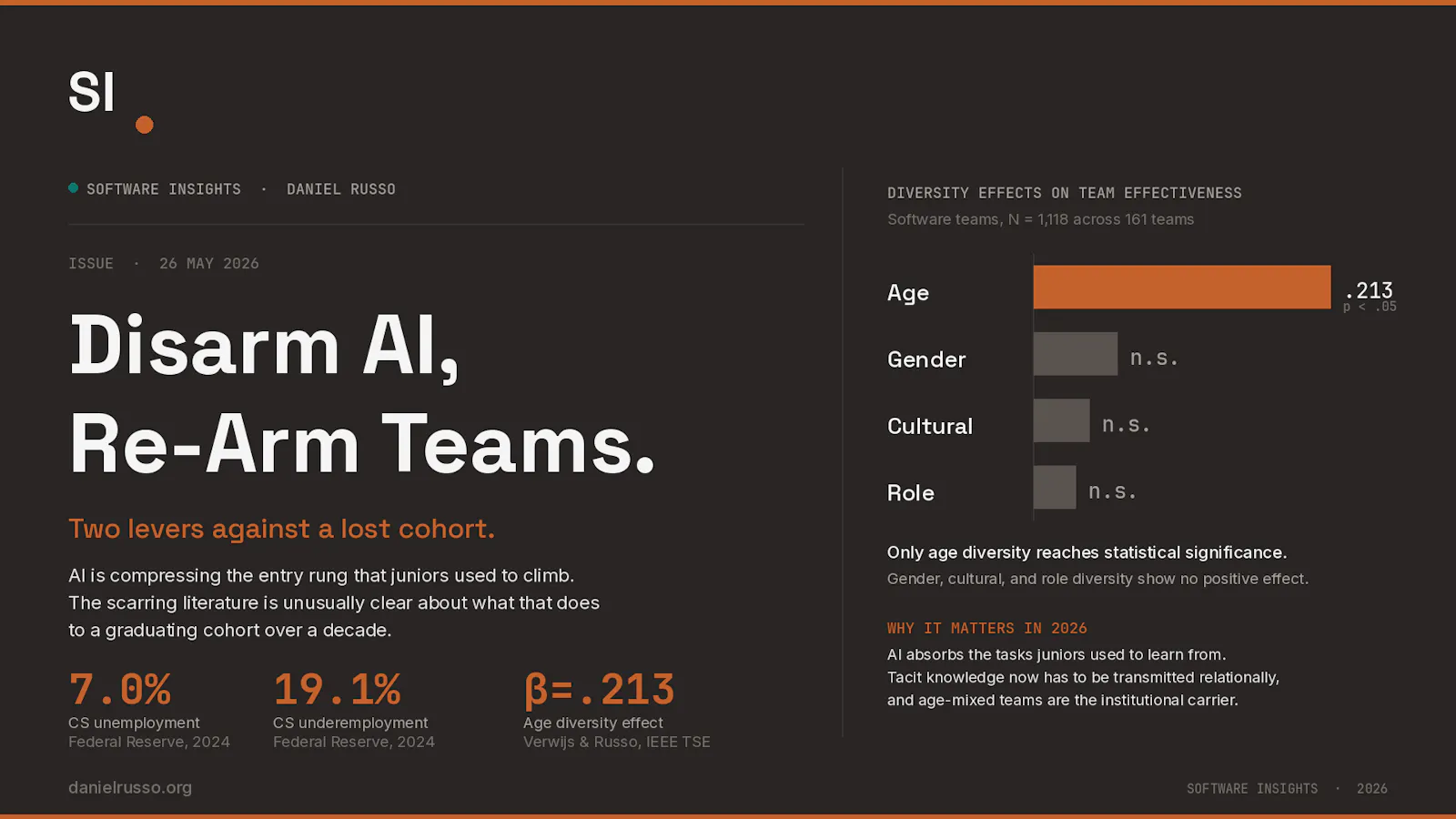
Verwijs and Russo (2024) analysed 1,118 software engineers across 161 teams using covariance-based structural equation modelling. The frame was the categorisation-elaboration model, which integrates two opposing predictions: diversity expands the cognitive resources available to a team, and diversity also produces social categorisation and relational conflict that erode outcomes. The study tested four diversity dimensions, gender, age, cultural background, and functional role, with psychological safety as a social moderator. The model fit the data well (CFI = .988, RMSEA = .036) and explained 40.7 percent of variance in team effectiveness.
The result that matters for this issue
Among the four dimensions, only age diversity produced a statistically significant positive effect on team effectiveness. Gender, cultural, and role diversity produced no significant positive effect. Gender diversity was associated with higher relational conflict. Psychological safety contributed substantially both to effectiveness and to lower conflict, but it did not moderate the diversity-effectiveness link. The analytically important result is the asymmetry across the four dimensions, not the existence of a diversity effect in general.
“Only age diversity improves team effectiveness directly. In other words, teams are more effective when their members vary in age. This is probably a proxy for differences in tenure and experience that encourage innovation and creativity. However, generational differences in work values have also been found to be relevant. Either way, this is in support of cognitive resource diversity theory and its prediction that diversity expands cognitive resources that teams have access to” (Verwijs & Russo, 2024, p. 151).
The standardised coefficient for the age-diversity effect was .213 at p < .05, and the coefficient for psychological safety on effectiveness was .660 at p < .01. These two findings carry most of the model’s explanatory weight.
Why age diversity buys what AI is destroying
The age-diversity finding inherits its mechanism from Pesch, Bouncken and Kraus (2015), who argue that age diversity is best understood as a proxy for tenure heterogeneity and accumulated work experience rather than chronological age. Age-mixed teams contain, by composition, the tacit knowledge that has to be transmitted from those who have it to those who do not.
This mechanism becomes load-bearing in a workflow compressed by generative AI. Junior engineers historically produced the artefacts through which they learned: boilerplate, small bug fixes, refactored legacy modules, and through that production developed the muscle memory of competent practice. AI now produces those artefacts faster than juniors can. The artefacts arrive in the codebase, the codebase compiles, and the juniors learn nothing, because the learning was in production.
Tacit knowledge is the second-order casualty of this compression. Production has been automated, so tacit knowledge can no longer be acquired through producing artefacts; it can only be transmitted relationally from someone who already holds it. Age-mixed teams are the institutional carrier of that transmission; tenure-homogeneous teams, whether all-junior or all-senior, break the belt. The Verwijs and Russo finding, therefore, does more empirical work in 2026 than it did in 2024, because the mechanism it identifies is precisely the mechanism that AI workflow compression destroys at the cohort level, and that team design can restore at the firm level.
Connecting the two levers
The two levers are complementary, and their relationship is asymmetric in time. Regulation alone cannot create mentorship inside a firm: the AI Act can constrain the rate at which juniors are displaced from the labour market, but it cannot oblige the seniors inside any given firm to allocate the calendar hours required to transmit tacit knowledge. That allocation remains an organisational choice. Team design alone, conversely, cannot stop displacement at the macro level. Firms that wait for regulation to force the issue will discover, around 2031, that the cohort gap is no longer repairable, because the seniors who could have trained the missing juniors will themselves have retired, and the juniors who could have learned from them will have left the field.
The playbook: an organisational audit
Eight diagnostic actions a software organisation can run this quarter. Each item below is framed as a measurement the team can take rather than as an aspiration the team can hold.
1. Compute the tenure standard deviation per team. Flag any team where the standard deviation is below the firm-wide median minus one standard deviation. These are tenure-homogeneous teams, regardless of how the head count was selected.
2. For each engineer hired in the last twelve months, measure the proportion of merged code in their first six months substantially authored by them without AI assistance. A proportion under 25 percent is a transmission-belt failure signal.
3. Audit whether mentorship time is logged. Mentorship that is not logged is, in practice, not happening, and mentorship that is logged but does not carry weight in performance review operates on borrowed time.
4. Audit how the firm reads the AI Act. A compliance-only reading treats it as a tax. A strategic reading treats it as a planning constraint that shapes the rate at which competitors can substitute automation for entry-level labour.
5. Measure psychological safety using a validated instrument rather than a culture survey. The Verwijs and Russo coefficient of .660 was obtained because the construct was operationalised through an established scale.
6. Cross-tabulate the firm’s graduate hiring rate against its AI-tooling spend over the last twenty-four months. If the two move in opposite directions without an explicit policy decision documenting why, the firm has made a strategic choice by drift.
7. Identify the three engineers who hold the most tacit knowledge about systems older than five years and audit their calendars for transmission time. Where peer meetings fill the week, and meetings with juniors are absent, the firm is consuming its seniority capital rather than reproducing it.
8. Examine the firm’s reading of the Platform Work Directive. Even firms without platform workers are affected by the signal it sends about algorithmic management transparency.
Next moves
For the Builder
Position yourself in an age-mixed team and stay there. Over the next five years, the asset that compounds in value is the senior engineer you are paired with; language models will continue to improve, but they do not transmit tacit knowledge, and senior colleagues do. Identify which seniors hold tacit knowledge in your firm and find reasons to share work with them, even when AI would let you finish the task alone. Read structural signals carefully: a team with a flat tenure distribution, a graduate hiring rate below replacement, and a manager who measures throughput but not learning. These predict where you will be in 2031.
For the Manager
Read your team’s tenure distribution as a leading indicator of two-year effectiveness rather than as a demographic statistic. A team converging toward tenure homogeneity in either direction has lost the transmission mechanism, and the loss becomes visible only later, when seniors leave, or juniors stall. Defend junior head count against short-horizon AI productivity arguments by stating the asymmetric risk: the firm can recover from a year of lower throughput more easily than from a generation of missing engineers. Pair psychological safety with age mixing rather than treating one as a substitute for the other; the Verwijs and Russo data indicate that the two are independent contributions and that safety does not moderate the diversity effect.
For the Roadmap Owner
Treat graduate hiring as institutional research and development. The accounting framing of graduates as a cost centre understates the option value of seniors trained inside the firm five years out, and the demographic arithmetic linking the 2026 cohort to the 2035 leadership is not negotiable. Reframe the AI Act as a strategic planning constraint rather than a compliance tax. The same constraint shapes the rate at which competitors can substitute automation for labour, which converts it from a firm-level tax into an industry-wide pacing mechanism. Commit to a documented hiring floor for graduates over the next three years and report against it.
Closing
The students who interrupted Eric Schmidt at the University of Arizona were responding to the assumption that their displacement was an acceptable price for someone else’s optimisation, and the labour-market data released three months earlier had already vindicated their reading. Their objection was directed at the political economy in which AI is currently being deployed, not at the technology itself.
The two-lever argument that this issue has set out runs as follows. At the level of the state, disarming AI means imposing human-oversight requirements that constrain the rate at which juniors can be substituted out of the cognitive workflow.
At the level of the firm, re-arming teams means restoring the age-mixed composition that allows tacit knowledge to be transmitted through the transmission belt that the workflow compression has cut.
Both responses operate inside the same closing window.
Daniel Russo, Ph.D., is a Professor of Software Engineering whose research examines the intersection of human cognition and artificial intelligence. Through “Software Insights,” he translates empirical research into actionable guidance for software practitioners and organizations.
If this issue surfaces a problem your organisation has been trying to name, I work with engineering leaders to diagnose exactly that kind of challenge, using the same methods behind the research you just read. No frameworks. No opinion without evidence.
danielrusso.org/advisory (Opens in a new window)
References
European Parliament and Council. (2024a). Regulation (EU) 2024/1689 of the European Parliament and of the Council laying down harmonised rules on artificial intelligence (Artificial Intelligence Act). Official Journal of the European Union.
European Parliament and Council. (2024b). Directive (EU) 2024/2831 of the European Parliament and of the Council on improving working conditions in platform work. Official Journal of the European Union.
Federal Reserve Bank of New York. (2026). Labor market outcomes of college graduates by major. Federal Reserve Bank of New York.
Oreopoulos, P., von Wachter, T., & Heisz, A. (2012). The short- and long-term career effects of graduating in a recession. American Economic Journal: Applied Economics, 4(1), 1–29.
Pesch, R., Bouncken, R. B., & Kraus, S. (2015). Effects of communication style and age diversity in innovation teams. International Journal of Innovation and Technology Management, 12(6), 1550029.
Pope Leo XIV. (2026, May 25). Magnifica Humanitas [Encyclical letter on artificial intelligence]. Holy See.
Schwandt, H. (2019). Recession graduates: The long-lasting effects of an unlucky draw [Policy brief]. Stanford Institute for Economic Policy Research.
Schwandt, H., & von Wachter, T. (2019). Unlucky cohorts: Estimating the long-term effects of entering the labor market in a recession in large cross-sectional data sets. Journal of Labor Economics, 37(S1), S161–S198.
Verwijs, C., & Russo, D. (2024). The double-edged sword of diversity: How diversity, conflict, and psychological safety impact software teams. IEEE Transactions on Software Engineering, 50(1), 141–160.
Date
May 26, 2026