October 2025
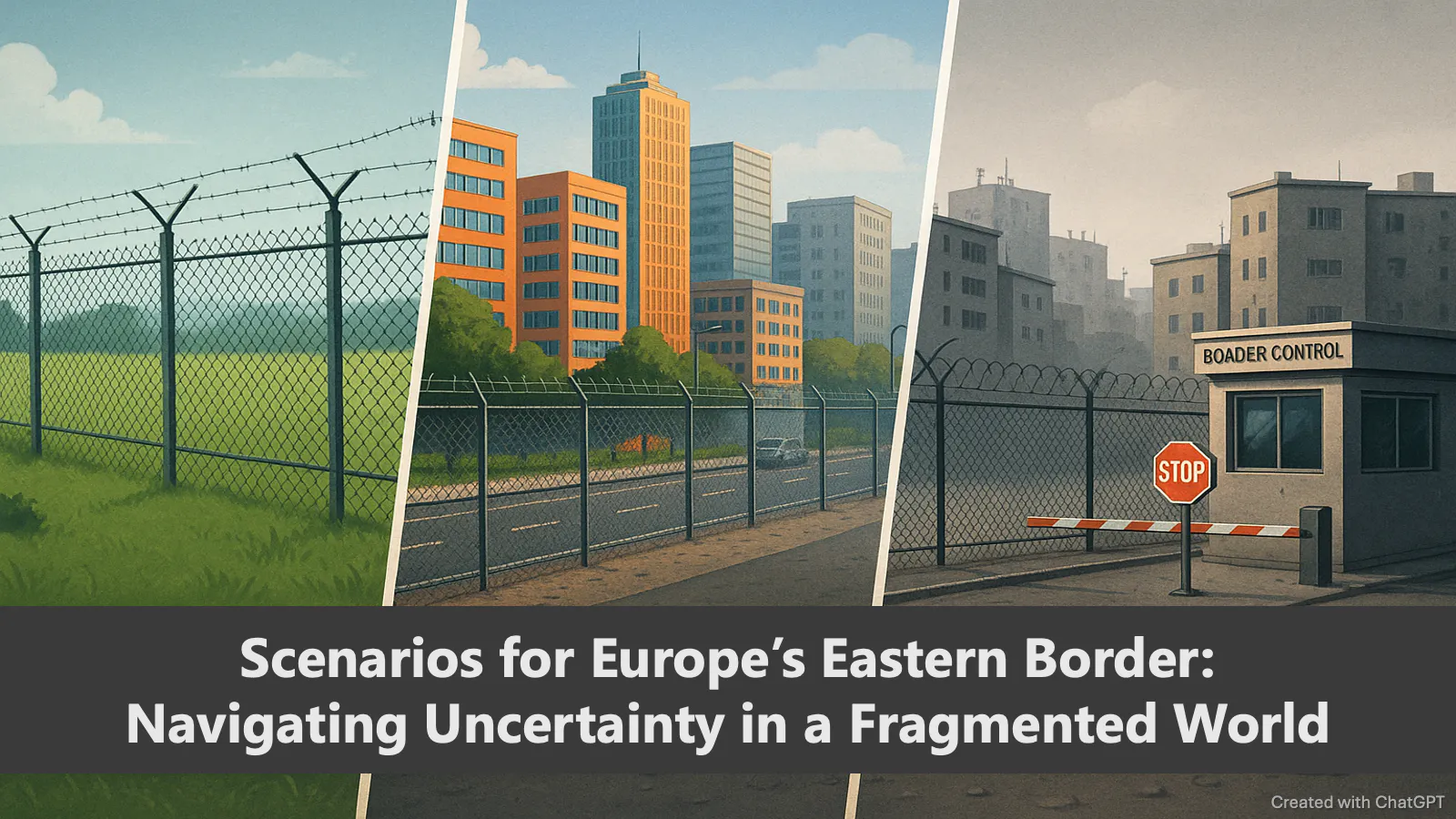
Europe’s north-eastern frontier has once again become a fault line of geopolitical uncertainty. The area, which was once seen as a periphery of integration where cooperation, mobility, and cross-border development could flourish, has become a testing ground for resilience, security, and European solidarity.
The ESPON CHANEBO project (Challenges at the EU’s North-East External Borders (Opens in a new window)) examined potential future scenarios along the EU’s borders with Russia and Belarus. The project's three scenarios — Green EU Buffer Zone, EU Showcasing, and EU–Russia Appeasement — capture diverging trajectories in a world shaped by prolonged instability, authoritarian resurgence, and shifting global power dynamics.
These scenarios are not predictions, but structured reflections on possible futures. They provide a lens through which to understand Europe’s strategic choices and their territorial consequences for the regions of South Karelia (Finland), Ida-Viru (Estonia), Latgale (Latvia), and Utenos (Lithuanian). However, they also prompt a broader debate about the EU’s capacity to maintain security and cohesion along its new geopolitical frontier.
A contested frontier in flux
The EU’s north-eastern border regions, stretching from the Gulf of Finland to the Lithuanian lakes, were once bridges of exchange. They hosted vibrant cross-border cooperation, supported by Interreg programmes and a cooperation framework including Russia, such as VASAB (Visions and Strategies around the Baltic Sea (Opens in a new window)). However, the 2022 Russian invasion of Ukraine shattered this logic, replacing interdependence with isolation and trust with suspicion.
Today, these border regions are at the intersection of militarisation, demographic decline and the EU’s green and digital transitions. They are faced with the dual challenge of defending European values and ensuring viable regional development.
The CHANEBO project engaged these regions in a forward-looking dialogue, exploring the consequences of maintaining current trajectories and the potential outcomes of change. Through participatory workshops with the four regions, stakeholders co-developed scenarios and shared visions for 2035 and 2045 that are anchored in security, resilience, innovation and social well-being.
The vision for 2045 focuses on secure, resilient and thriving borderlands — spaces that transform peripherality into opportunity and geopolitical exposure into a platform for sustainable prosperity. However, achieving this vision depends on the geopolitical evolutions shaping the relationship between the EU and Russia, and how the EU integrates security into cohesion, and how it balances centralisation with local empowerment.
Scenario 1: The Green EU Buffer Zone
In this first scenario, Russia remains a persistent threat, militarily weakened but politically aggressive. In response, the EU is hardening its frontier by investing heavily in defence, surveillance and infrastructure designed for resilience rather than openness.
The Green Buffer Zone concept involves border areas becoming fortified spaces. Military installations and defensive landscapes — sometimes even rewilded marshlands used as natural barriers — replace the once porous frontier. Civilian life becomes secondary to security priorities.
Across the CHANEBO regions, this manifests differently:
South Karelia experiences the emergence of a 'new iron curtain'. Defence spending, cybersecurity and supply resilience dominate local policy. Traditional industries are stagnating as young families leave, leaving behind an ageing population amid landscapes being rewilded. While the region's green identity persists, it increasingly takes the form of 'green militarisation' — a landscape of forests and buffer zones rather than flourishing communities.
Ida-Viru has become a frontline of hybrid warfare. Drones, cyberattacks and disinformation have become part of daily life. While the Estonian 'drone wall' reinforces national defence, local trust is eroding, particularly among the Russian-speaking population. The risk is as much a social one as a geographical one, where militarisation amplifies alienation rather than integration.
Latgale is turning into a heavily securitised frontier. Civilian priorities are sidelined and civic space is shrinking. However, the region's resilience hinges on maintaining trust, inclusion, and transparency. If handled inclusively, however, this scenario could paradoxically foster solidarity and innovation within the constraints of securitisation.
Utenos faces the gravest demographic contraction. The militarised landscape accelerates depopulation as residents leave, transforming large areas into uninhabited 'green corridors' or defence zones. The challenge becomes preserving vitality in depopulated territories, turning abandonment into ecological restoration without surrendering community life.
The Green Buffer Zone scenario is the cost of insecurity: safety achieved through isolation and resilience through contraction. It shows that the EU could win the security race yet lose the territorial one, creating secure yet empty spaces.
However, CHANEBO’s analysis suggests that this outcome is not inevitable. If border regions redefine themselves as adaptive conduits between the EU and its neighbours rather than walls, they could remain spaces of innovation and human security. In this sense, the scenario is a warning: resilience without inclusiveness risks producing stability without life.
Scenario 2: EU Showcasing
In the second scenario, Russia is weakened and no longer poses an imminent military threat; however, it remains an ideological rival. In response, the EU adopts a strategy of ideological competition, transforming its border regions into living examples of democratic success.
These border regions become Europe's showcase, receiving significant EU investment and boasting advanced infrastructure and flagship projects in sustainability, innovation, and civic engagement. Similar to West Berlin during the Cold War, these regions receive substantial public funding to project prosperity and stability towards Eastern Europe.
South Karelia experiences rapid growth fuelled by EU and national funding. Investments in green technologies, mobility, and education are revitalising local economies. However, this growth is fragile and dependent on continued external support. Inequality is widening between urban and rural areas, and social cohesion is weakening as Russian-speaking residents face discrimination amid polarised identity politics.
Ida-Viru is undergoing an industrial renaissance. The Just Transition Fund is accelerating the shift away from oil shale towards renewables and manufacturing. Yet integration and skills shortages remain bottlenecks. There is a risk of a dual economy emerging: a modernised industrial core surrounded by communities that are still struggling with unemployment and alienation.
Latgale is becoming a high-visibility success story — an 'ideological West Berlin' on the EU's eastern edge. EU-branded civic centres, smart mobility hubs and tax-free zones attract investors and returning migrants. While civic pride grows, dependency on Brussels and Riga also increases. The challenge lies in making prosperity self-sustaining rather than performative.
Utenos emerges as a showcase of EU climate leadership, hosting relocated state agencies and green technology hubs. Yet gentrification, social inequality and dependency risks persist. While local governance gains visibility, it has little autonomy, raising questions about the balance between top-down Europeanisation and place-based development.
The EU Showcasing scenario reflects Europe’s optimism about soft power — the belief that prosperity and values can radiate from well-funded frontiers. However, it also highlights a paradox: what if the EU wins the narrative war yet perpetuates dependency?
While these borderlands may indeed flourish under substantial EU investment, their long-term sustainability hinges on economic self-sufficiency, local ownership and democratic depth. Without these, the model risks producing a glittering façade — thriving cities masking uneven development and persistent peripherality.
As the CHANEBO report cautions, 'smart growth must remain inclusive, development must be ecologically aware, and innovation must be tied to civic values'. These are not just principles, but preconditions for resilient democracy in Europe’s borderlands.
Scenario 3: EU–Russia Appeasement
The third scenario envisages a cautious thaw. Russia implements limited democratic reforms, while some EU countries move towards more authoritarian governance. Borders reopen gradually, trade resumes and cultural exchanges resume, but mistrust lingers on both sides.
This is an uncertain future, where neither conflict nor cooperation prevail, but rather an uneasy coexistence. Although economic opportunities return, societal divisions remain raw. Border regions become laboratories of managed reconciliation, re-engaging without illusions.
South Karelia benefits modestly from renewed trade and tourism, but its economy remains fragile and political polarisation is intensifying. Local actors seek partnerships beyond Russia to avoid renewed dependency, deepening ties with the Nordic and Baltic regions.
Ida-Viru experiences cautious revitalisation, with tourism, logistics and free trade zones re-emerging. However, social divisions persist between Estonian and Russian speakers, and integration remains incomplete. This scenario illustrates how mistrust can act as a structural constraint, limiting innovation and participation despite economic opportunities.
Latgale is regaining its traditional role as a gateway between East and West. Cross-border trade resumes, but economic revival is modest and uneven. Local identity is strengthened through cultural revival, but the region risks becoming trapped in a low-income equilibrium. As the report notes, peace may return, but prosperity may not.
Utenos faces the dilemma of renewed connectivity amid persistent insecurity. Despite opportunities in eco-tourism and small-scale entrepreneurship, demographic decline, low investment and institutional fragility remain. There is a risk of appeasement without renewal, where geopolitical détente fails to translate into local resilience.
This scenario reminds us that peace does not necessarily lead to progress. While normalisation may ease tensions, it can also perpetuate structural stagnation. Without trust, transparency and institutional reform, renewed ties could lead to the reproduction of past dependencies and inequalities.
However, there is also a glimmer of hope. If managed wisely, it could foster new forms of cross-border ecological cooperation, cultural diplomacy and innovation partnerships. The key lies in anchoring reconciliation in local empowerment and civic trust rather than in purely geopolitical calculations.
Security, cohesion, and the future of Europe’s borders
Taken together, the three CHANEBO scenarios chart a spectrum ranging from militarised fortification and performative prosperity to cautious re-engagement. Each scenario provides valuable insights for territorial policymaking and European governance.
Rethinking security as a territorial concept. Security is redefined across all scenarios. It encompasses not only the military dimension, but also the social, environmental and informational dimensions. True resilience lies as much in inclusive governance, digital literacy, and local autonomy as in physical defence. Policies should therefore move beyond hard security in order to strengthen comprehensive security, building resilient institutions, diversified economies and empowered communities.
Avoiding the dependency trap. Both the Buffer Zone and Showcasing scenarios highlight the risks of dependency on defence funding or EU subsidies. To sustain vitality, border regions must cultivate local innovation ecosystems capable of generating endogenous growth. Investing in education, skills, and entrepreneurship is key to transforming dependency into capability.
Cohesion as strategic Infrastructure. In the emerging geopolitical order, cohesion policy becomes part of security policy. Investments in infrastructure, housing and connectivity are not just economic tools; they are also instruments of trust and territorial solidarity. The EU’s post-2027 cohesion framework should explicitly integrate territorial preparedness as a dimension of resilience.
Trust as the new frontier. Perhaps the most fragile element in all scenarios is trust: between citizens and institutions; between majority and minority groups; and between neighbouring states. Without trust, even the best-funded strategies will falter. Building trust requires long-term civic education, transparent governance and spaces for dialogue across borders and identities.
Navigating the uncertain edge
The CHANEBO scenarios are based in the north-east, but their implications extend across the continent. They present the border regions as laboratories for the future of the EU, where issues of security, sustainability and sovereignty converge most acutely.
Regardless of whether the future resembles a green fortress, a showcase of democracy or a zone of managed appeasement, Europe’s border regions will continue to test the Union’s ability to combine hard power with soft resilience.
To succeed, the EU must treat these regions as co-creators of the European project, not merely as buffers or symbols, and recognise that they embody both its vulnerabilities and its potential. Their experience highlights that resilience cannot be built solely in Brussels; it must also be cultivated in Lappeenranta, Narva, Daugavpils and Utena.
Indeed, Europe’s eastern border is less a line on a map than a reflection of its political soul. It reflects the Union’s struggle to reconcile security and openness, integration and autonomy, and values and pragmatism.
The CHANEBO scenarios remind policymakers that the choices made in these peripheral regions will determine what kind of Europe emerges by 2045.
A fortified Europe, safe but fragmented;
A performative Europe that is prosperous but dependent;
Or a resilient Europe that is cooperative, inclusive and self-assured.
As geopolitics and territory are closely intertwined, Europe’s future may depend on how it governs its borders. The eastern border, once considered peripheral, could become the core of a renewed European vision.
During their final workshop, the CHANEBO stakeholders took these scenarios a step further. Participants explored together how to develop a shared vision for the border regions and how to strengthen cooperation across borders, institutions and communities. They identified ways to leverage shared knowledge and resources, ensuring that we do not remain passive or 'helpless' in the face of an uncertain future, but instead recognise our own strengths and act collectively. Only together are we strong. In light of the current geopolitical climate and the growing uncertainties along Europe’s eastern frontier, this collective reflection is more urgent and important than ever. The ability to imagine, cooperate and act jointly across borders, which was discussed and developed within CHANEBO, is not just a research outcome, but a call to strengthen Europe’s resilience from its edges inward.
The full scenario report is available here (Opens in a new window).
by Kai Böhme & Jean Claude Zeimet
 (Opens in a new window)
Date
October 27, 2025
Topic
Scenarios & visions
0 comments
Would you like to be the first to write a comment?
Become a member of spatialforesight and start the conversation.