Abundance: How We Build a Better Future by Ezra Klein & Derek Thompson (Profile Books, 2025; paperback).
Read, December 2025.
Headline reaction: This was a deeply frustrating read; it really does not deliver on the hype, or what it ostensibly promises, as I discuss in detail below.
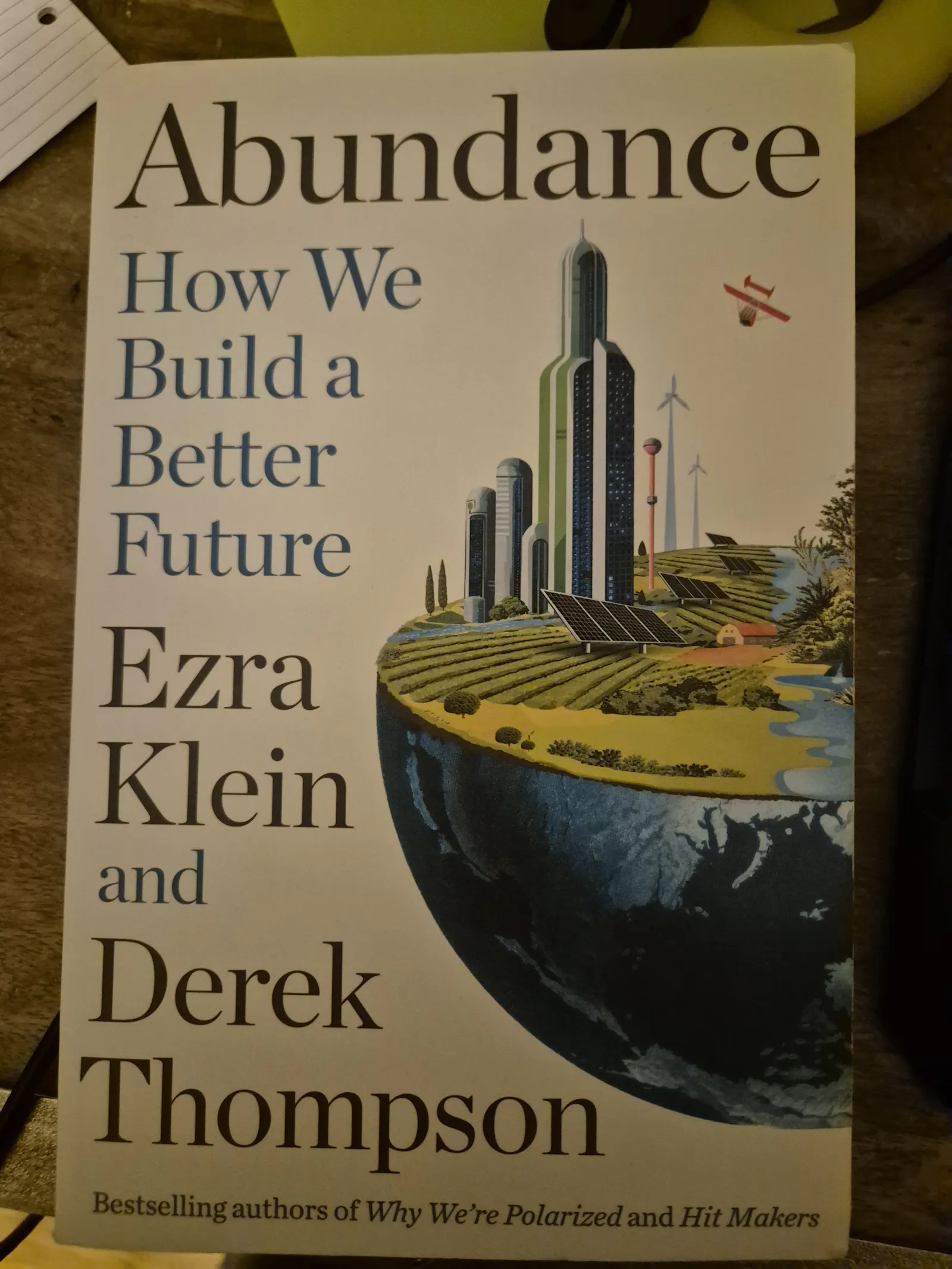
Abundance attempts to address the deep malaise afflicting democracy in the USA in a kind of a roundabout fashion: it starts with a future vision of plenty, and then segues to describe the deep and grotesque frustrations and difficulties in the US—in certain states in particular—around the delivery of, and building of needed infrastructure: usually housing; sometimes public transport; sometimes other kinds of infrastructure (tunnels, bridges, road,etc.); sometimes public utilities (clean water, clean energy, etc.); very often badly-delivered government services. The book thereby tells us a lot about what can be done better, without ever tackling the question: to what end?
Abundance comes with plenty of nice slogans—’scarcity is a choice’, and so on—many (maybe most) of which are true. It is generally well written; it is often brisk in expression; and it has that confident, quick-moving, op-ed-on-steroids feel making it engaging and even places exciting. You can get through it in a few hours without too much trouble.
And it has done extremely well in the world: straplined as the “instant New York Times bestseller” (this framing is splashed everywhere); the blurbs are enthusiastic; the Financial Times line about it being “forceful, quick-moving, important” is highlighted too (but is it? As I suggest below, there's less to see here than initially meets the eye).
Previously:
‘The Unfinished Contract — Our Democracies Must Learn or Die (S'ouvre dans une nouvelle fenêtre)’ (1771 words)
Currently, there are about c. 6k subscribers to the Cognitive Republic (S'ouvre dans une nouvelle fenêtre). The open rates for each piece, delivered approximately every two weeks, are close to 50% (way above average) - click here to start (S'ouvre dans une nouvelle fenêtre).
Below the line:
a ‘Serious Book for Serious People’ <sarc emoj>;
a dull vision of plenty;
The missing psychology: people don’t just want stuff
No dark vision; no threat model; naive about the moment;
The Texan Anomaly
The world’s irrationality: renewables and the “windmills cause cancer” problem (and much more)
Date
14/01/2026
0 commentaire
Vous voulez être le·la premier·ère à écrire un commentaire ?
Devenez membre de Cognitive Republic et lancez la conversation.