January 2023
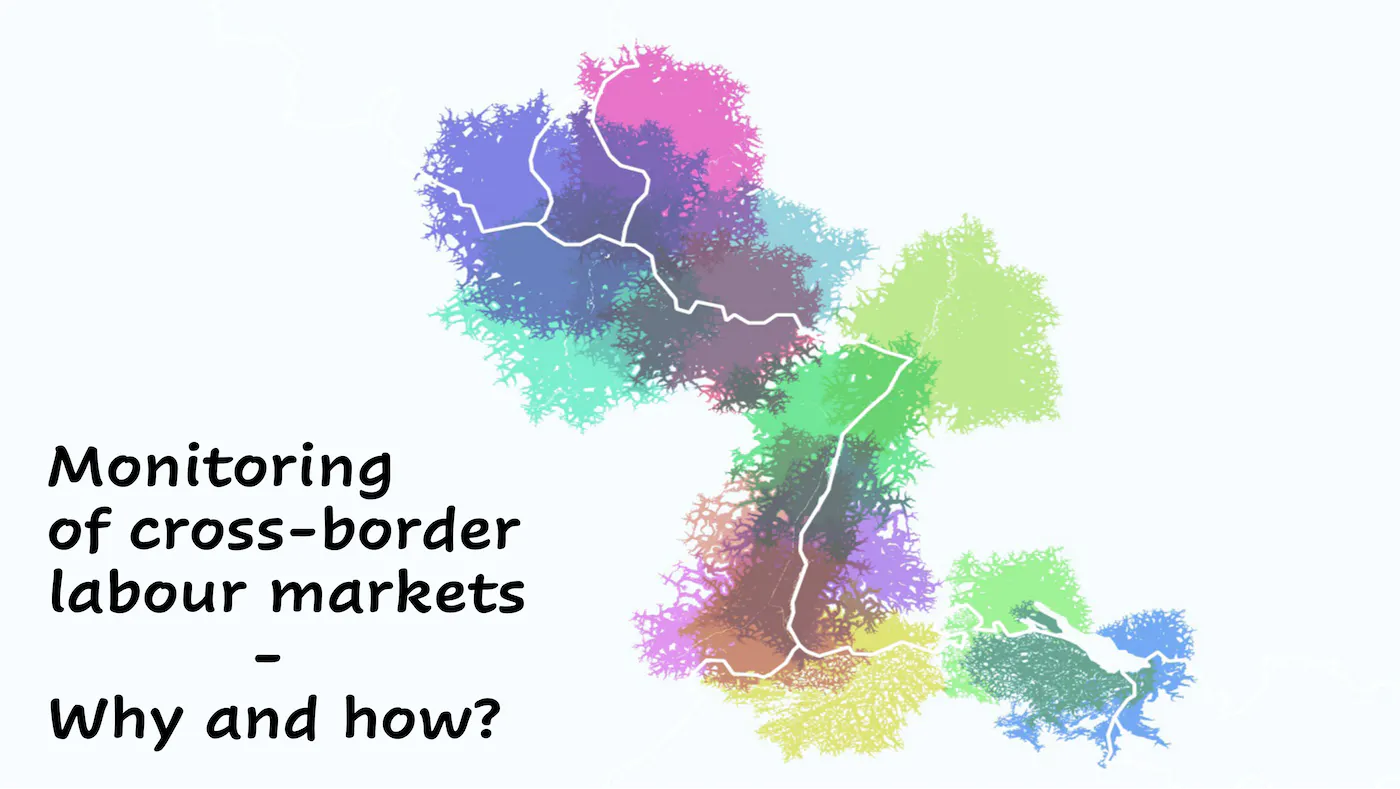
In a previous blogpost (S'ouvre dans une nouvelle fenêtre), we showed that the notion of cross-border labour markets is initially inspired by a limited number of areas with massive cross-border commuting flows, such as the metropolitan regions of Geneva and Luxembourg. However, in current European policy discussions, it includes a much broader set of cross-border regions where in and out-flows of commuters are a marginal component of primarily national labour markets.
Monitoring these diverse labour markets is important from different reasons. From a European perspective, progress in cross-border integration can be considered to reflect progress in Single Market integration. For a cross-border labour market to function, national administrative and legal systems manage have to elaborate joint solutions to a shared issue. Such labour market also reveal the extent to which mental barriers to cross-border interaction have been overcome.
To understand cross-border labour markets, it is often necessary to compile sub-regional social and economic data. Not only are NUTS 3 and NUTS 2 regions too large to function as “building blocks” for the delineation of these labour markets. To guide policies targeting these areas, one also needs to understand their internal structures.
Multiple attempts have been made to create databases that cover all European municipalities, known as “local administrative units” in the EU jargon. The ESPON programme has for example compiled them. However, limited data availability and differences in statistical methods and definitions makes it very difficult to produce and maintain such databases. Eurostat only disseminates data on total population by local administrative unit (S'ouvre dans une nouvelle fenêtre). These data were compiled by Spatial Foresight in 2015.
Each cross-border labour market only covers a limited number of countries. It is therefore often easier to overcome data compilation and harmonisation challenges. More ambitious databases can therefore be set up to make it possible to monitor trends in cross-border labour markets.
Forerunners in the Greater Region and around Switzerland: examples of good practice that may be difficult to transpose
The Inter-regional labour observatory of the Greater Region around Luxembourg (IBA/OIE (S'ouvre dans une nouvelle fenêtre)) is the European forerunner in this respect. This observatory started its activities in 2001. It currently operates based on a convention between regional authorities and agencies initiated by the Economic and Social Committee of the Greater Region (S'ouvre dans une nouvelle fenêtre)in 2010. It functions as a network of experts coordinated by a permanent secretariate based at the Info-Institut (S'ouvre dans une nouvelle fenêtre) in Saarbrücken. It produces yearly monitoring reports and more targeted analyses.
The Swiss-French Statistical Observatory (S'ouvre dans une nouvelle fenêtre) is also primarily a cross-border labour market observatory. It was established in 2001 to monitor effects of the seven bilateral agreements (S'ouvre dans une nouvelle fenêtre) that came into force in 2002. This observatory focuses on borders around Geneva. It operates based on a framework convention between regional and local authorities on both sides of the border. It publishes yearly ‘synthesis reports (S'ouvre dans une nouvelle fenêtre)’. An observatory for the neighbouring ‘Arc Jurassien’ was also established, in 2005. Its setup is a similar, but with some additional types of partners such as natural parcs. This is reflected in the broader thematic focus of analyses.
Other cross-border labour market observation initiatives are less established institutionally. In the Öresund region, the Örestat cooperation was established in 1998 and ran primarily on the basis of Interreg funding. Analyses of commuting trends were interrupted for some years, as Statistics Denmark refused to share data with Statistics Sweden (S'ouvre dans une nouvelle fenêtre) out of fear that the Swedish principle of public access to official records (S'ouvre dans une nouvelle fenêtre) would make it impossible to keep personal data away from public scrutiny. To overcome these problems, Region Skåne initiated a dialogue with statistical offices from both countries, in order to develop new ways (S'ouvre dans une nouvelle fenêtre) of measuring commuting that would make it possible to circumvent these legal obstacles to data exchange. Region Skåne on the Swedish side of the border is currently managing the database (S'ouvre dans une nouvelle fenêtre). However, analyses are produced by the Öresund Institute (S'ouvre dans une nouvelle fenêtre) and by the recently created analytical unit (S'ouvre dans une nouvelle fenêtre) of Greater Copenhagen cross-border collaborative organisation.
More punctual initiatives can also be identified. Along the German-Dutch Border, the ‘Grensdata/Grenzdaten (S'ouvre dans une nouvelle fenêtre)’ portal was developed in the framework of the two Interreg projects: ‘NL-DE grens (S'ouvre dans une nouvelle fenêtre)’ and ‘Werkinzicht (S'ouvre dans une nouvelle fenêtre)’. Interesting cross-border data compilation initiatives can also be identified in the Szczecin Metropolitan Region (S'ouvre dans une nouvelle fenêtre), in border regions between Germany, Poland and Czechia (S'ouvre dans une nouvelle fenêtre) as well as in Centrope region (S'ouvre dans une nouvelle fenêtre), which includes regions at the borders between Austria, the Czech Republic, Hungary, and the Slovak Republic
Through their challenges and successes, these examples show that monitoring of cross-border labour markets requires a long-term commitment by concerned authorities, and a capacity to involve relevant expertise. This in mainly achieved areas with massive cross-border commuting flows. In areas with more limited commuter flows, the incentive to set up the organisations that are needed is more limited. However, more evidence would be needed to fully capitalise on possible complementarities and synergies.
From an EU perspective, the key question is how to strengthen cross-border labour market monitoring across Europe. Good practices from the most advanced cross-border regions require investments and organisational setups that cannot realistically be expected to be reproduced across Europe. Analytical needs and priorities are also different when commuting is limited, and synergies remain to be identified. Attempts to transpose good practices such as those described above are therefore not necessarily purposeful, especially in regions with limited cross-border commuting.
Efforts at multiple levels to promote monitoring initiatives
However, dissemination of concrete solutions to align data from different sources can be purposeful. Typical challenges concern data applying different definitions (e.g. of employment and unemployment), available for different years, using different methods to produce estimates (e.g. between census years, or to estimate local data on the basis of regional figures) or based on different sources (e.g. census, registers, surveys and remote sensing). Recommendations can also be produced on the management of metadata. This can be a complex endeavour when combining data from different sources in a single database. The European Open Data Directive (S'ouvre dans une nouvelle fenêtre), which should have been transposed by Member States by July 2021 (S'ouvre dans une nouvelle fenêtre), also opens new perspective for the monitoring of cross-border labour markets. Local and regional authorities can be helped to take advantage of them.
The description of cross-border labour markets also mobilises some specific statistical methods and tools. Examples on the construction of ‘indicators of integration’ or on the ‘permeability of borders’ can function as sources of inspirations across Europe, even when concrete situations regarding data availability and analytical objectives are different. More complex analytical approaches, e.g. mobilising econometric and gravitational models, can also usefully be adapted from one cross-border region to another.
The EU can therefore contribute to capacity building when it comes to monitoring cross-border labour markets at the local and regional levels across Europe. The key bottleneck of data availability may however remain difficult to overcome. Some Member States have chosen to address it at the national level. For example, German federal authorities launched the MORO (S'ouvre dans une nouvelle fenêtre) project “Spatial Monitoring in Germany and Neighbouring Regions (S'ouvre dans une nouvelle fenêtre)”. This led to a compilation of data covering all German border regions. Generalising an approach in which national authorities provide data and support capacity building jointly with EU authorities, while regional and local authorities implement actual monitoring initiatives appears as a promising way forward.
by Erik Gløersen
https://steadyhq.com/en/spatialforesight/posts/739b80e9-e9a8-4db2-b9c6-6879f9cb7c7c (S'ouvre dans une nouvelle fenêtre)
Date
16/01/2023
Sujet
Territories
0 commentaire
Vous voulez être le·la premier·ère à écrire un commentaire ?
Devenez membre de spatialforesight et lancez la conversation.