February 2026
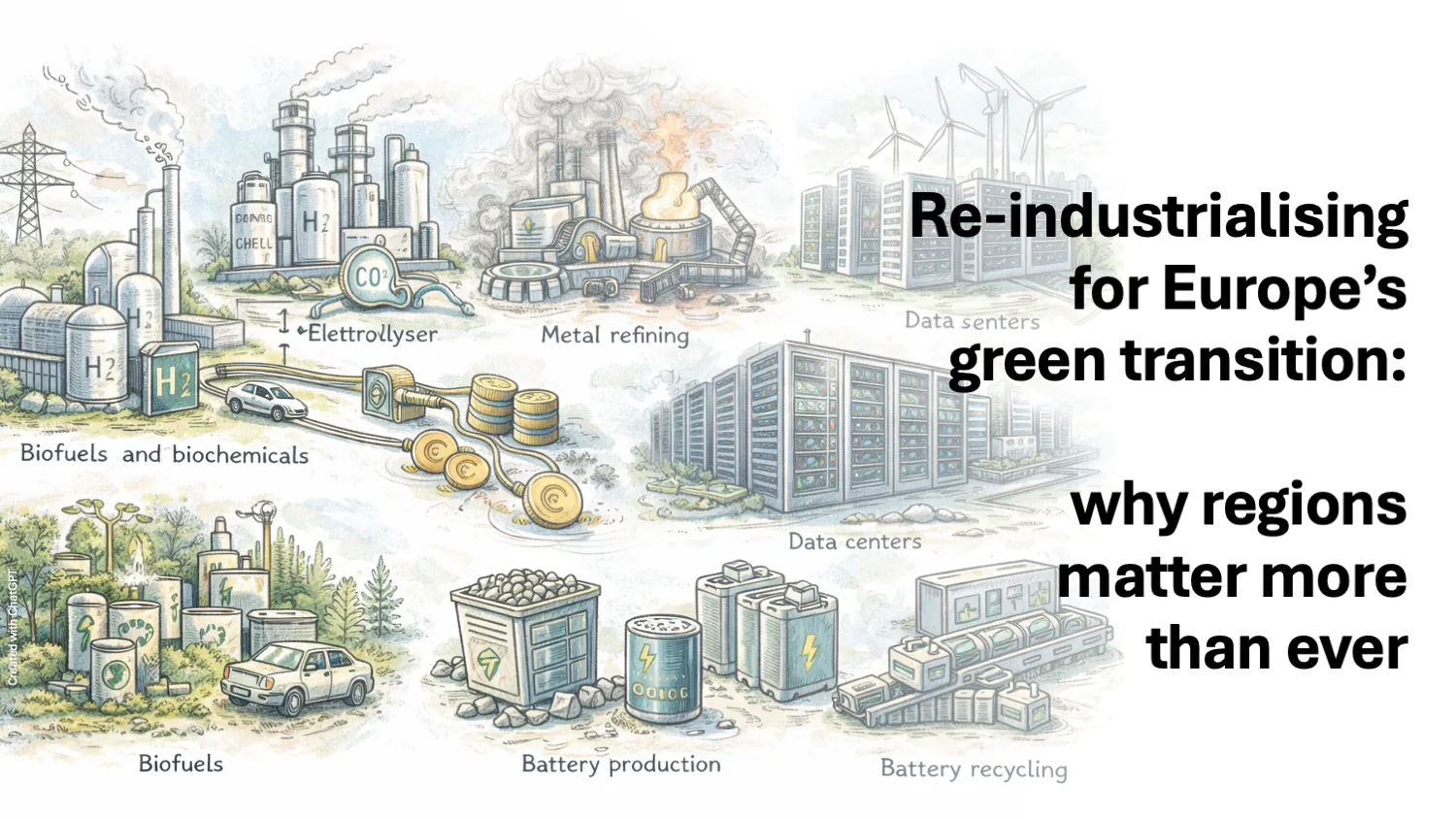
Europe’s green transition is often discussed in terms of technology, finance and regulation. However, far less attention is paid to its territorial political economy, such as where investments take place, who bears the risks and who ultimately reaps the benefits. The ESPON Re-Industry study (S'ouvre dans une nouvelle fenêtre) points out some aspects which could help to improve policies. Most importantly, achieving Europe’s climate and industrial goals requires a more strategic use of regional transition potential, as well as open discussions about the associated trade-offs. Europe’s climate and industrial ambitions depend on regions that are expected to take significant risks, while the rewards largely accrue elsewhere.
This is not just a matter of regional fairness. It is a structural tension at the heart of the green transition, one which current industrial and cohesion policies only partially address.
Regional potential is a cornerstone of the green transition
Decarbonisation is not footloose. Electrifying industry, producing green hydrogen, scaling up battery production, hosting digital infrastructure etc. depend on local assets such as renewable electricity, grid capacity, land, ports, skills, housing and social acceptance. These territorially embedded resources are unevenly distributed across Europe.
While the ESPON Re-Industry study focuses on the Kvarken area – Västerbotten and Västernorrland in Sweden and Ostrobothnia in Finland – its insights extend far beyond the Nordic context. Like many sparsely populated regions, the Kvarken area has long struggled with demographic decline, labour shortages, and modest productivity growth. At the same time, however, it also illustrates a new geography of opportunity. Access to large volumes of low-cost, low-carbon electricity has transformed these regions into prime locations for energy-intensive green industries.
The study assesses twelve industries across the battery value chain, the hydrogen economy, the bioeconomy, metals manufacturing, and digital infrastructure. These include active battery materials, battery cells, biofuels, biochemicals and biomaterials, data centres, electrolysers, fuel cells, hydrogen production and derivatives, hydrogen-based metal refining, electrification and carbon capture and storage (CCS), and battery recycling. The Kvarken area ranks among the most competitive in Europe for many of these activities.
This finding has clear territorial implications. Europe’s green transition will not be delivered by metropolitan areas alone. Rather, it relies on a much broader set of regions – often peripheral, sparsely populated and politically fragile – that host the physical backbone of decarbonisation.
Risk here, benefits elsewhere
Competitiveness, however, is only half the story. The more politically sensitive question is who benefits and who bears the risks or disadvantages.
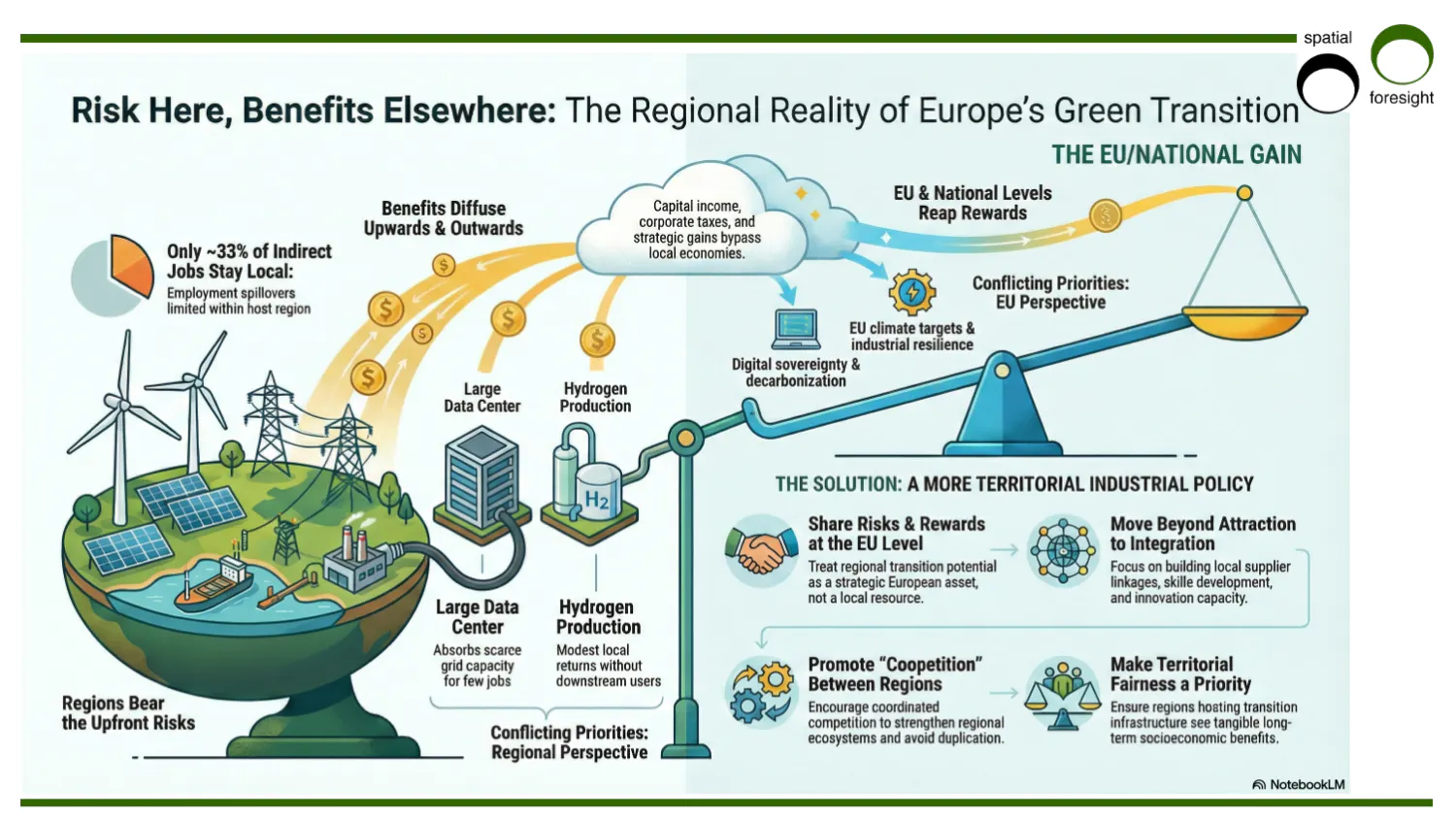
Green, energy-intensive industries typically require substantial upfront investment in public infrastructure in the host regions, as well as long lead times and exposure to volatile global markets. Regions and municipalities often have to invest in grid upgrades, ports, roads, housing, skills, and planning capacity long before a plant becomes operational; if it ever does. These commitments are often irreversible. If projects are delayed, scaled down or abandoned, regions and municipalities can be left with stranded assets and weakened public finances.
Furthermore, the economic returns of such investments are only partially regional or municipal. Capital income largely accrues to national or international investors. Corporate taxation is in many countries mostly captured at the national level. Climate mitigation, strategic autonomy and supply-chain resilience are European public goods.
Even employment spillovers are limited. On average, only around a third of the indirect employment effects of new green industrial plants remain within the host region. In several highly promoted sectors, such as data centres and hydrogen production, direct job creation is modest, and local supplier linkages are weak.
The result is a structural asymmetry. Regions bear a disproportionate amount of risk, while the benefits diffuse upwards and outwards. This is not an argument against green re-industrialisation. It is a warning that, without deliberate policy intervention, the willingness of regions and local areas to host Europe’s transition infrastructure cannot be taken for granted.
Northern Sweden and Finland: a revealing test case
These tensions are particularly visible in Northern Sweden and Northern Finland. Their highly decarbonised power systems provide a rare European advantage, including the ability to produce RFNBO‑compliant green hydrogen from the grid. RFNBO stands for 'Renewable Fuels of Non-Biological Origin'. In EU terms, the regions are exceptionally well positioned.
There are strong matches between specific industries and regional capabilities in these regions: for example biofuels and biochemicals in Västernorrland; hydrogen-based metal refining in Västerbotten; and battery-related activities in Ostrobothnia, supported by the EnergyVaasa ecosystem. Across many industries, these regions rank in the top decile, and sometimes even the top few percent, of European NUTS3 regions.
Yet this promise comes with tension. Labour markets are tight, populations are small and infrastructure needs are significant. Individual projects can dominate local economies, amplifying both positive effects and negative impacts. Recent collapses and delays in flagship green industrial investments across the Nordics highlight how quickly optimism can turn into fiscal and political strain.
Therefore, for regional and local players, the strategic question is not only how to attract investment, but also which investments to pursue and under what governance and risk-sharing conditions.
One transition, multiple perspectives
Different levels of governance prioritise different outcomes and often implicitly assume that their priorities align.
From a European perspective, a large data centre powered by renewable electricity would strengthen digital sovereignty and contribute to decarbonisation. However, from a regional perspective, it may absorb scarce grid capacity while creating few jobs and limited local benefits. Similarly, while hydrogen production can be central to EU climate targets and industrial resilience, it offers modest regional returns unless downstream uses are co-located.
In contrast, assembly-intensive manufacturing, such as the production of battery cells, electrolysers and fuel cells, tends to generate more local employment and income. However, it faces fierce global competition, rapid automation and higher exposure to failure. Bio-based industries can be closely integrated into regional economies where the necessary resources and skills are available locally, but they are sometimes considered less strategic at the EU level.
It all boils down to political choices about whose objectives take precedence. When these choices remain implicit, they fuel frustration and mistrust between levels of governance and encourage regions to compete for projects that may not serve their long-term development goals.
Towards a more territorial industrial policy
The ESPON Re-Industry results suggest a shift in Europe's approach to industrial and green transition policy is necessary.
Firstly, regional transition potential should be recognised as a strategic European asset. This requires stronger EU-level mechanisms for sharing risk and reward, acknowledging that costs are concentrated in specific regions while benefits are shared more widely.
Secondly, industrial policy must move beyond the logic of attraction. The long-term value of green re-industrialisation depends on embedding supplier linkages, skills development, innovation capacity, and industrial symbiosis, rather than just headline investment figures.
Thirdly, cooperation between regions is important. The Kvarken case demonstrates the potential of 'coopetition': coordinated competition within a shared functional system that avoids duplication, strengthens ecosystems, and improves strategic positioning with regard to investors.
Finally, the green transition demands a more explicit debate on territorial fairness. If Europe expects regions to host the physical infrastructure of decarbonisation and digitalisation, it must also ensure that these regions see long-term social and economic benefits.
The green transition cannot succeed based on technology and finance alone. Its political sustainability depends on whether territorial realities are acknowledged and addressed. The ESPON Re-Industry study makes one thing clear: regions are not merely implementation sites. They are key players in Europe’s industrial future, and they require policies that recognise this.
The final report of the ESPON Re-Industry study is available here (S'ouvre dans une nouvelle fenêtre).
by Kai Böhme
 (S'ouvre dans une nouvelle fenêtre)
Date
24/02/2026
Sujet
Resilience & transition
0 commentaire
Vous voulez être le·la premier·ère à écrire un commentaire ?
Devenez membre de spatialforesight et lancez la conversation.