These pictures with Russian children are satirical fakes
04.05.2024
This article was first published on Substack (Si apre in una nuova finestra) on May 4, 2024, and republished on Steady on August 15, 2025.
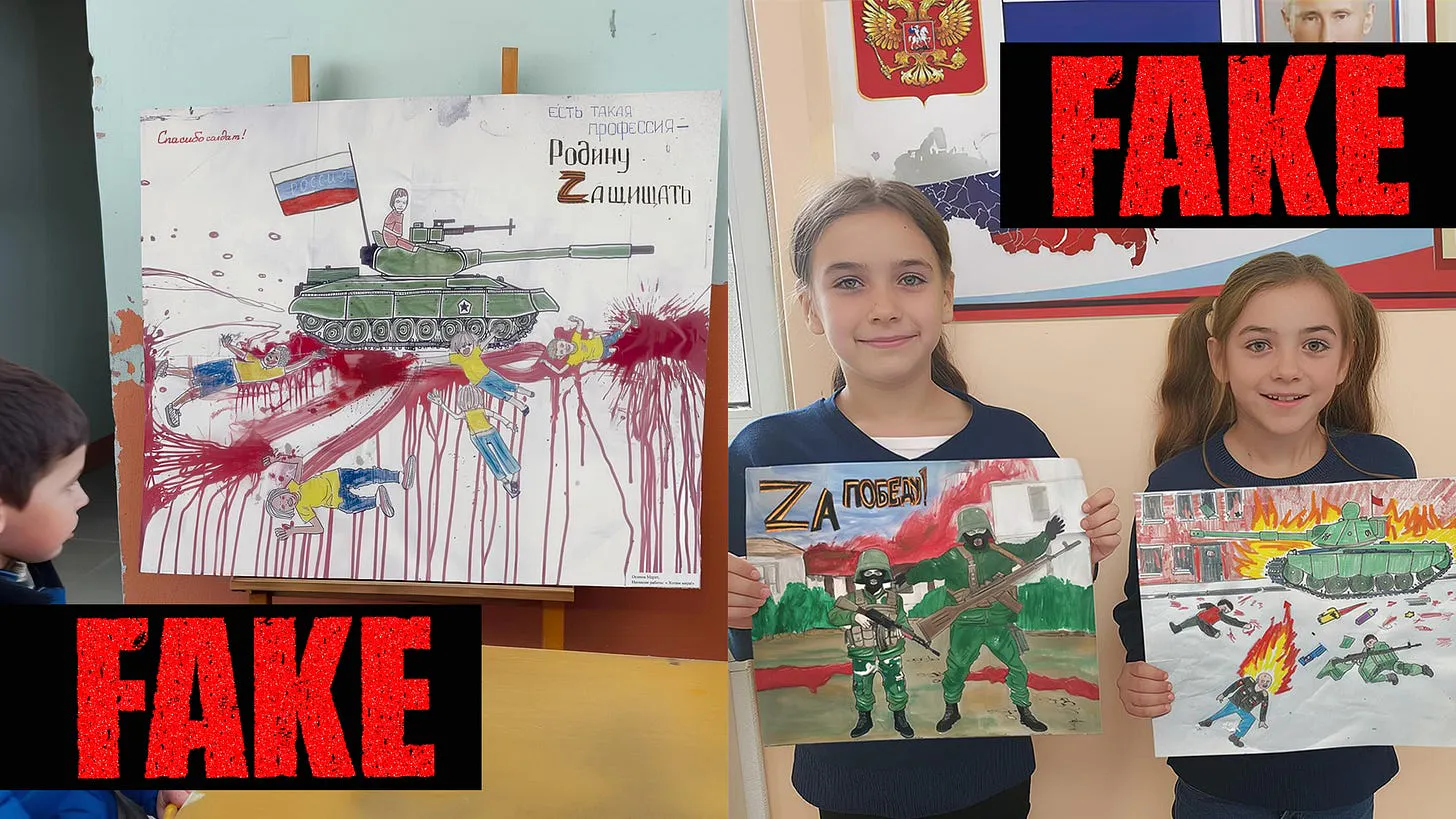
Since Tuesday, a series of photos have been going viral on social networks, purportedly showing Russian children presenting disturbingly bloody drawings depicting Russia's war of aggression against Ukraine. However, it turns out: the photos are fakes. An investigation into the motivation of the responsible artist, what children in Ukraine and Russia actually draw, and the question of where the boundaries between satire and misinformation lie.
Michael Stadnik is a German director with roots in Ukraine. Currently, he is putting the finishing touches on a documentary about the Russian occupation of the Ukrainian city of Butscha (watch the film trailer on YouTube (Si apre in una nuova finestra)). On Tuesday, Stadnik became aware on Instagram of a series of images featuring Russian children presenting bloodthirsty drawings about the war in Ukraine in front of a class.
“I initially believed the photos were real and even shared them on Twitter. However, a comment emerged asking me, in essence, 'Is this real?'“ Upon closer examination, inconsistencies became apparent to him. These include missing fingers, distorted facial features, and disorienting perspectives.
Stadnik is now certain that AI was involved in generating the photos and intends to draw attention to the issues on Twitter with a post (Si apre in una nuova finestra). However, not everyone believes him. “I was also accused of allegedly lying.” Nevertheless, he takes the time to address individual comments and also receives encouragement.
“Thank you, I have seen a few people repost this, and it is not a great idea to be spreading fakes. Russia is great at that, but we dont need to resort to it“, commented an anonymous account named Sofia. Michael Stadnik agrees with this sentiment. “In doubt, it reflects back on Ukraine,’ he tells me over the phone.”
Thousands of people have already seen the images on social networks. Not everyone fell for it, but at least some journalists and even pro-Russian Telegram channels did, according to Michael Stadnik.
The author wanted to draw attention to a serious issue
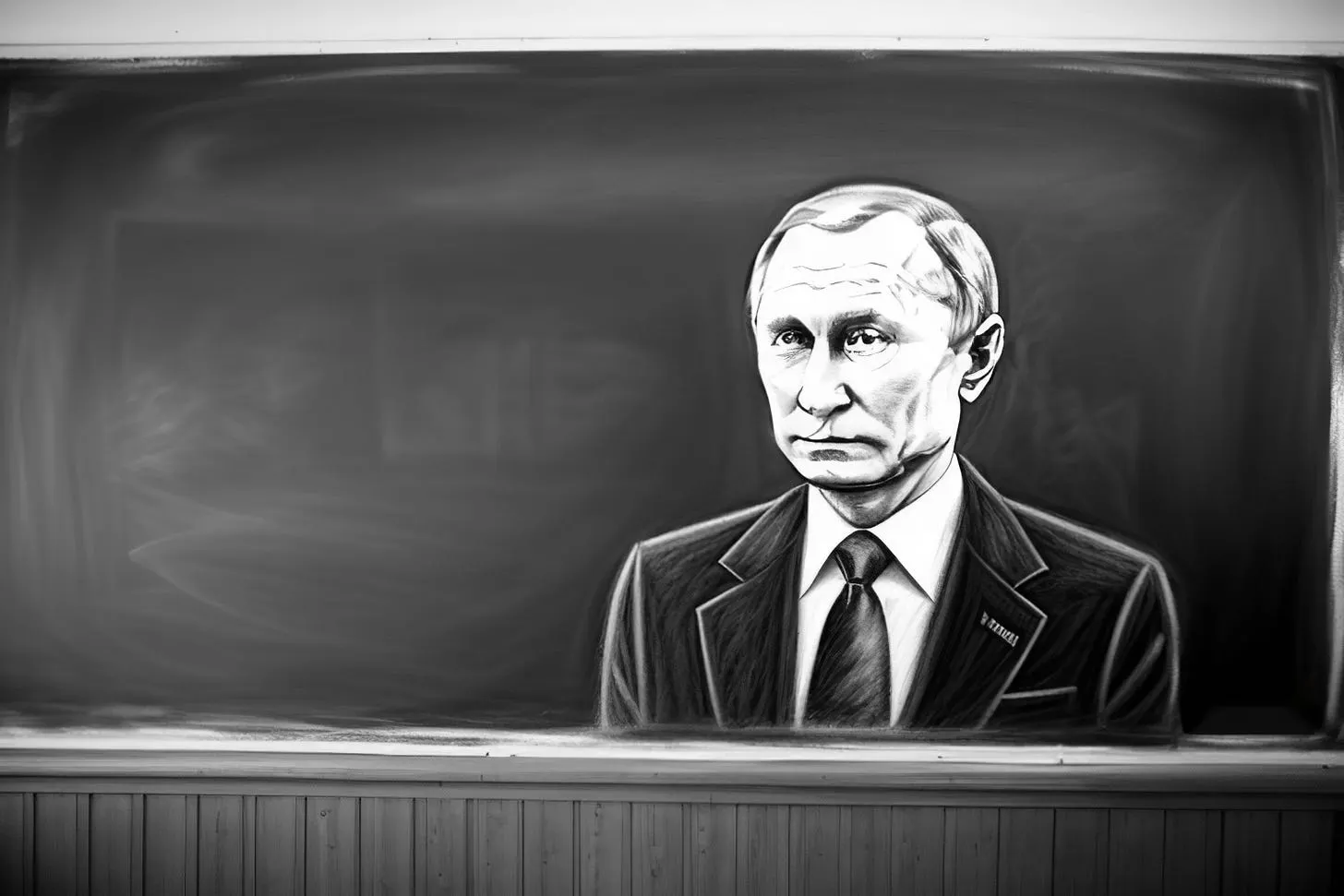
Stadnik is also the one who, to my knowledge, first points out the origin of the images to others. An Instagram account named 'HogFaces (Si apre in una nuova finestra)'. The content on his account is of a satirical-artistic nature. For instance, in his biography, he claims to be located in a bioweapon mosquito laboratory in Ukraine. This is a reference to a conspiracy narrative that the Russian government even presented to the United Nations Security Council (Si apre in una nuova finestra).
The humor of HogFaces can indeed be described as 'grotesque.' For example, he critically comments on Germany's dealings with Russia through an image of Angela Merkel depicted as a pig, ridden across a field by Putin, while she follows a piece of pipeline labeled 'Gas' dangling enticingly on a rod in front of her.
 (Si apre in una nuova finestra)
HogFaces introduced himself to me as a Ukrainian artist from Kharkiv and admitted: “Everything in the photo is generated, except for the children’s inscriptions on the drawings and the portrait of Putin.” He created the images using the AI application Midjourney and Photoshop.
He says he used authentic pictures of Russian children and teenagers as a reference for creating the artificial children's drawings (Si apre in una nuova finestra). He assures me that the faces of the children and teenagers are all artificially generated.*** According to him, the majority of the drawings come from a Russia-wide propaganda-oriented drawing competition (Si apre in una nuova finestra) titled 'Heroes of Russia and Donbass' from the autumn of 2022, organized by the pro-government party Fair Russia and the newspaper Roman-Gazeta.
I ask him about his motivation. “These pictures were made by me to draw attention to the problem of propaganda among children, including the youngest, and primarily in the occupied territories.”
The satirical fake within the satirical fake
When reviewing a selection of images from the drawing competition, it becomes apparent that authentic drawings by Russian children and teenagers have significantly fewer explicit depictions of violence. Occasionally, one can see explosions, injured people, and blood in the drawings. Death naturally often looms. However, I could not find mutilated bodies like those in HogFaces' generated images.
So how could the photos be so explicit based on these templates? HogFaces says he also included realistic war images in the dataset. On April 1st, the artist already shared a gallery of generated photos on Instagram (Si apre in una nuova finestra), showing children with drawings of war. In two of the images, a drastic scene is depicted, which he also used for his creations by feeding it to Midjourney.
 (Si apre in una nuova finestra)
The corresponding illustration depicts a tank with a incorrectly drawn Russian flag running over a man holding a Ukrainian flag. There's a swastika on his cheek, the trident of Ukraine on his knee, and a symbol on his shoe, possibly representing a Star of David. It is the only illustration in HogFaces' pool of drawings that approaches the brutality of his artificially generated images.
However, the image does not come from the drawing competition and was already published in 2008. At that time, the satire site of the fictional Ukrainian party 'Dnieper-Donetsk Workers' Union' (PDRS (Si apre in una nuova finestra)) displayed a commented picture gallery (Si apre in una nuova finestra) in response to the 2008 Russo-Georgian War, featuring supposed drawings by the 'politically smartest worker children.'
Supposedly, the questionable drawing there was attributed to a Peter Tkachenko from the 5th grade. The satirical nature is also evident in the caption: 'Peter sent us an SMS through the phone: "HERE OUR TANK DESTROYS BANDERA (Si apre in una nuova finestra), WHO DAMNED RUSSIA AND OSSETIA."'
Another satirical drawing on the site, depicting Russians distributing passports in the occupied Sevastopol, is described by Michael Stadnik, whom I brought attention to the site, as almost prophetic.
Russia: Childhood and adolescence in a propagandistic state
In the genuine drawings of Russian children, signs of the effects of state and socially shared propaganda naturally appear. For instance, a picture drawn by a 6-year-old boy depicts a battle between two tanks with the caption: 'Tank battle between Russian troops and Nazis.'
Some children draw themselves in military uniforms marching. Several drawings stylize war criminals such as Mychailo Tolstych (Si apre in una nuova finestra) as supposed heroes. 'Donbass, that's Russia,' is stated in another drawing. The letter 'Z' is also ubiquitous as a symbol of Russian military propaganda.
Last year (Si apre in una nuova finestra), a father was sentenced to prison and lost custody of his daughter. She had made a drawing against the war in her school, which included the phrase 'Glory to Ukraine.'
Not all drawings by Russian children and adolescents fundamentally differ from those of their counterparts in Ukraine. Many also wish for peace in their pictures or draw military equipment and atrocities to cope with the horrors of war in their own way. However, this does not change the massive differences between both societies and governments, for which no child ultimately bears responsibility.
The militarization of childhood and adolescence (Si apre in una nuova finestra) in Russia is no secret but deserves much more public attention, especially in Germany. Particularly distressing is the example of Russia's Yunarmiya (Si apre in una nuova finestra), which specifically trains children for war. This militarization has been evident in Russian society for some time, as recalled, among others, by Yuliya von Saal's guest contribution (Si apre in una nuova finestra) in German newspaper FAZ in June 2022, but even before the invasion in February 2022, this trend was observable (Si apre in una nuova finestra).
At this point, one should also not forget the abduction of thousands of Ukrainian children by Russia since the start of the Russian war of aggression. This is another of the numerous war crimes (Si apre in una nuova finestra) that Russia has already committed in this conflict.
https://youtu.be/-4c-baj28x0 (Si apre in una nuova finestra)
Fakes for educational purposes only?
HogFaces aimed to raise awareness of these issues with this action. Did he succeed? Michael Stadnik has mixed feelings about it. 'Initially, I think: 'No.' In the second step, once it becomes clear what it's actually about, it could potentially set a process in motion.'
When asked if he sees a contradiction in his images intended for enlightenment initially contributing to the spread of misinformation, HogFaces responds to me:
“My favorite technique is absurdity and hyperbolization. And I hope such an approach will open the eyes of at least some Russian mothers, teachers, or just an ordinary citizen, and they will reflect on whether they are doing the right thing. Yes, these pictures are absurd and exaggerated to attract attention. It can be said I just show what will happen next if nothing changes now. Maybe they are like those pictures of rotten lungs on cigarette packs.
My images can be called fake, I don’t mind; I’m not a media after all. But at least my fake doesn’t contribute to killing people. It makes someone laugh, someone think, someone possibly be horrified or disgusted. I don’t see anything wrong with that.
I like the reaction of ‘thinking Russians’ to the Icon of the terrorist Yevgeny Prigozhin with the sledgehammer with which he killed people, or to these children drawings, like ‘Please tell me someone that we have not fallen so low’.
If some Russian does not understand that this is just digital art, perhaps they will think about whether everything is okay in their country. What could happen if a Ukrainian decides that this is a real photo? They can’t hate them even more in any case. If it is a foreigner, it may be possible to reach them at least this way.”
Whatever the satirical photos by HogFaces ultimately trigger, a deeper engagement with one's own vulnerability to misinformation and a better culture of admitting mistakes could also be part of this debate. Stadnik, who initially believed the images to be authentic, has already contemplated this. The emotional aspect, especially when it comes to children, was decisive for him in initially finding them credible.
But even I, as the author of this text, have begun to doubt. No, a deliberate dissemination of fakes that can harm society or individuals should of course remain taboo. However, when satirical-artistic content is uncritically adopted, it also reflects a reality that must escape control to some extent. Yet, there are gray areas here as well, which should be open to criticism.
Ultimately, this is not just a dry fact-check, but a sometimes-commenting engagement with various aspects of a complicated story that is far from over — unfortunately, just like the war in which it unfolds.
* Cover image: Illustrations via Instagram / HogFaces (Si apre in una nuova finestra), Editing and montage: Gunnar Hamann.
** This text was translated from German to English with the assistance of ChatGPT.
*** Update from May 4th, 2024: However, HogFaces exclusively refers to the original post (Si apre in una nuova finestra) on Instagram that went viral. Another post made by him does contain faces of real russian schoolkids.
Data
15/08/2025
Argomento
Alternativer Faktencheck


