There are aspects of life which are astonishingly simple. They are part of our cultural basic understanding how things work, so much that we roll our eyes when we are being reminded of them. We even feel patronized. And even if we sense that we may do not get the full meaning, many of us are afraid to ask for guidance because everyone else seems to have figured it out a long time ago.
Still, there’s a difference between adapting by situational copying versus true understanding. The latter enables us to transfer a concept, an idea, an universal truth to different contexts and situations. We also are able to reflect why something might not work as expected and adjust as a consequence. This is what my Basics are about. You are late to the party, as was I. it’s okay.
One of those universal truths is the following: “The Person Who Chases Two Rabbits Catches Neither” and if your eyes are not popping out like Arnie’s in Verhoeven’s Total Recall when reading this, you either advanced to an amazing level of zen mastery or you’re very ignorant. In case you are truly uninformed: translated it means that focusing on more than one goal/target, will make you accomplish nothing. Ah, see, now you’re rolling your eyes.

But then, as universal truths go, why do we, as mankind regularly fail to uphold that principle? Why do we constantly load our lives with projects and activities which run in parallel? It’s simple: we wonder if we should, than we believe we can, ultimately we decide we must.
Tech analogies are almost as good as those from football
Our brains are fascinatingly close to CPUs of computers when “multitasking”. We do have some subconscious routines which run without us thinking about it (breathing! digesting! brain plasticity stuff! doing the dishes!) but as soon as we do tasks consciously without muscle memory automation it becomes a metal slugfest of short term context switches.

With degrading quality in results, I might add. There are reasons why people should not drive and use their phones. They do it anyway, eyes darting between the road and the phone, because they think they should take that call, than start believing that somehow, magically they are able to do both at the same time and the final conclusion leads to point of believing that all along it had been the! only! viable! option!
This darting of the eyes between road and phone are context switches. Those switches come with an overhead. It’s regulated by an executive function in our prefrontal cortex which tries to juggle both contexts and all it’s information. A CPU works like that as well, it switches between contexts a few thousand times per second and meanwhile it stores the relevant information of those contexts in various storage devices. So, as long as your brain is not working as reliable as a machine (spoiler: it’s not) you will lose stored context information. If your executive function does not work well, you will start with one thing, switch to another and completely forget that there was a previous one (ADHS anyone?).
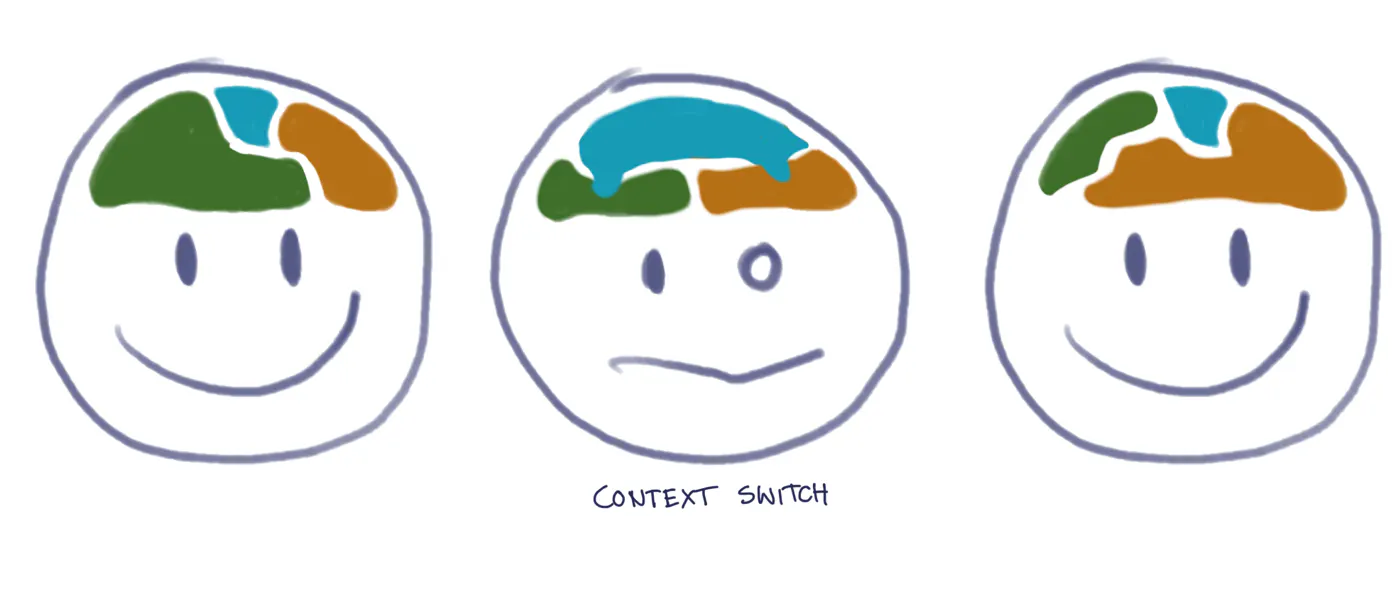
The more complex your contexts become and the more uncontrolled changes happen in your environment, the more information your executive function needs to be able to manage. And the more information needs to be processed, the more time it’ll take. A switch may be just seconds (very bad at driving faster than 6 km per hour) or several dozens of minutes (oh it’s lunch time already?). It’s a massive hog draining your cognitive resources. You absolutely need to stay away from a lot of context switching because it slows you down like hell. And funny enough, you think you are pursuing two goals at the same time, while you are actually purchasing three now.
Getting to Point B without disruption
Answering Phone
Make sure both don’t lose intel or fail
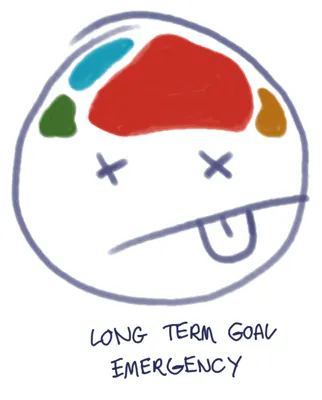
You may as well have long-term goals which may require your attention as well. Raising kids is a very good example. A normally functioning parent will reserve a significant amount of resources making sure their kids grow up fine and are okay. We easily forget those long running goals because we are used to their resource consumption as a background task. They are still blocking resources, though, even in the background, waiting for the right trigger to become active.
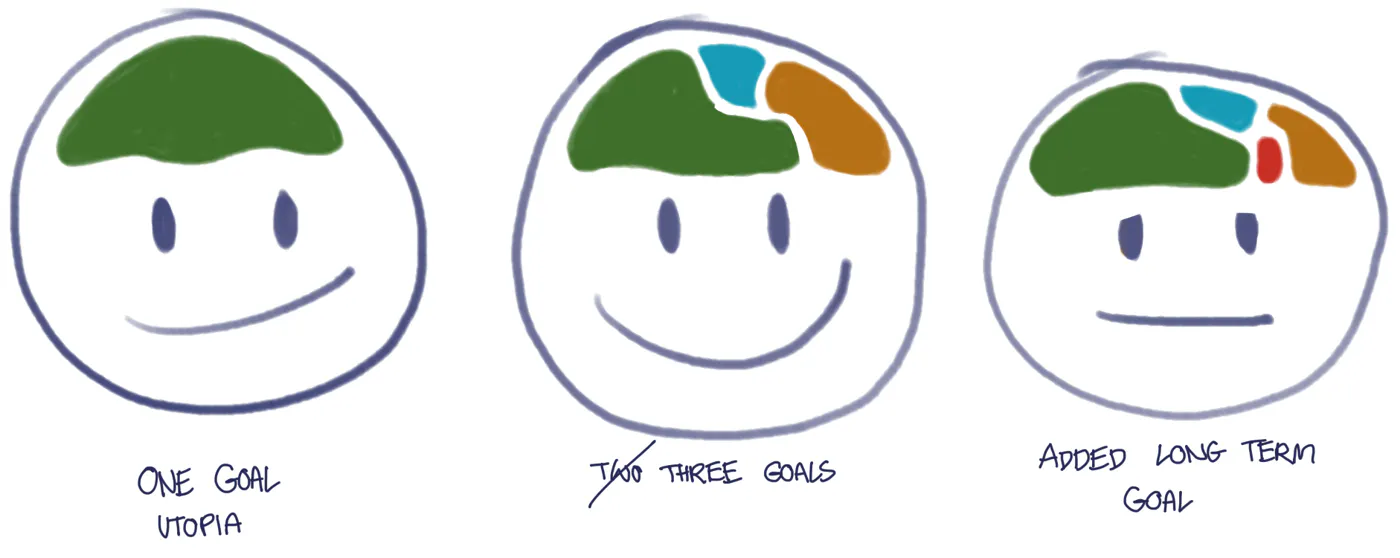
Yes, it may work. And by the time we crossed a bunch of warning signs which paled in comparison to our emotionally significant, but very anecdotal evidence of previous times where everything worked out fine, it’s too late and we crash. Sometimes literally.
How to solve the conundrum? In short: Prioritize or decouple.
If everything is a priority, nothing is
In my other piece I wrote something along the lines “Things observed in the small do not necessarily go away when adding people”. As you can guess, goal chasing and task switching does not magically disappear when 1+n people try to accomplish different goals working together using the same resources.
Quite the opposite: It gets exponentially worse. It’s quite common knowledge, that the more people you add to a team, the more communication is needed between all the team members. You may have seen something like this before:
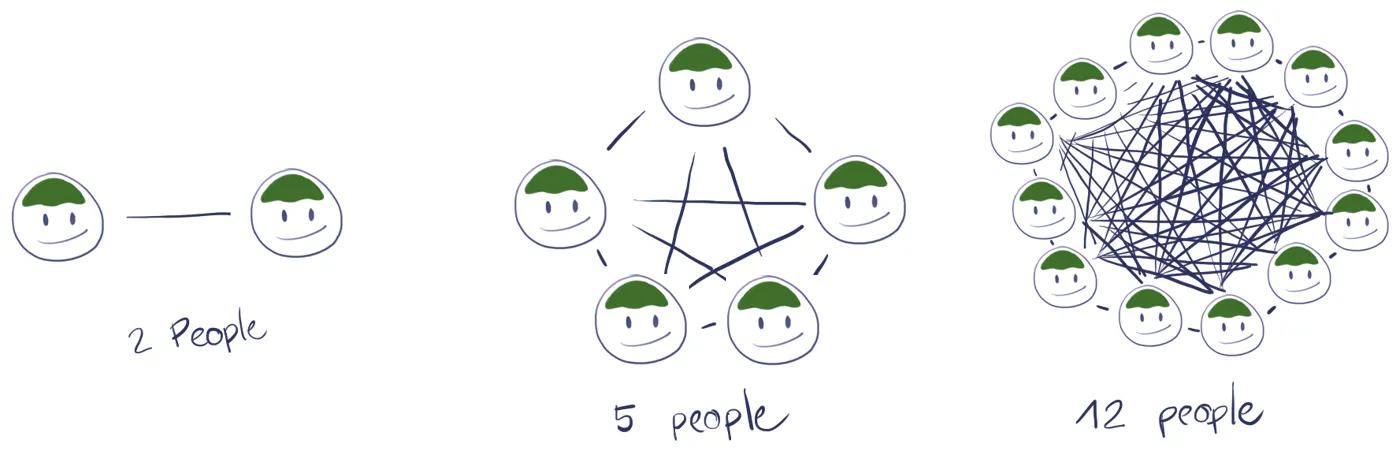
Now, if you instruct this team to follow two different goals at the same time, you end up with two contexts per person plus an executive function. One person works on topic A, the second on topic B, a third meanders off completely and a fifth tries to coordinate it all. They interact with each other and might induce an infinite number of context switches with any kind of information they exchange.
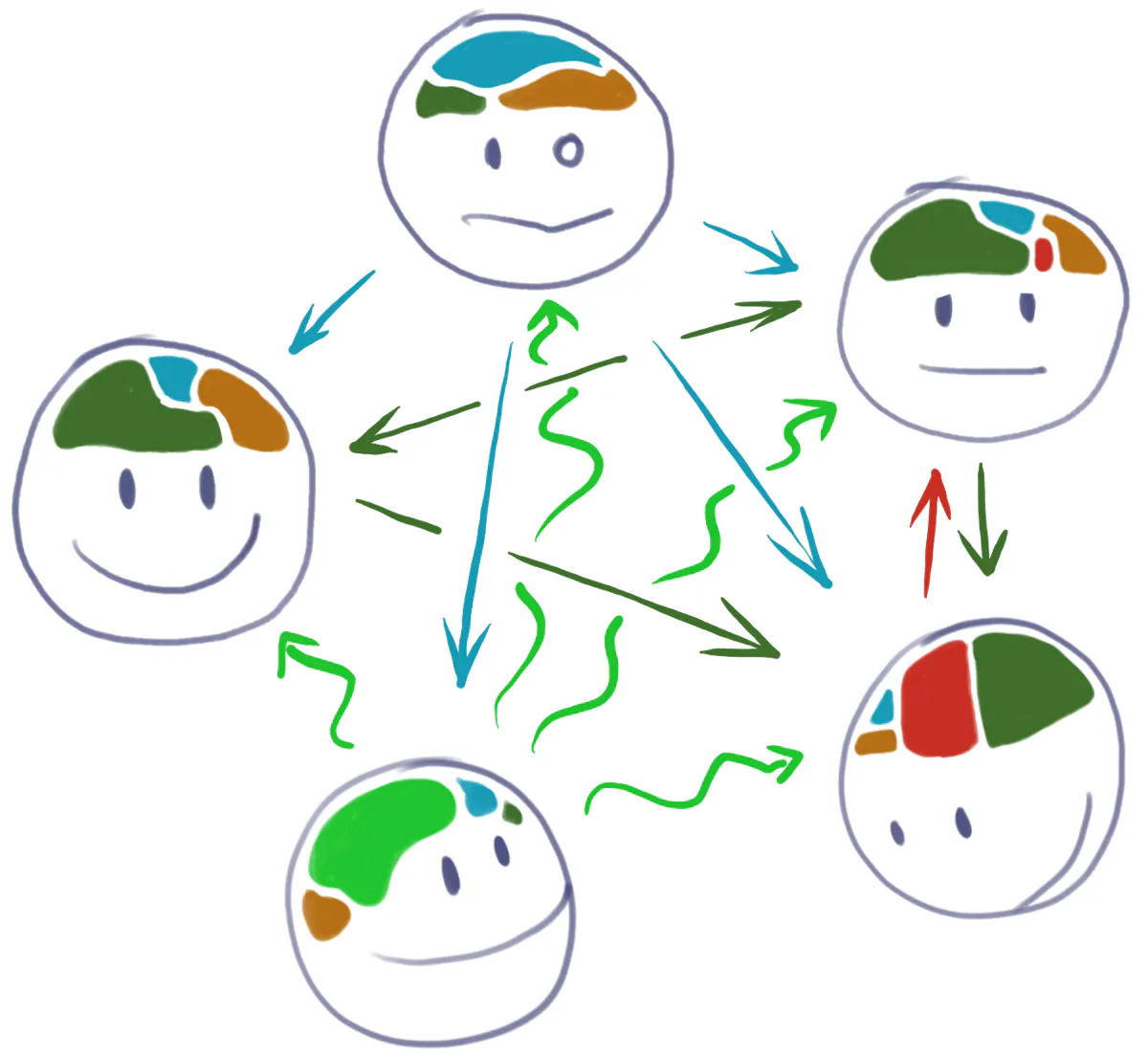
To regulate and handle this, teams start to “bloat” the executive functions. Scrum is a very good example for this. The basic idea is to provide a framework that allows a team to have a clear focus. Organizing when and why people come together so they can talk about specific stuff because otherwise your whole team suffers Attention Deficit Hyperactivity Disorder. More clear: Every member may bombard other members with information and tasks constantly, creating an indomitable amount of context switches.
A framework can be useful, to a degree. But as soon as you elevate the executive function to a goal for achieving multiple goals, you are draining significant energy and time which could be spent on either of the other two goals. An executive process must be learned by every team member. A team must be really good at this to make it work. And you must be very sure that this really pays off. If your team is not good enough, you will keep on bloating the controlling element, by adding more meta tech, more meta processes, more meta communication, slowing them down even more. As a rule of thumb a team should pursue only one goal at the time. If you got too many, do them sequentially. It’s the easiest to understand and follow but also the hardest to defend in a complex world.
For working with multiple goals in a sequential fashion, a clear and understood priority is needed that whenever task B challenges task A. You can and will favor the one with the higher priority in an instant and everyone in the team needs to act by this directive. Taking into account that a team often does more “less visible” things (e.g. operations), those things need to have a prioritization as well. Those “less visible” things are basically the workspace equivalent to “raising the kids” in the previous paragraphs: most kids can trigger the emergency priority of their parents. And then everything else becomes irrelevant.
Dependencies demanding attention slow you down
The other way to solve this problem is to decouple the goals and the teams pursuing them. So each set of people can focus on just one goal, but at the same time. This is basically what happens when you parallelize processes in your computer by using two or more (logical) CPUs. The difficulty of course is to detangle your goals first and keep them like that, ideally forever. Often it’s impossible to separate them completely and it might only work for a given period of time.
There are several things at play here:
you might have to make decoupling your most important priority first. This basically means you are not gaining any visible velocity to your original goals while doing this. Decoupling is a goal in itself.
Temporary decoupling seems nice, but you always have to merge the advancements of parallelized work because it is, well, temporary. The longer decoupling goes on, the harder it will become to merge the parts. Projects work like this very often, suddenly realizing that at a certain deadline separated work items do not fit together because they have not been synchronized sufficiently. It’s also a classic problem in development teams.
Whoever manages the decoupling still needs a relevant understanding of the related parts to make qualified assessments about separating them and solve upcoming problems.
You may work out techniques and concepts of how decoupling and parallelization works, but those normally come in form of a significant extra layer. You may have to coordinate on architecture and interfaces and timelines. It’s a more institutionalized, controlled version of the executive function.
It’s rather fascinating how a simple concept (multitasking) in everyday life becomes it’s own role or process or software when you need to implement this concept with several people. Agile coaches and project managers and software architects fulfill this role in software development, to try and mitigate the effects of complex environments – they are, so to say: personifications of our executive functions.
It’s quite tempting to employ a massive bunch of those coordinating people to make sure the others can work in peace, but this is really dangerous. Coordinating people cannot operate by themselves, they are the snake oil in-between the turning cogs of the system and they easily can kill a running machine by interfering too much. They can turn into bureaucracy (ugh!) and become a living thing with the implicit goal of sustaining itself.
Chasing rabbits as a company strategy.
In Corporate strategy observations from the bottom of Getting Things Done (Abre numa nova janela) I wrote about portfolio management. Short recap: It’s a stochastic bet on wins and losses doing multiple things at the same time. It makes sense from a strategic viewpoint, thinking about humans and machines as adaptable and easy to combine Lego bricks. But the same principles as in smaller dimensions apply here as well: More people, more goals. More goals, more problems. What you additionally get to the previous is: org structure.
If the different things you want to do are not properly decoupled, you cannot do them in parallel realistically. One goal will interfere with the resource of the other, timetables overlap and concepts, interface and milestones must be aligned constantly. You may believe it works, but it’s tedious and cumbersome. It’s an illusion and it’s hidden behind a leviathan of project management to make you believe everything is under control while it is not - no matter how many milestones and traffic lights you stick to it. You will find out when the final end date will be postponed again and again, when the costs rise and rise. And then you drop the project/goal because either you run out of money or opportunity.
Alternatively you may glue everything to a priority queue. If (!) everyone plays along it might work somewhat getting work through the door, but you still need to coordinate and align everything in certain time intervals. Remember that there will be at least one additional meta goal: the executive function. It will be built into your company DNA and it will be bloated despite your best intentions and this will cost you. People will still have different goals and try to accomplish different things when they are supposed to work together at the same moment in time.
And you need to have an emergency brake at every level of hierarchy and it needs to trigger every time, when the level below cannot solve problems by itself. You encounter this with more-or-less hidden dependencies and bad decoupling. To let problems bubble up to get them understood and solved in the right circles of influence, you need to be able to adjust upper level context sufficiently and in time to make a qualified, well assessed, problem resolving decision. If you cannot accomplish that as a person, you are either incompetent or you got too much on your plate while the system’s broken. We often want to believe it’s the first because scapegoats are so much more satisfying and easier to understand.
But most of the times your company is chasing too many rabbits.
Conclusion
Despite all our good intentions and the more or less internalized knowledge that we should focus on one goal, must of us won’t do it, can’t do it. We tend to overestimate ourselves, our ability to understand our own motivations. We are not alone and everything around us is shifting. Still we need this truth as a constant reminder:
Your strategy should always be to reduce the number of concurrent goals for all people involved to the least possible (ideally just one [1]) and get over with it “quickly”.
If you now feel like arguing that all the things you, your team or your company indeed do need chasing right now and that it is the only. viable. option. - think again. Did you chose to chase because you felt like you should chase? Or did you do the math that chasing both at the same time is cheaper and more likely to succeed than doing it sequentially? Did you cheat at doing the math because you wanted it to work out? Maybe it was easier, less dangerous, more rewarding to succumb to hunting both rabbits? Do you fear the idea that some people are not productive, while waiting for others?
It is your responsibility. If you don’t accept it, goals will grow like weed. You need to understand that, and this is important: No framework, no process, no tool, no architecture, no org structure will secure the goals if you are trying at too many of them at once. And You will always slow down when the executive function kicks in. You will always spend more money.
Be rigorous. Stay vigilant. Make it your long-term goal with a high priority alert. ;)
Data
10/09/2025
Tópico
Tech & Product
0 comentários
Gostaria de ser o primeiro a escrever um comentário?
Torne-se membro de The Meandering Fray e comece a conversa.


