September 2025
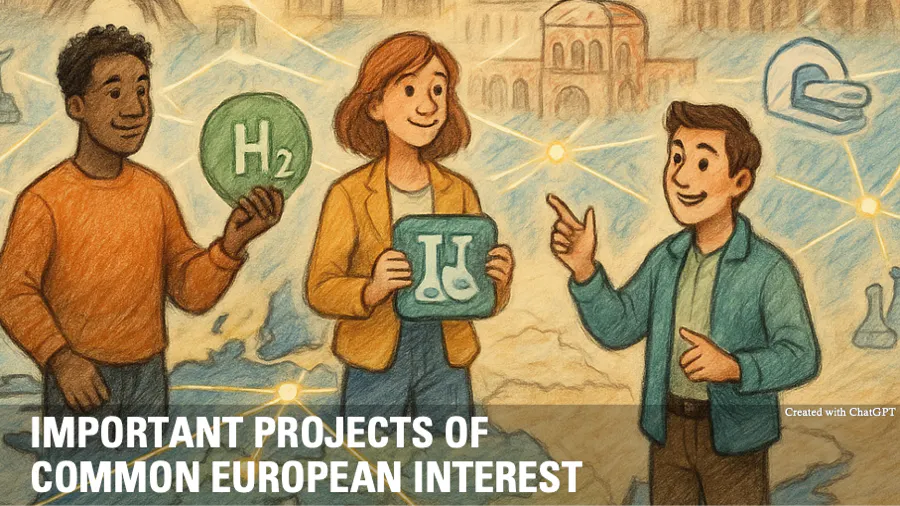
In the proposed EU budget for 2028–2034, the term 'Important Projects of Common European Interest' (IPCEIs) appears at various points. This is a good reason to take a closer look at these projects.
IPCEIs aim to strengthen Europe’s technological capabilities, accelerate the green and digital transitions, and reduce dependence on global competitors by facilitating cross-border collaboration on strategic projects. Although they are often only known to a few experts in the field, they could actually be of wider interest and be further strengthened in future.
At its core, an IPCEI is a policy instrument designed to permit the exceptional. Under the EU’s state aid rules, member states are usually prohibited from subsidising specific companies. However, IPCEIs are an exception, allowing governments to support cross-border industrial projects that address market failures and serve strategic European interests in sectors such as batteries, hydrogen, semiconductors and cloud services.
However, this is not a blank cheque. Projects labelled as IPCEIs must involve at least four member states (fewer only if the project’s nature justifies it), deliver benefits beyond national borders and combine public and private investments. They must push the boundaries, focusing on research, development, or the initial industrial deployment where market forces alone are insufficient.
In short, an IPCEI is a collaborative leap into strategic risk, designed to build EU capacity where it might otherwise not emerge.
The rationale behind IPCEIs
The idea of IPCEIs arose from the realisation that, although the EU has robust regulations, it is lagging behind in industrial innovation and technological sovereignty. In the face of substantial state-backed investment in the US and China, the EU required a means of responding without disregarding its own rules on competition and state aid.
IPCEIs were designed to bridge this gap. They aim to unlock investment in areas where returns are uncertain, coordination is difficult or infrastructure is too costly for individual actors to manage alone. The mechanism allows national public support where it would otherwise be blocked, provided the project is ambitious enough and the benefits spill across borders.
Since 2014, the Commission has gradually refined the IPCEI framework, issuing updated guidance in 2021 that emphasises transparency, spillovers and evaluation more strongly.
Concrete examples
Despite their low visibility in public debates, IPCEIs are already in action. Since 2018, the Commission has approved ten IPCEIs focused on innovation and industrial deployment, as well as one focused on infrastructure (see full list (Abre numa nova janela)).
One example is the Fehmarn Belt Fixed Link, a major infrastructure project connecting Denmark and Germany via a submerged tunnel. Although it is predominantly financed nationally, it was approved as an IPCEI due to its strategic value for European transport integration and the TEN-T network.
In December 2023, an IPCEI involving cloud and edge computing was approved, involving seven countries and 19 companies. The aim is to create the first interoperable and openly accessible European data processing ecosystem: a multi-provider continuum from cloud to edge. This project develops data processing capabilities and software and data sharing tools that will enable the use of federated, energy-efficient and trustworthy cloud and edge distributed data processing technologies and related services.
In July 2025, Tech4Cure was approved. Ten companies from five member states are participating in this IPCEI with ten projects. This is the second health-related IPCEI. It will support cross-border research and innovation, as well as the initial industrial deployment of advanced and novel digital/AI solutions for medical devices, in order to promote the concept of predictive, preventive and personalised medicine ('3P medicine').
These projects demonstrate that IPCEIs can transcend mere ambition. They are building European value chains and attracting growing attention.
What next?
Both Enrico Letta and Mario Draghi point out in their reports on the future of Europe that IPCEIs are useful but insufficient (see also earlier blog posts on the Draghi report (Abre numa nova janela) and on the Letta report (Abre numa nova janela)). In both reports, IPCEIs are not discarded. They are reimagined.
Letta describes IPCEIs as a first step towards a coordinated European industrial policy. However, he warns that their ad hoc nature limits their effectiveness. His message is clear: if the EU is serious about achieving strategic autonomy, it needs permanent, structured tools based on shared priorities and joint resources. He suggests expanding the IPCEI model to other sectors and maturity levels, not just frontier innovation.
Draghi goes a step further. While he praises IPCEIs as a way to pool resources and reduce the risk to private investment, he argues that the current setup is too complex, opaque and burdensome. He proposes a new EU-level instrument inspired by the IPCEI model, but managed centrally. With open participation, streamlined state aid procedures and integration with cohesion instruments, this upgraded approach would facilitate more agile and European strategic investment.
The recent proposal for the Multiannual Financial Framework (MFF) for the period 2028–2034 mentions IPCEIs, especially in the context of the two new instruments: the European Competitiveness Fund (ECF) and the National and Regional Partnership Plans (NRP Plans).
The ECF is expected to support specific IPCEI projects, particularly those that align with strategic goals or involve broader participation from member states.
Meanwhile, NRP Plans will be encouraged to include IPCEI-type initiatives, thereby bridging the gap between national planning and cross-border investment. NRP Plans should include cross-border and multi-country projects, particularly IPCEIs focusing on research, development, innovation, first industrial deployment, or the construction of infrastructure open to third parties, bearing in mind the analyses provided in the latest Annual Single Market and Competitiveness Report.
And what about the territorial dimension?
This is where the picture becomes less clear.
While IPCEIs are, by definition, cross-border, this does not necessarily mean that they are territorially inclusive. Projects tend to gravitate towards industrial powerhouses where companies have capacity and governments have fiscal space. Neither Letta nor Draghi explicitly address the implications for cohesion of this dynamic. So far, there has been no clear mechanism to ensure that less developed regions benefit, participate or have a say.
The MFF proposal hints at broadening participation and involving more SMEs. These could be entry points for a more balanced approach, but currently, they remain merely intentions.
For IPCEIs to become a symbol of EU industrial solidarity, they will need to engage more explicitly with the territorial dimension.
With regard to territorial cohesion, a recent report by the European Committee of the Regions (Abre numa nova janela) reveals a lack of awareness among local and regional authorities, as well as weak channels into IPCEIs. For IPCEIs to support cohesion as well as competitiveness, multi-level coordination, targeted capacity support for SMEs and smart specialisation-anchored spillovers are essential design features.
The question remains as to whether IPCEIs can become not just tools for competitiveness, but also for cohesion, supporting a European future that is both more sovereign and more shared.
by Kai Böhme
 (Abre numa nova janela)
Data
25/09/2025
Tópico
Trends
0 comentários
Gostaria de ser o primeiro a escrever um comentário?
Torne-se membro de spatialforesight e comece a conversa.