December 2022
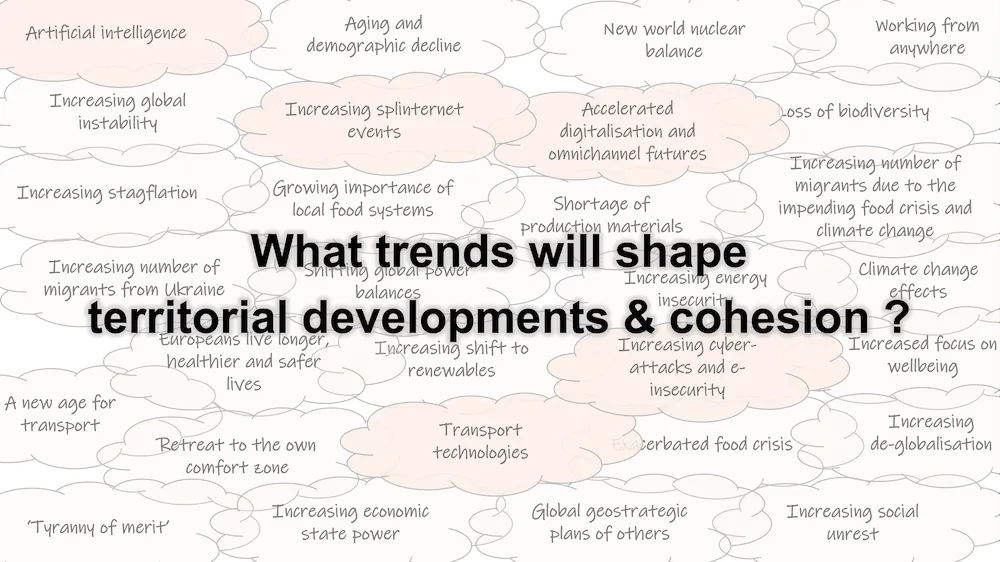
What trends will shape territorial developments and cohesion outlooks in the years to come? During 2022 we addressed mega-trends in several studies, e.g. for the European Parliament (Abre numa nova janela), the European Committee of the Regions (Abre numa nova janela) or ESPON (Abre numa nova janela). Bringing together the various pieces of trend analysis provides a rich picture about possible developments which may shape territorial development and cohesion in Europe. Therefore, we have brought them together in a series of blog posts (to be published between December 2022 and February 2023) addressing societal, technological, economic, environmental and political trends.
Future trends will probably exacerbate spatial and societal fragmentation, interdependencies and policy mismatches. This is likely to increase perceptions of uncertainty and vulnerability in a world of disruptive changes leading to a ‘pervasive uncertainty’.
Trends considered to have the strongest impacts on territorial development and cohesion include exogenous technological trends (e.g. digital society, post-carbon and circular economy), social change (e.g. migration, aging, fluid social institutions and shifts in values), environment (e.g. adapting/mitigating climate change and managing scarce resources), and economic (e.g. slowbalisation, peak of everything, working from anywhere). Also political trends play an important role, both political developments in Europe, as well as those in other parts of the world which affect development prospects in Europe.
In many regards the trends point at a risk of increasing concentration on urban areas with growing territorial imbalances and inequalities, which may translate into social fragmentation and increasing discontent.
Technological trends
In this blog post we summarise some key findings concerning technological trends.
Technological progress is a driver of economic and social change, potentially severely impacting spatial development in Europe. Developments that will shape future perspectives range from social and new media as well as mining and processing big data to automation, digitisation, artificial intelligence and bio-tech. Technology fusions blurring the lines between physical, digital and biological systems are expected to have disruptive effects. These can be related to work organisation, social engagement and the transformation of industry, health and education systems. In the initial phase technological change will exacerbate spatial inequalities. Technological revolutions or industrial transformations lead to phases of spatial concentration, i.e. accelerate developments where the ‘winner takes all’.
Some of the technological mega-trends to be considered:
Artificial intelligence: Technological developments – especially artificial intelligence, automation and bio-tech – influence our future lives and work. Already today, we are in a technological realm, with virtual reality mingling with real life. The Internet of Things and artificial intelligence pick up more and more, while job automation and high internet connectivity change our daily lives.
Accelerated digitalisation and omnichannel futures: The COVID-19 restrictions brought a tremendous boost to digitalisation in Europe. Just think of home office, videoconferences, e-learning, e-governance, e-commerce and e-entertainment. In some areas the pandemic as accelerated projected developments and changed mainstream behaviour, which will be further shaped in years to come. This concerns e.g. the increasing shift towards a co-existence of digital and physical offers, as seen in the shift to omnichannel retail, led by digital shopping. Omnichannel approaches are also expected to become more frequently used in e.g. (tertiary) education and entertainment.
Transport technologies: Particularly with regard to spatial developments, the future of transport is important. This ranges from expected changes related to e-mobility, self-driving cars and busses, to the use of drones for the transport of goods and persons to possible new transport systems such as the hyperloop.
Increasing cyber-attacks and e-insecurity. Technological trends influenced by Russia´s war on Ukraine are especially linked to security and protection. Increasing cyber security is necessary, including reducing third party dependence. Attacks concern not only the digital world, but also physical infrastructure and technological supply chains. Cyber-security is an essential dimension of resilience and the transition to a green and digital future.
Increasing splinternet events. Increasing tensions between governmental territoriality and technical suggest that the internet might move from a word-wide-web into a splinternet or cyber-balkanisation, where parallel transnational ‘internets’ connect like-minded parts of the world. Splinternet events not new, but they intensify as political and commercial interests put different restrictions on free use of the tool.
Linked to territorial development and cohesion, technological ‘revolutions’ and transitions generate network effects which often lead to economic and spatial concentration. This implies increasing cohesion challenges in the years to come. Only after a technological ‘revolution’ a phase of technology diffusion can be expected which is associated with convergence between economic players and places.
At the same time, following Smihula’s further development of Kondratiev waves or cycles of industrial revolutions, each new wave is shorter than a previous one. This is mainly due to an acceleration of scientific and technological progress. The prospect of ever fast sequences of technological ‘revolutions’ poses considerable challenges to cohesion. As it might imply that phases of economic and spatial concentration following in ever shorter periods and periods of technological diffusion and cohesion become shorter and shorter.
More blog posts on environmental, societal, economic and poltitical trends are to come.
by Kai Böhme
https://steadyhq.com/en/spatialforesight/posts/7cae0136-7e0d-4d62-ab84-ebd698ad94ee (Abre numa nova janela)
Data
14/12/2022
Tópico
Trends
0 comentários
Gostaria de ser o primeiro a escrever um comentário?
Torne-se membro de spatialforesight e comece a conversa.