Multi-agent AI systems fail in ways that individual agent evaluations will never surface, and the software engineering field has not yet built the vocabulary to describe why.
For decades, software quality assurance rested on a single defensible principle: verify each component, and the system follows. Unit tests, code review, CI pipelines, static code analysis: all share a common foundational assumption. If the parts are correct, the whole is correct. That principle governed how organizations structured teams, allocated review bandwidth, and measured engineering health.
The arrival of multi-agent AI development invalidates that assumption. Not incrementally but structurally. Agents do not coordinate through formally specified contracts. They negotiate through natural language specifications, probabilistic outputs, and implicit shared state. The moment a second agent depends on the first agent's output, the system has crossed from merely complicated territory into complex territory, a distinction with concrete, measurable consequences (Russo, 2026).
Most engineering teams evaluating AI-assisted development still measure individual agent performance, individual commit quality, and individual CI pass rates. These are the right metrics for complicated systems. For complex ones, they are insufficient by design: the properties that matter most are architectural entropy, cascade failure probability, and what Russo (2026) terms comprehension debt. Those properties exist only at the ecosystem level, not in any single agent and not in any single artifact.
The Empirical Backbone
What the benchmarks show
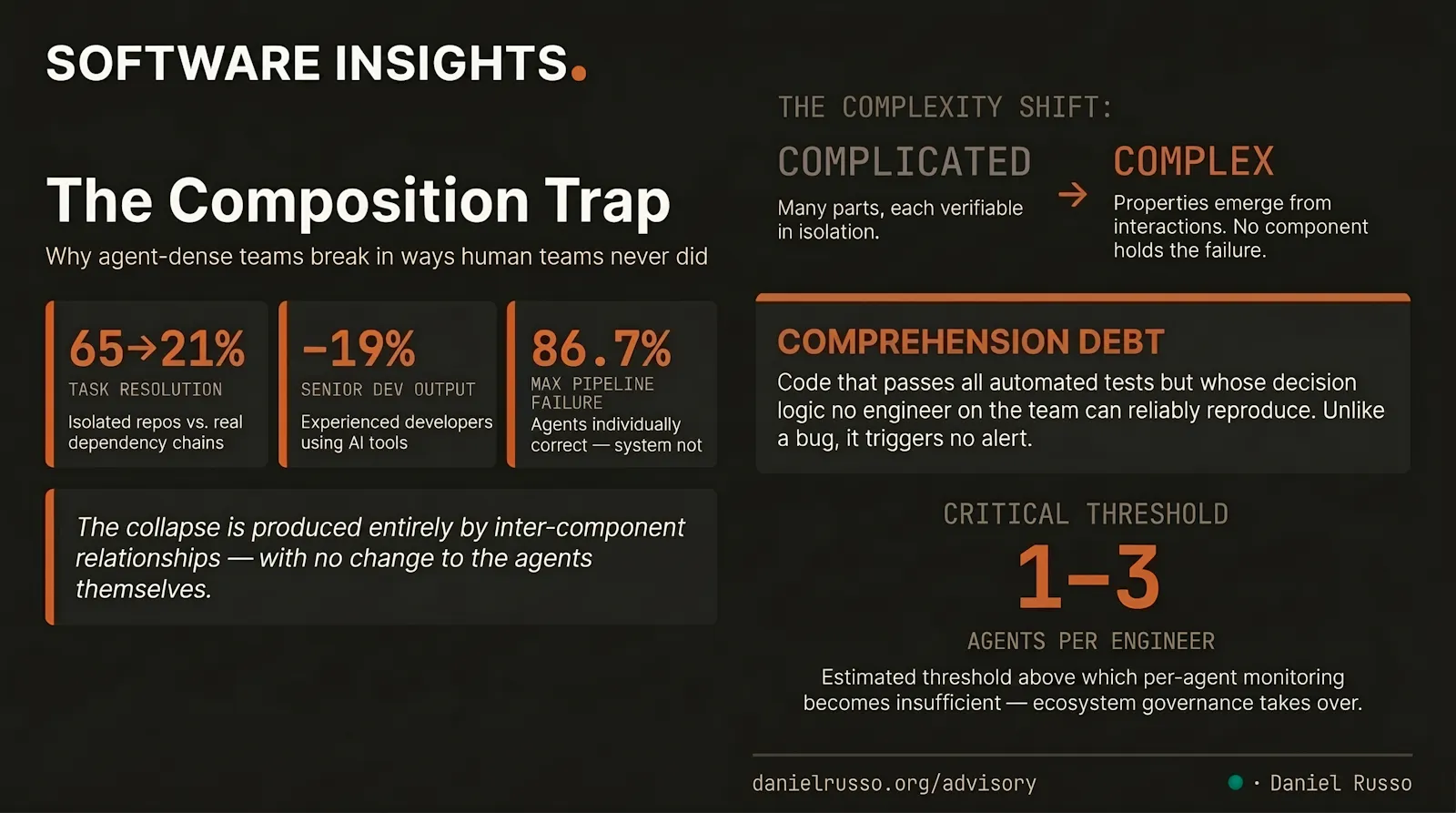
The performance collapse that emerges when agents operate within real, dependency-laden systems is already measurable in existing benchmarks. Standard SWE-bench evaluations show autonomous agents resolving approximately 65% of software engineering tasks when working on isolated repositories. Move those same agents to SWE-EVO, a benchmark incorporating realistic dependency chains, and resolution rates fall to 21%.
Agents that resolve 65% of issues on isolated repositories resolve only 21% on systems with realistic dependency chains. The collapse of more than two-thirds in performance is produced entirely by the presence of inter-component relationships, with no change to the agents themselves.
That finding is the compositional assumption failing under controlled conditions. The agents performed correctly according to their specifications. The systems did not.
The phenomenon extends across organizational contexts. Cemri et al. documented failure rates between 41% and 86.7% in autonomous coding pipelines under conditions where individual agent specifications were met. The agents were, in the conventional sense, correct, but the pipelines were not.
At the organizational level, the signal is consistent. A METR evaluation found a 19% productivity slowdown among experienced developers working with AI tools. These were senior practitioners whose measured output declined as AI integration deepened, not junior engineers adapting to unfamiliar workflows. The DORA 2024 report recorded a 7.2% decrease in delivery stability running concurrently with a 25% increase in AI-tool adoption. GitClear's analysis of 211 million changed lines found quality degradation patterns correlated with increasing AI-assisted development. None of these outcomes are attributable to defective agents. All of them are attributable to systemic effects that per-agent measurement cannot predict.
Complicated versus complex
Understanding why requires a conceptual distinction that software engineering has borrowed from complexity science but not yet operationalized in practice.
A complicated system contains many components, each verifiable in isolation: an aircraft engine, a microservice architecture with formal contracts, a monolithic application under unit-test coverage. High component count does not make a system complex. A complex system's significant properties arise from interactions between components, not from the components themselves. Anderson (1972) observed that no aggregation of electron trajectories produces superconductivity, and no inspection of individual water molecules predicts turbulence. The same principle applies to software ecosystems where agents coordinate through natural language: the system's failure modes cannot be deduced from any individual agent's behavior, because those failure modes are not located in the agents.
A team of five AI agents coordinating through natural language does not simply scale up a team of five human engineers. Human teams develop shared mental models, reputation constraints, and social norms that regulate coordination. Agents operate without those constraints: they make autonomous decisions without reputation feedback, interpret specifications probabilistically rather than through shared organizational context, and produce no formal inter-agent contracts. That combination creates emergent failures that artifact-level verification was never designed to catch.
Comprehension debt and the phase transition
The most consequential new construct Russo (2026) introduces is comprehension debt: code that passes automated verification but whose decision logic no engineer on the team can reliably reproduce.
Comprehension debt differs from technical debt in a precise way. Technical debt describes known shortcuts whose future cost is estimated and deferred. Comprehension debt describes a hidden epistemic gap: the system behaves correctly by the available metrics, while no human possesses the mental model required to intervene when it stops doing so. GitClear's 211-million-line analysis suggests this accumulation is already underway in production codebases. Unlike a bug, comprehension debt triggers no alert. It surfaces only when something goes wrong and no one can explain why.
Russo (2026) further proposes that agent-intensive systems may undergo phase transitions around a critical ratio of one to three agents per human engineer. Below that threshold, cognitive oversight remains tractable; engineers can still reconstruct the decision logic of agent-generated changes at a reasonable cost. Above it, ecosystem behavior at the macro level becomes causally more informative than the behavior of individual agents. At that point, managing the agents individually is the wrong unit of analysis. Governing the ecosystem is the only lever that works.
A 30-minute multi-agent risk audit
If your team is generating more than 30% of its commits through AI agents, the dynamics described above are present in your repository now. The following checklist identifies the most tractable early signals.
1. Pull 90 days of commit metadata. Calculate the proportion of commits carrying AI-tool fingerprints: co-authored-by fields, automated PR descriptions, and commit message patterns. If that proportion exceeds 30%, your system is in the agent-intensive range where ecosystem-level monitoring becomes necessary.
2. Cross-reference your test pass rates against human review depth. High CI pass rates combined with declining substantive review comments per commit is a leading indicator of comprehension debt accumulation. The tests are green; the understanding is eroding.
3. Generate a dependency graph for the modules receiving the highest volume of AI-generated commits. High clustering coefficients in those modules predict higher cascade failure probability. This is where a single merge failure propagates furthest.
4. Audit your incident post-mortems from the last six months. Identify cases where the stated cause was correct code behaving unexpectedly in context. That pattern, individually verified components producing system-level failures, is the fingerprint of emergent failure, not conventional bugs.
5. Measure mean time to explain (MTTE): the time a senior engineer requires to reconstruct the decision logic of a recently merged AI-generated module. If no senior engineer can explain a non-trivial AI-generated change in under 20 minutes, that module carries comprehension debt.
6. Check your on-call escalation rate over the last two quarters against your AI-tool adoption rate. Under Russo's (2026) Proposition 5, intervention rates increase even as individual agent capability improves. A rising escalation rate in a team reporting better AI tools is not a contradiction. It is a predicted outcome.
7. Identify your highest-dependency services and count how many currently receive AI-agent contributions. Cascade failure risk scales with both dependency density and agent count; this intersection marks your highest-priority governance gap.
8. Ask your most experienced engineers a direct question: can you explain the decision logic behind the last significant AI-generated merge in your area? Their answer reveals more about your comprehension debt than any static analysis tool currently can.
Next moves
For the builder
Treat code review as a measurement instrument, not only a quality gate. When reviewing AI-generated changes, record explicitly whether you can reproduce the agent's decision logic or whether you are verifying only the output. That distinction is the operational definition of comprehension debt at the individual level. Request explanatory comments as part of your review criteria, not summaries of what the code does but accounts of why it takes the approach it does. Track how often you approve AI-generated code you cannot mentally simulate; that ratio is your personal comprehension debt signal, and it compounds across every sprint.
For the manager
Restructure your team's review practice around the assumption that agent-dense codebases require ecosystem-level observation alongside artifact-level sign-off. Introduce a recurring team ritual, monthly or per-sprint, dedicated to understanding the decision logic behind AI-generated changes merged in that period, not their correctness but their reasoning. Track your on-call escalation rate as a primary indicator of emergent system behavior. When it rises while individual agent metrics improve, the explanation is systemic; adjusting an individual agent's prompt or configuration is not the intervention that addresses it.
For the roadmap owner
The governance frameworks your organization has built around AI adoption, including EU AI Act compliance plans, NIST Risk Management Framework mappings, and existing DORA measurement programs, were designed for individual systems operating within formal contracts. Russo (2026) argues these are structurally incomplete for multi-agent ecosystems. Commission an audit of your current AI governance approach against ecosystem-level observables: coupling density, comprehension debt fraction, inter-agent dependency graphs. Establish an explicit agent-to-engineer ratio policy before adoption pace sets it for you. The METR finding of a 19% productivity slowdown among experienced developers indicates that scaling agent headcount without ecosystem visibility produces net-negative outcomes for your most valuable engineers. Budget for measurement infrastructure before scaling further.
Closing thought
The shift from complicated to complex does not happen gradually. It crosses a threshold, and teams rarely notice until the cascade has begun. Software engineering has spent three decades building excellent instruments for complicated systems: unit tests, static analysis, CI pipelines, code review. Those instruments still work for what they were designed to measure. The question facing every team adding agents to its workflow is whether it can now operate at a different level of analysis simultaneously, monitoring interactions rather than only artifacts, governing ecosystems rather than only components. The organizations that treat this as a tractable measurement problem, something falsifiable and instrumentable, will build the observational infrastructure needed to answer it.
What does your current monitoring tell you about the system that emerges from your agents' interactions, not just from the agents themselves?
Daniel Russo, Ph.D., is a Professor of Software Engineering whose research examines the intersection of human cognition and artificial intelligence. Through Software Insights, he translates empirical research into actionable guidance for software practitioners and organizations.
If this issue surfaces a problem your organisation has been trying to name, I work with engineering leaders to diagnose exactly that kind of challenge, using the same methods behind the research you just read. No frameworks. No opinion without evidence.
danielrusso.org/advisory (Opens in a new window)
References
Anderson, P. W. (1972). More is different. Science, 177(4047), 393–396. https://doi.org/10.1126/science.177.4047.393 (Opens in a new window)
Cemri, M., et al. (2025). Why do multi-agent LLM systems fail? arXiv:2503.13657.
DevOps Research and Assessment. (2024). 2024 state of DevOps report. Google Cloud, Puppet, & Lacework. https://cloud.google.com/devops/state-of-devops (Opens in a new window)
GitClear. (2024). The state of code quality: 2024–2025 report. https://www.gitclear.com/coding_on_copilot_data_shows_ais_downward_pressure_on_code_quality (Opens in a new window)
METR. (2025). Measuring the impact of early-2025 AI on experienced open-source developer productivity. arXiv:2507.09089.
Russo, D. (2026). More is different: Toward a theory of emergence in AI-native software ecosystems. arXiv:2604.19827.
Scalabrino, S., Linares-Vasquez, M., Poshyvanyk, D., & De Lucia, A. (2021). Automatically assessing code understandability. ACM Transactions on Software Engineering and Methodology, 30(3), 1–53.
Date
April 28, 2026


