September 2024
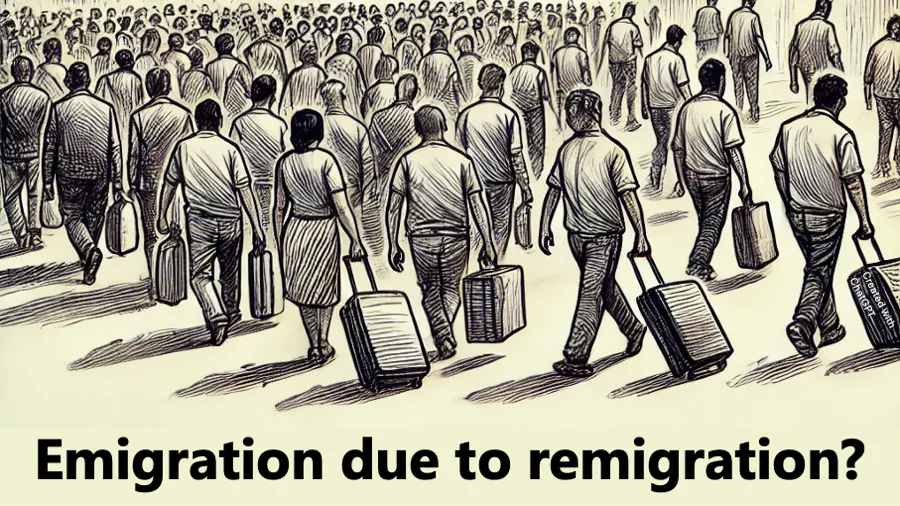
Could this be the start of something big? People are considering moving away from regions governed by radical right-wing parties.
Right-wing politics have been steadily gaining ground across Europe, with a noticeable impact on regional governance and development. In September, elections in some German states gave a boost to the radical right. This has accelerated the debate on how to deal with radical right-wing parties, but also their impact on regional development. There is increasing talk of people wanting to leave the region or even Germany if they come to power. These are not necessarily the people with a migrant background, whom these parties want to 'remigrate' anyway.
In this context a recent study about ‘Rejection, fear and plans to leave (Opens in a new window)’ by DeZIM, the German Centre for Integration and Migration Research, is very timely. The study was conducted before the elections in some German states in September, but it provides insights into the possible consequences of the election results. It examines the societal impact of the growing influence of the Alternative for Germany (AfD) party, focusing in particular on public perceptions of the party's controversial policies and their impact on migration plans. The study is based on a nationwide survey conducted in March 2024 and focuses on how people perceive the AfD, particularly in light of its plans for 'remigration' - a controversial proposal to deport large numbers of immigrants from Germany.
Although the study focuses on Germany, its findings are likely to resonate across the EU. Many EU member states have experienced similar upsurges in right-wing politics, making the study's findings broadly relevant to understanding the wider European political and developmental landscape.
The study provides a comprehensive view of the psychological, social and potential demographic shifts that could result from the AfD's growing popularity, particularly in eastern Germany, where the party has made significant electoral gains.
Rejection of the AfD
One of the most striking findings of the study is that a clear majority of respondents perceive the AfD as undemocratic and extremist. More than 72% of respondents described the AfD as antidemocratic, while 80% described the party as racist. Some 77% described it as extremist, showing a broad rejection of the AfD's political stance across different demographic groups.
This negative perception was consistent across different regions, genders and ethnic backgrounds. Even among those with conservative political leanings, many still saw the AfD as a threat to democratic values. However, AfD supporters were largely outliers in this trend, with only 3-5% of them describing the party as undemocratic or racist.
This widespread disapproval suggests that, despite its electoral success, the AfD is not seen as a 'normal' political party by the majority of the German population, which may limit its wider acceptance in mainstream politics.
Fear of ‘remigration´ policies
A key issue explored in the study is the AfD's 'remigration' plan, which proposes the mass deportation of immigrants, particularly those with non-European backgrounds. This policy has caused considerable anxiety among the German population, particularly among immigrant communities.
The study found that 58.5% of people with a migrant background expressed anxiety about this policy. Concern was even higher among people from the Middle East and North Africa (MENA) region, with nearly two-thirds of respondents saying the AfD's rhetoric made them fear for their safety. This fear is not unfounded; many see the party's stance as reminiscent of dark historical precedents of forced expulsions.
Even more telling is the fact that nearly 85% of respondents, including some AfD supporters, oppose the party's remigration plans. This highlights the extreme nature of the policy and its potential to alienate large sections of the population, both native Germans and immigrants.
Emigration and internal migration plans
One of the most alarming findings of the AfD's rise is its impact on internal migration plans in Germany. The study found that nearly 10% of respondents with a migrant background are seriously considering leaving Germany due to fears associated with the AfD's growing influence. This figure rises to almost 19% among those from the MENA region. The fear of living under an AfD government is not limited to those with a migration background. Even among native Germans, some 2% consider emigrating if the AfD gains power in their region.
For many, the plan is not to emigrate to another country, but rather to move to another federal state if the AfD comes to power in their own state. Around 13% of respondents with a migrant background are planning to move to another federal state, with people from the MENA region (24%) and non-EU European countries (15%) particularly likely to be considering this.
This trend is particularly pronounced in states such as Saxony, Brandenburg and Thuringia, where the AfD is already the dominant political force.
Implications for regional development
The prospect of emigration or internal migration, with people leaving AfD-led states, could have far-reaching consequences for the demographic and economic structure of these areas.
The study findings paint a worrying picture for regions with significant right-wing political dominance, particularly those where the AfD has become a major political force. While the party's rise may resonate with a segment of the electorate, its broader societal impact is likely to be negative:
Economic and social consequences. The fear generated by the AfD's policies, particularly its anti-immigration stance, could lead to further emigration from regions where the party is influential. This is likely to have a severe impact on the labour market, as large parts of Germany are already experiencing a shortage of skilled labour. As skilled people eave, this shortage will become more pronounced and it will also become more difficult to attract skilled labour force to these regions. Sooner or later, industry may follow their skilled labour force. The negative perception of the AfD's policies among businesses could deter investment, especially from foreign companies that may see these regions as hostile to diversity and international cooperation. All of this would be particularly problematic for areas in eastern Germany that are already facing depopulation and economic stagnation. A shrinking population would exacerbate these problems, leading to a smaller workforce, less economic activity and reduced public services.
Social division. The rise of the AfD also threatens to deepen social divisions. The study shows that the party's rhetoric, particularly around 'remigration', is causing fear and anxiety among migrant communities, which could weaken social cohesion. In addition, the party's framing of issues around national identity and anti-immigration policies has the potential to further polarise the population, leading to increased social tensions.
The long-term outlook. Looking ahead, regions with a strong AfD presence face a challenging future. While the party may make short-term political gains, the long-term consequences of its divisive policies are likely to lead to economic stagnation and social unrest. To avoid these outcomes, regions with high shares of right-wing politics will need to find ways to balance the concerns of their electorates with policies that promote inclusion and economic growth.
The long-term development prospects for regions where right-wing politics dominate are uncertain, and they may face significant challenges unless a more inclusive approach is adopted. Unfortunately, these developments are not unique to Germany. Similar trends can be observed in many other European countries. The question remains where people want to go.
It could be argued that these migration plans and their potentially devastating impact on local and regional development prospects are far-fetched. Firstly, there may be some inertia before people turn their talk of leaving into an actual move to another state or country. Secondly, remigration plans require national government decisions and are not subject to state, regional or local government decisions. However, there are many small local actions that can be taken in preparation. As reported in the Economist (Opens in a new window), Monfalcone, a town in north-east Italy, has banned cricket and tried to ban prayer in the town's Islamic centres to drive out its Bangladeshi residents. It is the small steps that are worth watching, not just the big plans.
by Kai Böhme
https://steadyhq.com/en/spatialforesight/posts/c558d017-0a70-487f-8484-8f7776c25bc8 (Opens in a new window)
Date
September 21, 2024
Topic
Trends
3 comments
Would you like to see the comments?
Become a member of spatialforesight to join the discussion.