October 2025
In face of the tremendous global challenges of defence, security and trade, EU is hard pressed to provide the preconditions necessary to meet the obligations for tomorrow’s sustainable growth. In order to achieve this, we argue there is a need to consider the feasibility of territorially-based spatial cohesion policy with a mission (or missions), in line with Marianna Mazzucato’s influential approach to revolutionising European policies by introducing a more mission-driven approach to them (originally introduced in 2019 (Opens in a new window)). Such an approach would involve the framing of grand societal challenges (such as climate change, health, and digital transformation) into bold, cross-sectoral “missions” that align public investment, private innovation, and civic participation around clear, measurable goals to deliver systemic change.
The future credibility of Europe is in fact a quadruple challenge: external security challenge, internal cohesion challenge (with interlinkages to external security), financial challenge largely due to the demographic development, as well as the multi-faceted sustainability challenge. Whilst Europe is facing an external security challenge and needs to safeguard itself in an unstable global environment, marked by geopolitical rivalries, wars close to its borders, shifting alliances, migration pressures, cyberthreats, and energy dependencies, responses cannot be found in security and defence policy sectors alone.
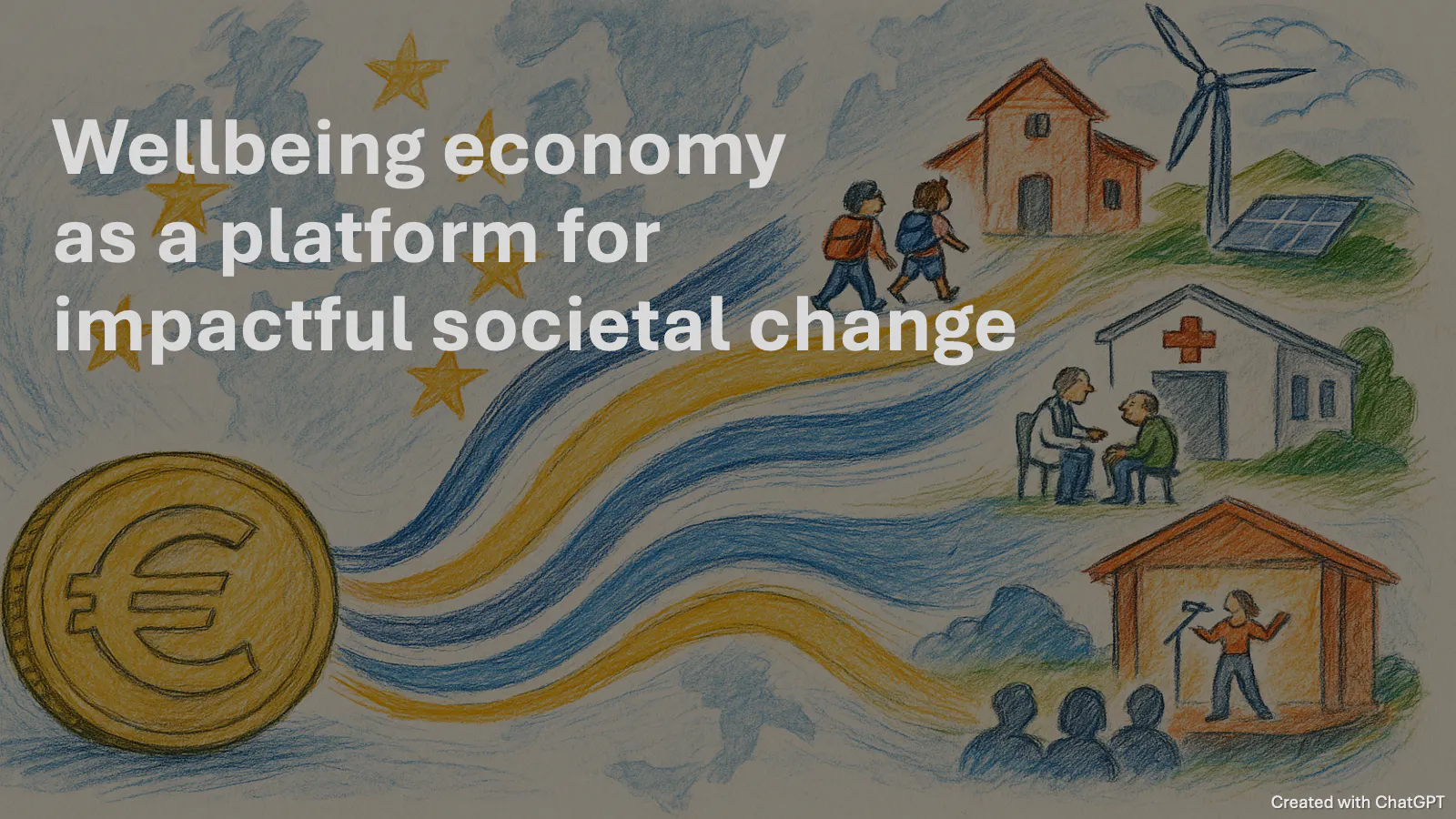
As the financial equation is only one element of the current challenge, a new, significantly altered and more mission-driven policy design and modus operandi is indeed required to retain credibility on the global scene and to ensure the trust of citizens’ in EU’s ability to deliver for prosperity and wellbeing in our continent. Therefore we consider the relevance and appropriateness of a wellbeing economy approach as a platform for impact, societal change and sustainability transition. We argue that a ‘wellbeing economy’ could provide an umbrella for the more impactful, phenomenon-based and cross-sectoral approach to territorial policy.
When the EU requires at the same time credible defense, sufficient strategic autonomy, and resilience (based on autonomy) against external shocks, it needs to be more alert to the internal challenges, as well, as there is clearly an internal cohesion challenge, with Europe struggling to balance unity and diversity. Within the EU and the wider continent, there are cleavages between East and West, North and South, large and small states, core and periphery, urban and rural areas, thriving and lagging behind areas, areas easily embracing green and digital transitions and areas challenged by them, areas more resilient and able to cope with future shocks and less resilient areas. Rising populism, democratic backsliding, inequality, and questions of identity test the social and political fabric holding the European project together.
In sustainability terms, Europe may not be concentrating enough on the need to transition to a model of development that is economically viable, environmentally sustainable, and socially just.
Challenges are massive, even existential: in terms of its economic development, Europe is struggling to meet the need for competitiveness, innovation, fiscal stability and energy transition, whilst paying heed to the ecological necessities of climate change, biodiversity loss, and resource depletion. Both the above have their repercussions on the social elements of inclusion, demographic change, and labour market adaptation. Culturally, the challenge entails preserving Europe’s heritage while fostering openness and adaptation in a changing world. Taken together, these challenges form a kind of multi-layered stress test for Europe, with the characteristics of the challenge requiring solutions that are equally interconnected, responding to external insecurity fueling internal divisions (e.g., over migration or sanctions), internal disunity undermining Europe’s capacity to act on global sustainability, and the sustainability transition, if poorly managed, creating further social and cultural rifts, feeding populism and weakening cohesion. Europe cannot afford to lose sight of these challenges and the scenarios required to respond to them.
Impact driven approaches to European wellbeing scenarios - national, regional and local
National strategies provide an overall setting for redesigning missions. There have been developments toward a more systems-driven, impact-based management and policy across the EU and the OECD already for a considerable time. Impact-driven mission approaches in areas such as wellbeing and sustainability are of increasing interest. The main concern is whether these initiatives will survive the securitisation of the EU policy agenda, but the need for societal cohesion and resilience may be the missing link between a shared policy agenda and lacklustre societal trust.
For rethinking and redesigning wellbeing, sustainability and resilience, one of the most influential approaches has been the ‘Doughnut model’, developed by economist Kate Raworth and advanced through the Doughnut Economics Action Lab (DEAL), providing a framework to tackle ecological overshoot and social inequities by embedding systems thinking in economic governance.
Amongst some examples are for instance Finland, New Zealand, Scotland and Wales, leading us to ponder whether innovative governance solutions are more easily developed in smaller states and if scale should matter, how could the EU benefit from these smaller scale examples in its governance and policy design: perhaps more experimentalist governance and small scale pilots are the way forward instead of large-scale over-arching uniform structures?
Whilst wellbeing economy is on the agenda, and also referred to in the Finnish Ministry of Social Affairs and Health strategy, allowing for a systematic approach to wellbeing through its National Action Plan for the Economy of Well-Being (2023–25) (Opens in a new window), the topic is more present on the research and civil servants’ desk, rather than a political priority. The governance model for the wellbeing economy embeds wellbeing indicators and impact assessments into state, regional and municipal decision-making, aiming to align policy and investment choices with health, inclusion and sustainability. Already in 2023, the Ministry of Social Affairs and Health published Finland's National Action Plan for the Economy of Wellbeing (Opens in a new window), which provided recommendations to draft a proposal for a national wellbeing economy governance model and a set of indicators for monitoring the wellbeing economy. Yet in day-to-day practice, the realities remain quite different, as there are no wellbeing-oriented budget tools that would provide support for the assessment of sustainable wellbeing and steer budgetary allocations based on these principles. Neither is information steering or knowledge-based governance providing sufficient support, as there are no reporting procedures that bring together the analyses of different sustainability dimensions. Additionally, there is a lack of national-level monitoring indicators that would be linked to decision-making. A critical step in response to these caveats dimensions.
 (Opens in a new window)
Scotland, in turn has embedded wellbeing outcomes into its National Performance Framework (NPF), linking policy goals to social, environmental, and economic wellbeing, with one flagship mission focused on reducing child poverty by 2030. This legally binding mission aligns cross-sector efforts across housing, education, health, employment, and social protection, treating poverty as a shared responsibility rather than a single-department issue. Progress is tracked through a comprehensive set of wellbeing indicators—such as household income after housing costs, food security, children’s educational participation, and health outcomes—which are integrated into annual reporting and parliamentary scrutiny to ensure accountability. By coordinating policies across sectors and emphasising both short-term income measures and long-term capabilities like skills, health, and family stability, the mission embodies an impact-driven, cross-sectoral, and resilience-oriented approach consistent with the principles of a wellbeing economy.
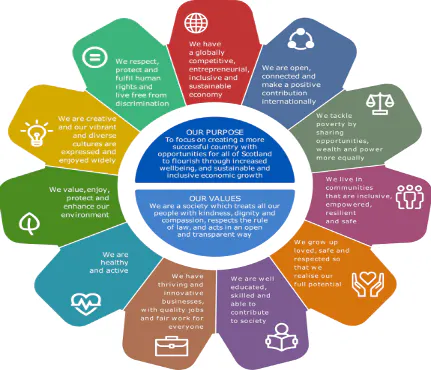
Many of the aspects of the NPF are cross-sectoral in nature, as the various aspects of wellbeing from creativity to innovation or inclusiveness clearly cannot be achieved by any one sector in isolation. The various elements of the budget are defined as values-based (prioritising delivering on equality, opportunity and community missions and investing in our public services, and protecting people, as far as we can, from the harm of the UK Government’s cost of living crisis); targeted (ensuring that spending represents value for money to the taxpayer and delivers maximum impact); as well as reform-focused (ensuring that public services remain fiscally sustainable, outcomes improve and they support the people and communities who need them most, with commitments to Fairer Funding for the Third Sector). (Scottish Government 2023)
Outside the EU, New Zealand amongst others is worth mentioning, as it has pioneered the Wellbeing Budget, requiring all major fiscal decisions to be assessed against their contribution to social, environmental and human capital alongside economic growth. In Wales, the Well-being of Future Generations Act (Opens in a new window) (2015) legally obliges public bodies to act in ways that improve the social, economic, environmental and cultural wellbeing of both present and future generations, supported by a Future Generations Commissioner. Under the Well-being of Future Generations (Wales) Act 2015, all Welsh councils set Well-being Objectives and report annually via an Annual Wellbeing Report.
Local and regional wellbeing strategies bring resilience closer to home
In addition to national level, regions and localities are working towards a thematic wellbeing agenda. Amsterdam became the first city to adopt it in 2020 as a formal recovery and resilience strategy, co-developing a ‘City Doughnut’ with local partners to balance wellbeing and ecological boundaries across four lenses—social, ecological, local, and global. This approach reflects key Systemic Risk Response (SRR) criteria, including Complexity, Justice, Multiple Ways of Knowing, Universal Responsibility, Mainstreaming, and Sanctity of Nature, showing how reframing economic assumptions, building coalitions, and shifting mental models can catalyse systemic transformation. Amsterdam’s experience demonstrates how communities can drive adaptive, values-based responses to systemic risk, offering a replicable pathway for other cities.
In addition to Amsterdam, Brussels (Belgium) and Ayrshire (Scotland) provide inspiring examples of designing wellbeing strategies and frameworks inspired by Kate Raworth’s ´Donut model´.
The Brussels-Capital Region has embedded the Doughnut framework through the “Brussels Donut” Portrait (Opens in a new window), positioning it as a shared strategic compass and developing an indicator set across the model’s four lenses—local social (e.g., housing affordability, access to green space), local ecological (air quality, nitrogen and phosphorus pressures), global ecological (consumption-based CO₂ and material footprint), and global social (fair trade and supply-chain risks). This indicator framework is designed to connect measurable targets directly to the Doughnut’s balance of wellbeing and ecological boundaries. In North Ayrshire, Scotland, the council has operationalised the Doughnut’s wellbeing-economy principles through a Community Wealth Building (CWB) strategy (Opens in a new window), underpinned by an Inclusive Economy Dashboard that tracks progress across CWB’s five pillars plus the environment. Indicators include fair employment and incomes (employment rates, living wage coverage, school-leaver destinations), procurement and plural ownership (business survival rates, jobs density), and assets and places (fuel poverty, town-centre vacancy, derelict land), with performance benchmarked against Scotland-wide data using a simple RAG system. Together, these regional cases show how the Doughnut model can be adapted into actionable indicator frameworks, aligning local economic strategy with ecological and social thresholds in distinct policy contexts.
Similarly, several French regions, including Provence-Alpes-Côte d’Azur (PACA), Occitanie, Normandie, and Pays de la Loire, publish sustainable development dashboards that, while not always explicitly framed as ‘wellbeing economy’ tools, approximate such metric systems by aligning with the UN Sustainable Development Goals (SDGs). These “tableaux de bord du développement durable (Opens in a new window)” track social, environmental, economic, and territorial indicators—such as emissions, biodiversity, poverty, education, mobility, and energy—benchmarking regional performance against national averages and monitoring trends over time. PACA’s dashboard, for example, is directly aligned with all 17 SDGs and uses traffic-light or trend signals to illustrate progress. Though not formal KPI scorecards with enforcement mechanisms, these dashboards serve as instruments for transparency, monitoring, and strategic guidance, making them the closest equivalent to wellbeing-economy metric sets currently used by French regions.
Mission-orientation in the making?
A more holistic, systems-based approach to strategies is no doubt required when faced with the major turbulence of the EU’s operational environment, geopolitical realignment, and economic volatility. Whilst the initiatives referred to above illustrate how national, regional and local governments can move beyond GDP by embedding wellbeing at the core of governance, budgeting and accountability, mainstream approaches remain dominant and committed to GDP and employment as the main indicators. In most cases the regional and local examples are more indicative of the thematic and analytical approach to working with quality of life and wellbeing themes. We are yet to see examples where this work would be accompanied by a more ambitious mission-oriented work, where a mission of fundamental change would be commonly defined and subsequently designed in the form of a mission strategy. The rethinking of KPIs and working with thematic indicators obviously is an important first step. Europe cannot be overwhelmed into inaction by the enormity of the renewal and resilience challenges, as the stakes are no less than survival and European democracy itself. The mission for redesigning missions, as well as redesigning the required policy and governance approaches is very much ON.
by Kaisa Lähteenmäki-Smith
 (Opens in a new window)
Date
October 13, 2025
Topic
Resilience & transition
0 comments
Would you like to be the first to write a comment?
Become a member of spatialforesight and start the conversation.