Feburary 2024
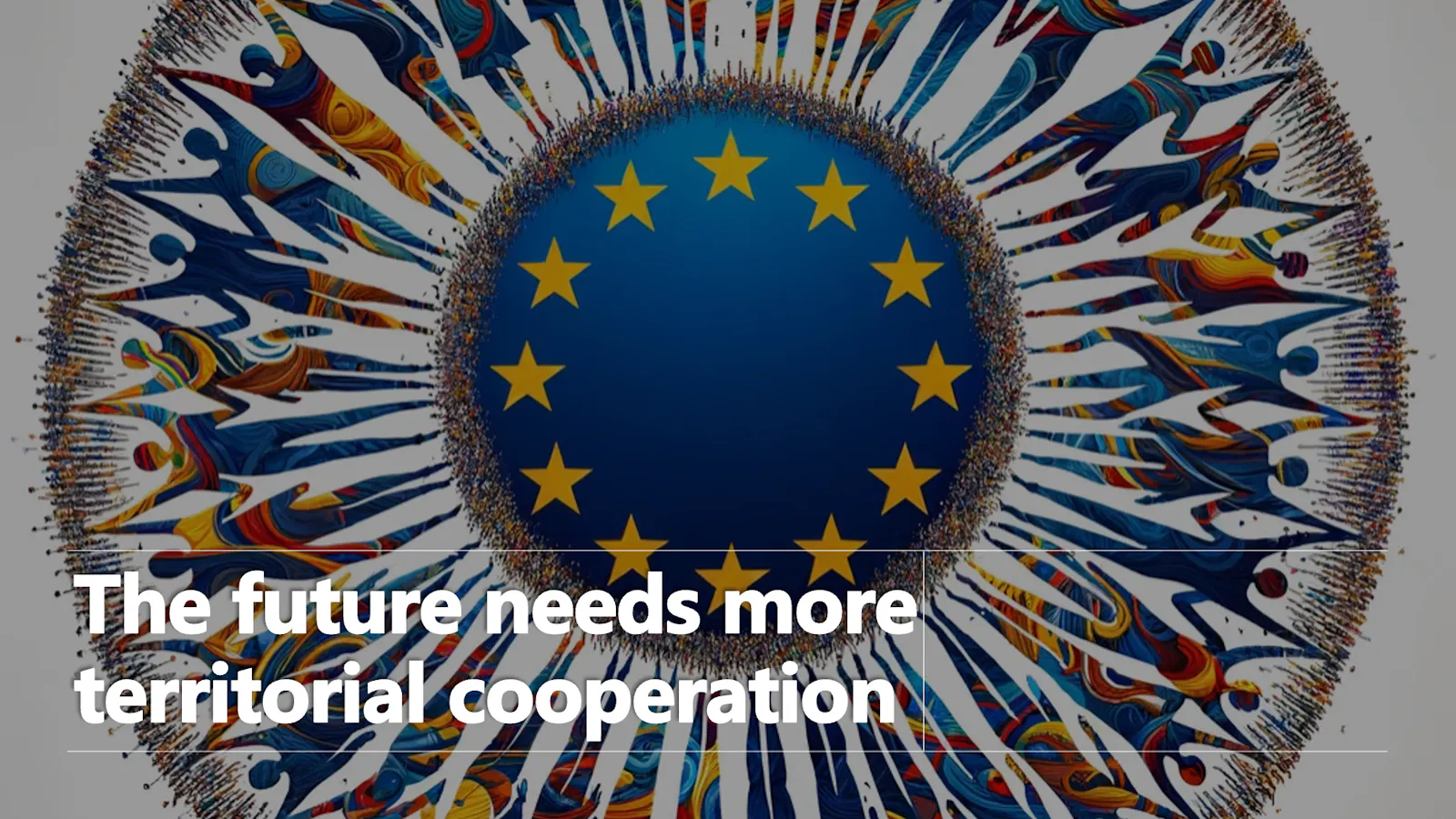
In the EU, every place exists in an intricate and profound interconnectedness. What happens in one place has implications for the development prospects of other places, and vice versa.
High levels of interdependence and integration in the EU imply that economic, social, environmental, security challenges and potential cannot be fully addressed in individual countries or territories. This concerns not at least border regions, which consitute an important part of the EU. In fact, EU internal border regions
cover 40% of the EU territory,
account for 30% of the population – 150 million people,
produce 30% of the EU's GDP, and
host almost 2 million cross-border commuters.
Border areas are an important part of the EU and come with their own challanges. There is a substantial number of studies on administrative and legal barriers to cross-border cooperation, showing that EU integration across national borders is often anything else but smooth.
There are considerable policy statements that border obstacles need to be overcome. Among others, the Territorial Agenda 2030 (Opens in a new window) casts a spotlight on this interconnection, emphasising the need to simplify the lives of citizens navigating the diverse tapestry of national borders within the EU. Along the same lines, the 8th Cohesion Report (Opens in a new window) emphasises that addressing today’s cohesion challenges requires better governance in border areas, stronger coordination of services, infrastructure and investments, and exchanges of experience supported by pan-European research. Shouldn’t internal EU borders become obsolete?
Borders are costly barriers
EU internal borders are a paradox: they serve as both gateways and barriers. To flourish, the EU needs seamless cross-border integration to mitigate the economic repercussions and job losses attributed to these barriers.
Despite all progress and goodwill to boost EU integration and overcome cross-border obstacles, national borders between EU countries – and between EU and EEA/EFTA countries – create barriers to development and integration. Cooperation between places inside and outside the Schengen area is especially affected as national borders remain hard borders that still represent barriers for the mobility of people, goods, and services. Moreover, borders between EU (and EEA/EFTA) countries and other external countries create even stronger barriers restricting mobility and commercial exchanges and creating uncertainty in the current highly volatile geopolitical environment. Deficiencies in cross-border integration remain costly.
According to estimates presented by Hynek Böhm at a meeting of the group of high-level experts on the future of Cohesion Policy (Opens in a new window), the price tag of existing borders has been calculated at EUR 458 billion. This is equivalent to 3% of EU GDP (or 9% of GDP in land border regions). The lack of integration also results in the loss of more than 6 million jobs. These are basically the costs of an imperfect functioning of the Single European Market (due to administrative and legal cross-border hindrances).
These are also costs of many enterprises in the EU favouring collaboration with partners in the same country over collaboration with partners in other countries. Most collaborations between enterprises in the EU still do not cross national borders, as emphasised by Ron Boschma in another meeting of the group of high-level experts on the future of Cohesion Policy (Opens in a new window). There is a bias to connect to players in their own country, which means, complementarities with players in other countries are exploited only to a rather limited extent.
The EU has taken some steps towards eliminating or rather overpassing the barriers of internal borders, either by reducing their obstacles or by enforcing cooperation.
Initiatives to reduce cross-border obstacles
In recent years, there have been plenty of debates and discussions about cross-border obstacles in the EU, as well as initiatives to tackle legal and administrative border obstacles along EU internal borders. One of these is b-solutions (Opens in a new window). This cooperation of the Association of European Border Regions (AEBR) and DG REGIO is a great occasion to collect information with a bottom-up approach in which practitioners of cross-border cooperation can tell what obstacles they encounter when trying to realise projects with the neighbouring countries.
In addition, there is the European Cross-Border Platform (Opens in a new window). It is the place for cross-border stakeholders to meet and discuss border communities' unique circumstances and needs, allowing them to engage with EU institutions through the European Committee of the Regions (CoR). It advocates new approaches and policy solutions for cross-border regions, contributing to their social and economic growth while building a common European future.
There is also the new proposal on a mechanism to resolve legal and administrative obstacles in a cross-border context (Opens in a new window). In short, it proposes to set up cross-border coordination points in all member states. They shall serve as first entry point for people and enterprises experiencing cross-border obstacles and assess their reports on obstacles with view to possible solutions. The objective is to find place-based (often bilateral) solutions for specific cross-border obstacles and do this on demand from local stakeholders in cross-border areas and voluntary basis.
EU cooperation programmes
To further stimulate cross-border integration and harness some of the economic potential of better integration mentioned above, Cohesion Policy plays an important role. Not at least Interreg programmes (Opens in a new window).
Interreg’s EUR 10 billion budget (2021-2027 programmes) is distributed over four strands of territorial cooperation:
64 cross-border cooperation programmes support cooperation between border regions in at least two Member States to address common challenges, cross-border obstacles and untapped growth potential in border areas.
13 larger transnational cooperation programmes support cooperation involving national, regional and local partners in Member States, non-EU countries (e.g. Norway, Iceland, Liechtenstein), enlargement and neighbourhood partner countries, to increase territorial integration.
4 interregional cooperation programmes focus on EU-wide development of networks, facilitation of exchanges and transfers of experience, and support to policy making.
5 outermost regions cooperation programmes enable these regions to cooperate with neighbouring non-European third countries and territories on their specific common challenges.
Interreg mechanisms adopt a bottom-up approach, focusing on people-based initiatives and promoting involvement from local authorities and smaller players. This generates local engagement, ownership, and capacity building, while offering direct connections to places abroad, including at the EU level. Therefore, Interreg is about more than just boosting cooperation and overcoming transaction obstacles. It fosters a sense of European belonging and strengthens EU integration.
In addition, multiple possibilities for embedding territorial cooperation in national and regional Cohesion Policy programmes have been introduced in the 2021-2027 period. For the first time, regional and national programmes are required to support cooperation across borders where relevant. Each programme shall set out the expected contribution to macro-regional strategies, sea-basin strategies and interregional, cross-border and/or transnational actions for each specific objective.
Through these instruments, Cohesion Policy supports four EU macro-regional strategies and three EU sea-basin strategies. These integrated frameworks address common challenges in larger geographical areas that include Member States and third countries.
Other legal instruments like European Groupings of Territorial Cooperation offer complementary support to cross-border cooperation by improving non-financial opportunities for cooperation.
As for the future
Still all this is not enough to harvest the EUR 458 billion in additional economic activity which would become possible by removing barriers to cross-border integration and fully implementing the four freedoms of the Single European Market. More needs to be done. As the EU starts discussing Cohesion Policy post 2027, the imperative for enhanced territorial cooperation is unmistakable. In addition, a mechanism to resolve legal and administrative cross-border obstacles is needed.
A strengthened focus on cooperation needs to reflect that cooperation varies territorially. The EU comprises a significant variety of border and cross-border regions, each facing different challenges and potential. It must acknowledge the unique challenges and opportunities presented by the EU's diverse regions, fostering a sense of European belonging and enhancing administrative capacity and governance through mutual exchanges and learning.
In light of forthcoming enlargements, particular attention has to be paid to territorial cooperation along external borders, which will become internal borders due to enlargement. Such cooperation can help forthcoming integration processes and support the development of capacity building and mutual learning.
Territorial cooperation can empower local and regional actors by enhancing administrative capacity, government quality, and governance within an area.
Let us embark on this journey together, towards a future where borders unite rather than divide, creating a stronger, more cohesive Europe for generations to come.
by Kai Böhme
Date
February 12, 2024
Topic
Cohesion (policy)
0 comments
Would you like to be the first to write a comment?
Become a member of spatialforesight and start the conversation.