2026/07/15
“Ressentiment” (Opens in a new window) -noun: deep-seated resentment, frustration, and hostility accompanied by a sense of being powerless to express these feelings directly.
Looking at the latest news it seems the rift between Poland and Ukraine is solely about historical grievances. While these were always lurking in the background, its resurfacing right now is not entirely accidental.
The realpolitik explanation for why this diplomatic fallout happened stems from the practical reason that neither country needs the other like they did before. Poland is now convinced that Ukraine will survive one way or another, and thus the Russian threat is currently under control. They can now sleep soundly because Moscow will not be able to push towards Warsaw anytime soon.
More than that they see a military giant emerging in Ukraine, a country they saw as an unfortunate little brother, or even junior partner they were patrons of for the past decades. This challenges their aspirational status as the leader of the region.
The Recent History
Since its partition, Poland was never a real regional heavyweight due to Germans and Russians historically sabotaging those efforts. But today Warsaw does have a lot of potential going for it. Namely, the largest population in the EU’s eastern flank with nearly 38 million people, and a rapid economic rise from a backwater Eastern European state into a formidable size, almost reaching that of the Netherlands with an untapped potential for catching up to Spain or even Russia one day. These are combined with a high defence spending and a large military in the same ballpark as Germany and Italy, with the potential of being a peer to France and the UK.
On a diplomatic front, they have seen themselves as ironclad. Combined with EU and NATO membership, Warsaw was the most loyal US ally on the continent, and regional countries threatened by Russia all looked up to them as their first line of defence and immediate security protector.
This perception got rapidly shaken in the past year or so. With Washington increasingly seen as an unreliable ally, their previous strategy of betting their defence on US guarantees seems exceedingly naive today. Simultaneously, Kyiv proved that even amidst Washington’s ceasing support, they are capable of resisting and deeply hurting Russia. They made it apparent to everyone in the region that the only country that is both capable and willing to shield them from Moscow is not the US or Poland, but Ukraine.
As a consequence, they even took over the position of the most resourceful US partner in the region. It was not long ago that in order to have the ear of Washington, London, Berlin, Paris, or Brussels, Kyiv needed Warsaw’s mediation. Today Ukraine has become an unavoidable player that all of these capitals need, deeply incentivise to have in the room, and eager to cooperate with.
All of these factors led Poland to a severe feeling of status loss they can do little about. The country is structurally incapable of hurting Kyiv without putting its own and its neighbours’ security at risk, thus powerless to counter Ukraine directly. It cannot materially do much without shooting itself in the foot during the process.
Polish society needed an outlet for all of these emotions. Their seemingly only way to achieve that was through raging about historical grievances. This gave them a tool to feel morally superior to the previously subordinate party that outshone - or mogged - them.
The Ukrainian attitude today is that they not only have the unquestionable and absolute moral high ground, but also a newfound confidence that they can do things on their own due to their geopolitical and military leverage. They are not only indispensable as a European security guarantor but the only ones that possess the technology and the expertise that are essential in the wars of the 21st century.
Ukrainians came to understand that Europe needs them just as much as they need Europe. Their whole recent history was that of a rule taker that can be pushed around by their overlords - overwhelmingly Russia, and to a smaller extent Poland and the US. This has changed, and it has become part of their national self perception that they are a strong independent nation that cannot be told what to do. Not from Moscow, not even from Washington, and certainly not from Warsaw.
This does not mean that Zelenskyy didn’t make a mistake in the way he handled the situation. It's in both countries vital long-term interest to eventually find a common ground over historical grievances. But Kyiv’s message is that it will not happen purely on Polish terms.
A Case Study
What illustrates Polish sentiment perfectly is a tweet from Hubert Walas of Good Times Bad Times (Opens in a new window), a geopolitical commentator many here must be familiar with. He consistently produces excellent videos on Russia and Ukraine that goes back to 2021, when even very serious and seemingly well-informed analysts dismissed a Russian invasion as unthinkable.
Regarding other global topics he has a remarkable skill in translating Polish geopolitical views to international audiences. This is a good - although unintended - example.
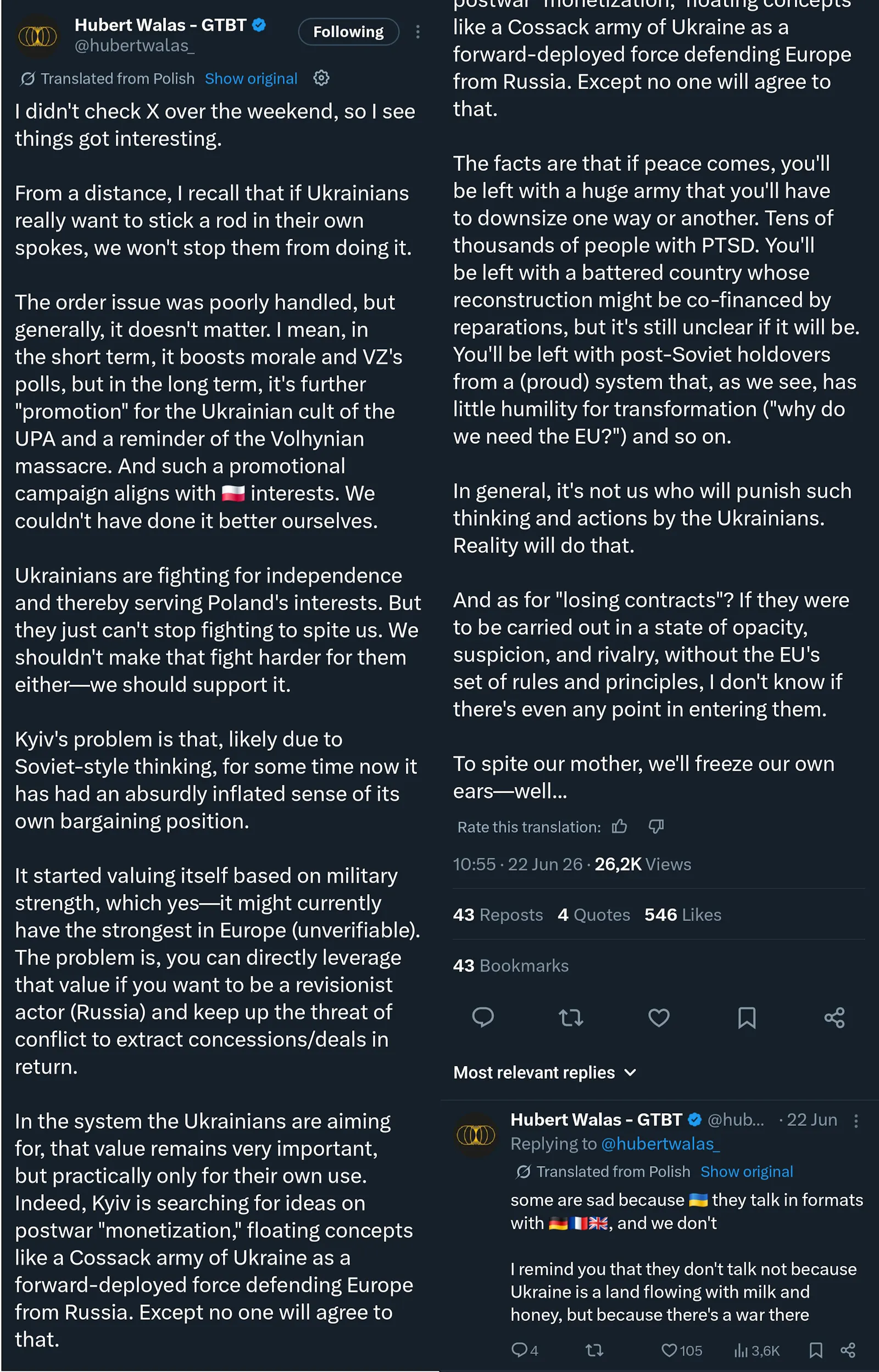
This emotional post reads as a perfect case of geopolitical status anxiety fuelled by ressentiment. Not far in spirit from the copious amount of “copium” posts we mocked Russians for in the early phases of the war, after it became clear that their invasion is not going according to plan. It demonstrates how status anxiety turns into rationalization to defend a wounded national ego.
Since Poland is strategically trapped and currently lacks leverage to meaningfully respond to Zelenskyy’s disrespect, the post reframes it as a strategic victory due to it highlighting Ukraine’s historical sins. It’s a satisfying psychological mechanism to make Poles feel morally superior in the present, while envisioning a future where they can use it as a political weapon to regain authority.
Instead of acknowledging that Ukraine’s bargaining position dramatically improved, the post claims that it is only a temporary mirage that will vanish once the war is over. Even more so, the large, technologically advanced, and battle-hardened army will not be an asset for Ukraine - after all who needs that in Europe anyway -, but a burden.
There is also a hint of anticipatory schadenfreude: Ukraine’s position might temporarily seem like it’s on the up, but eventually they will pay dearly for it with PTSD and the burden of needing to rebuild their crippled country. It is the outsourcing of their psychological desire for revenge to “reality", envisioning that economic and human devastation will eventually force Ukraine back into a subordinate position.
The extra tweet is what highlights Poland’s core status wound the best:
"some are sad because 🇺🇦 they talk in formats with 🇩🇪🇫🇷🇬🇧, and we don't. I remind you that they don't talk because Ukraine is a land flowing with milk and honey, but because there's a war there"
This line is aimed at reassuring Poles that Ukraine didn’t take their historical geopolitical position for long, only until the war is going on. After that, everything will return to the pre-war status quo where Poland remains the undisputed leader and voice of the region.
Summary
Due to its history, Poland sees itself as the heroic defender of Europe. Both from the Ottomans and the Russians, while at the same time limiting German expansion eastwards. They have good reasons to claim that, and it is a useful national myth which they - mostly - successfully adopted into their foreign policy, at least in regard to Moscow.
The root of their identity is that they are the ones who protect the region, and it is not merely their historical responsibility and fate, but even moral privilege. Ukraine has now claimed that narrative for itself with the whole world watching.
Today, Polish insecurity stems from constantly viewing their neighbours as imminent threats. Proven correct about Russia only solidified their conviction that Germany is also out to get them, and justifies their fear that a strong Ukraine cannot be trusted either.
Warsaw’s defining political tragedy today is believing to be in a position equivalent to Prussia in the 18th century, with the unescapable reality of being Poland.
Weekly Map
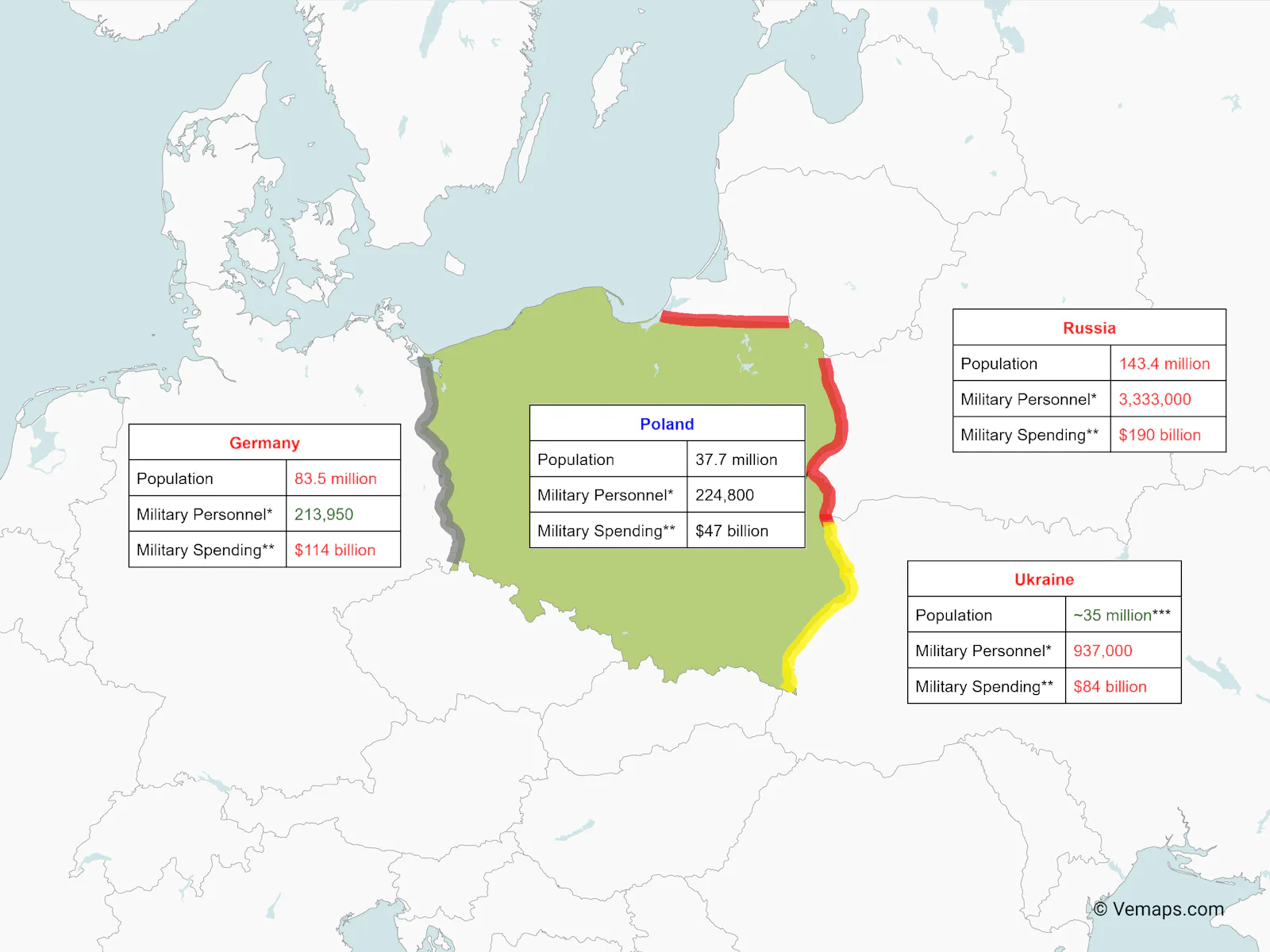
*Active + reserve + paramilitary in 2026, according to IISS (International Institute for Strategic Studies) (Opens in a new window)
**2025, according to SIPRI (Stockholm International Peace Research Institute) (Opens in a new window)
***Including currently occupied territories, according to own research (Opens in a new window)
Recommended Reading
Date
July 15, 2026
Topic
Ukraine