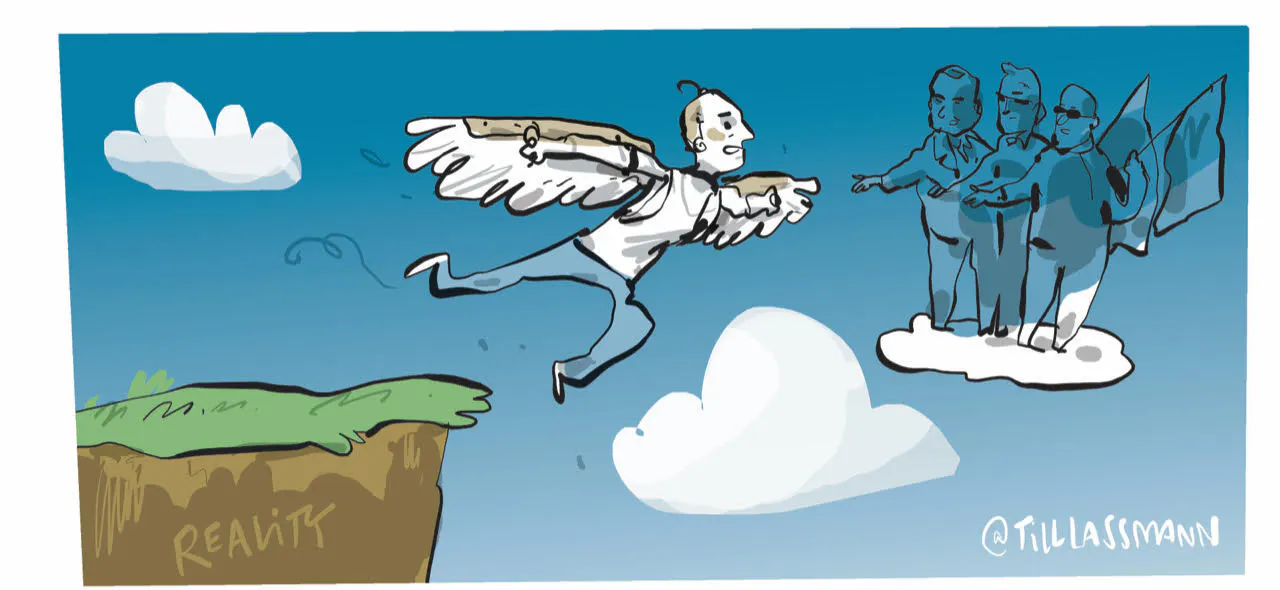
Image: Till Laßmann
08/11/2025
Dear friends,
what do you call the opposite of a false alarm – or maybe not the opposite, but: what do you call an all-clear that falsely communicates that a danger has disappeared, at least diminished, or in any case is no longer as present and supremely scary as it was until recently? No idea, but there really ought to be one of those patented German portmanteau words for it, but since there isn't, I'll provisionally call it a "false all-clear".
False all-clear in Holland
First of all, it's obviously brilliant that Zohran Mamdani won in New York, likewise the Democrats' successes in Virginia and New Jersey, but it's primarily – closer to home – the relative success of the gay centrist Rob Jetten in the parliamentary elections in the Netherlands that allows the centrists here (sorry: "the centre") to dial back the fear of fascist takeover to a personally bearable level (just below the point where one would have to get one's act together and change one's behavioural patterns). Everywhere people are rejoicing: "Look, that oddball Wilders lost the election, it's possible to defeat fascism with a message of confidence: everything. Will. Be. FINE!"
Sure, it's lovely that Wilders' PVV probably won't be involved in government anymore, partly because last time it was simply waaaay too chaotic, not so much because it was too hard right. But, point 1: anyone who looks more closely will notice that whilst the PVV did indeed lose seats, other, even more far-right parties gained more seats than the PVV lost. Point 2: in order to win, the Dutch centre shifted so far to the right that the election result itself confirms the rightward shift. Here the Democrats 66 (Jetten's party) followed Starmer's, Macron's and Biden's, and especially Mette Frederiksen's recipe for success. Shift right without being the right-wingers themselves, a bit of performative cruelty towards migrants (cf. the current deportation debate in Germany), a lot less green stuff, and nothing woke anymore of course, but without the fascist foaming at the mouth we know from so many hard right parties.
The timeline of fascism
I'd go so far as to formulate, based on observations from Austria, the USA, Holland and several other countries, a provisional "timeline of fascist takeovers" – not because it happens this way in absolutely every situation, but because it often happens this way, and we should prepare ourselves strategically for it.
It begins with the fascists coming to power, either directly (Holland, Austria, USA) or indirectly (e.g. Sweden). All sorts of terrible things happen, there's lots of political and administrative chaos, the right's popularity ratings plummet (because they of course don't have any “solutions” either). After several years of the fascists in power (I'm counting the far-right wing of the Tories, who've governed since BoJo, amongst the fascists), deep frustration sets in amongst the population. As I said: not necessarily because everything is so right-wing, but because it's so chaotic. After their first, often somewhat surprising electoral success, the fascist parties usually don't have enough cadres to allow them to govern (or revolutionise) effectively. So what happens up there in government looks rather unattractive, uninspiring, in fact like a complete turn-off, which drives people away from the right-wing parties.
But: Within the framework of what I've called “assholisation”, the transnational societal rightward shift, most of the voting populations of our wealthy externalisation democracies actually do want tougher action against migrants (everything that comes "from outside" has always been the perfect scapegoat for all sorts of problems), want "more security", want more authoritarian being-taken-care-of by Mummy and Daddy. This means that whilst the fascists lose elections, the discourse has already shifted so far to the right that whoever governs now will have to govern so far to the right that the fundamental political hypotheses of the rightward shift (“the people want to shift to the right, are tired of woke, immigration, women's rights” etc.) are confirmed. Because the then-governing centrist parties govern on average somewhat to the left of the brutal id-driven desires of the asshole society, they'll repeatedly disappoint it, repeatedly trigger these ludicrous right-wing temper tantrums so that in elections 4-5 years later the fascists win again.
Then the same game begins again, and ends either in the de facto abolition of democracy, or in a scenario that Gideon Rachman describes in the FT as follows: "Perhaps the future will not be a choice between the centre and the far right — but the gradual erasure of the distinction between the two camps (Öffnet in neuem Fenster)". Either way, Jetten's electoral success – I'll exclude Mamdani, because I'd rather explain his electoral success through the lens of my new thesis of the “war of fascist yokels against the cities”, more on that another time – doesn't mean that we have suddenly found effective strategies against the rightward shift and fascisation, much as “the centre” likes to tell itself this now, just as it told itself with Macron, Biden and Starmer. You can see how well that's gone or is going.
“All strategies against the AfD have failed” (Öffnet in neuem Fenster)
And that's what I want to discuss below: strategies against far-right, against fascist parties, against assholisation and the rightward shift – and why "all strategies against the AfD... have failed", as Sebastian Friedrich and Nils Schniederjann recently noted in their new antifascist blog "Über Rechts".
Friedrich's highly recommended text analyses eight different anti-AfD strategies, from exclusion to cooptation, from confrontation to issue appropriation, and comes to the depressing conclusion that "the balance sheet of previous strategiesfor dealing with the AfD... is sobering. Each of them carries risks, none has permanently weakened the party. Although there's no shortage of starting points, there's still no overarching strategy. Instead, one experiences mainly headless activism that jumps from tactic to tactic." That's pwerful stuff. I know from climate debates how difficult it is to admit one's own political failure, especially when the consequence is the realisation that in the absence of effective antifascist strategies, the rightward shift and fascisation will continue for now.
But the text doesn't ask two important questions, which I'd like to discuss here.
Firstly, why have all strategies against the AfD failed?
Friedrich's text analyses completely contradictory strategies, comes to the conclusion that they don't work, and then derives the failure of each strategy from the problems inherent in each respective strategy. I'd suggest a different approach: if, as in the climate struggle, all previous strategies have failed, perhaps that's not down to the details of this or that strategy, but to the fact that the dynamics driving the rightward shift operate at a level of reality that cannot be influenced by the means of party competition and the “battle of ideas”.
An image for this would be: of course I can build higher dams and flood protection in a village situated below a melting glacier, but the glacier melts due to processes I can't really influence in the village, and at some point the water will come down, no matter how high I build my flood walls. No matter how much I change my behaviour, no matter how cleverly my strategies are formulated: because they don't reach the cause of the problem, they can never solve the problem, in fact, in most cases they no really relevant influence on it (ditto UN climate summits and the climate catastrophe).
Causes of fascisation
Of course I can't provide a definitive explanation of such a complex phenomenon as the current transnational rightward shift here – a transnational megatrend is always multicausal, often overdetermined (when a multitude of causes all point in the same direction, drive the same trend), but my main explanation is a socio-psychological one: since my eureka! moment when I understood the "coming out of asshole society", I've located the causes of fascisation and assholisation in the psychology of a failed society in collapse. I've analysed our guilt and shame, our fear of disempowerment and fear of becoming a fascist murderer in the catastrophe (or one of their accomplices). I've formulated the thesis that fascism, turning away from humanistic values, turning away from facts and turning towards what Kellyanne Conway so evocatively called "alternative facts" (lies, bullshit, untruths), represents a kind of liberation movement, a liberation from values that we in the Global North claimed to live by, but which we, as late-imperial communities of plunder ("externalisation societies"), could never actually implement: "One of the problems we have as leftists in collapse is that fascism becomes a genuine liberation movement precisely because of collapse and guilt and fear: liberation from reason and ethics, from empathy and nature, from ones humanity and most other humans."
Today I'd like to go a step further in explaining the incredible force of the fascist offensive, its omnipresence in all, really all areas of life, and the fact that the rightward shift is not primarily attributable to the nasty input of nasty lobbies and nasty social media, but to entirely human and comprehensible, albeit ethically and practically disastrous reasons.
_____________________________________________________
I finance most of my political work by way of this blog, and would be grateful for your support
_____________________________________________________
The sigh of the privileged but anxious creature
I'll start with Marx' and Engels' critique of religion, which you probably know through the usually not quite correctly quoted sentence according to which religion is the opium of the people (not: "for the people"!). Before that, the two write an even cleverer sentence, namely that religion is "the sigh of the oppressed creature", that it necessarily emerges in situations where people have no control over their environment, where more and more shit happens that is either catastrophic, or inexplicable, or frightening, or all of the above.
Eleven years ago, when I wanted to understand the global rise of politico-religious movements, I explained it to myself as follows: religion is an otherworldly promise, it draws its power from transcendence, not immanence, not what is, but what will be, once messiah and rapture and nirvana and 72 virgins. Back then I knew relatively little about collapse, but knew that the global situation was deteriorating. That realistic future predictions produced increasingly negative results for more and more people, that therefore "immanence", what is, was becoming ever darker and more terrible for more and more people. Therein lies the reason for the rise of political-religious movements such as Evangelical Christians, Christian Nationalists, but also political Islam in its various forms, or Modi's Hindu nationalism. That's why societies in collapse don't suddenly turn rational, but increasingly irrational – like that Viking colony on Greenland which, shortly before its ecologically induced collapse in the "little ice age" in the 15th century, didn't produce ships to leave the island (I mean: they were Vikings, after all), but all sorts of religious knickknack to placate the gods who supposedly plunged them into misfortune.
Now let's go one step further: if a shitty reality generates absurd religious notions of Judgement Day, etc., which one can then place alongside the shitty reality ("Life is a vale of tears, but afterwards...!”, aka "pie in the sky"), what absurd notions does a collapsing reality produce, in which what was already an "earthly vale of tears" potentially gets worse every day, and will never really fundamentally improve again? A collapsing reality, for which we, the richer and more privileged we are, also feel somehow shamefullyresponsiblyguilty, invites an escape from reality: if reality is shit, then it's really easier and more pleasant to ignore it completely. And if one is relatively privileged in this reality, then the most pleasing way out is to adopt an absurd religious delusion that explains why it's all OK, why your wealth is good and God's will, why it's OK that thousands upon thousands simply drown in the mediterranean, because the European way of life is non-negotiable. Fascism in this sense isn't the sigh of the oppressed, it's the aggressive temper tantrum of the privileged but fearful creature.
Fascism as death cult
One step further still: seen this way, fascism, especially clerical fascism, is the likely majority religion of wealthy societies in collapse. It's not only liberation from reason, ethics, empathy et al, it's absolute and permanent escape from reality.
Drowning people in the Mediterranean? Not only do I not care about them, they don't even exist! Climate catastrophe? Either it doesn't exist, or it's God's punishment for gays fucking each other in the ass. Trans people? The don't exist, and if they do, we'll just exterminate them. End of the world? Either the Führer can avert it, or we wanted the end anyway, because the world is so shit. This last point is important: since Klaus Theweleit's fascism study "Male Fantasies", we've known that fascism is also a kind of death cult, a celebration of the hero's death in an already hopeless fight against the hostile, culture-devouring hordes. And what can be more beautiful in the moment of societal thanatos than not to fear it, but to celebrate it? To be… kind of turned on by it?
What now?
Which brings me to the second important question I want to discuss in response to Friedrich's clever text: what follows from this? To be honest, I can't exactly say yet, I don't have any particularly interesting ideas yet beyond what I've already said about the connection between antifascism and “prepping together”.
But thinking out loud a bit, here are a few hypotheses. Feel free to tear them apart, that's what hypotheses are for.
So, what follows from these thoughts? It follows that fascism in collapse will probably be a sexier, more attractive product for most people than being a rational humanist who takes responsibility in and for the world we're in (at least until we've developed attractive practical proposals for it, i.e. "political products"). That we therefore have to realise that in the longer term we'll almost certainly be a minority as active antifascists, and must formulate our strategies accordingly. That what applies to climate collapse also applies to antifascism: telling ourselves that the problem is only temporary, that we have strategies to solve it, and that after a certain "overshoot" general rationality would restore itself, is itself part of the problem, because it delays the moment when we start preparing for the more probable scenario rather than the less probable one. That we must prepare ourselves for being an antifascist minority that in the medium term must fear exile, prison or physical violence up to and including murder.
Of course, this won't happen tomorrow or the day after. But in 2012, hardly anyone would have thought that Bernd Lucke's national professors' party would one day prepare to lead Germany back into fascism. That's barely 13 years ago, so just think what it'll look like in 2038, in a, let's say, 2.3-degree warmer world, with a wobbling AMOC, with warlike conflicts everywhere, with increasingly unhinged tech billionaires... How will we get on there with our luxury product "taking rational and ethical responsibility" in societies that have made "we take no responsibility for the poverty and suffering of others, especially when we ourselves have caused it" their new motto?
Remember: The rightward shift is (also) an escape from reality. That's why it's almost unstoppable in collapse, because reality becomes increasingly unbearable. As unpleasant as this scenario sounds: it's at least one we should prepare for. And allow me this comment in conclusion: I know that this text predicts a rather dark future, and that invites rejection at first – but on a day when the EU weakens its climate targets despite increasing climate catastrophe, a trend I predicted over three years ago, I believe I've earned you engaging with my prognoses without immediately shouting "that's defeatism!"
With, as usual, antifascist greetings,
Tadzio
Datum
08.11.2025
Kategorie
English
3 Kommentare
Möchtest du die Kommentare sehen?
Werde Mitglied von Friedliche Sabotage und diskutiere mit.