27/11/25
Dear friends,
In the many discussions I have with my left comrades, with the climate movement, and sometimes with the "center of society"—discussions where I basically argue that we urgently need to prepare for coming catastrophes, that we need to start “prepping together” — there's one thing I can't really get my head around: the incredible conservatism of progressive strategic thinking.
Generals, Comrades, and the Last War
What do I mean by that? Well, formulating strategies is necessarily about future behavior: strategies are plans for how certain goals can be achieved through the deployment of given resources. Strategies, in short, deal with the future—even substantively reactionary strategies are future-oriented projects. And that in turn means that the strategy which can expect to be more effective than others is the one that incorporates a realistic picture of the future: if my view of reality is too strongly shaped by the past, if I'm not adequately able to include likely changes that the future will bring into my strategy, then I have to assume that my strategy is doomed to quick failure, because the distance between it and reality as it will be in the future will constantly increase. This fact is the origin of the old bonmot according to which generals are always prepared to fight the last war again—the one in the past—but not, you know, the next one, the one in the future.
And what goes for proverbial generals unfortunately also goes for most of my comrades, most greens, most antifascists, and for the remaining liberal "center": we either look to the past—"But look, here's an example from 1975, from the 1930s, here's one from the 19th century that refutes your defeatist hypotheses!"—or to the present, for example: "It's not true that most workers in the Global North will fight against the climate action agenda, just look at Fridays for Future and the German public sector union ver.di, look at everything their doing together under the banner of #WirFahrenZusammen!"
I don't want to entirely dimiss this alliance, which is quite interesting in some of its details, but let's put it this way: the fundamental line of the mainstream trade unions on the jobs-and-growth vs. climate-protection question hasn't shifted one iota, and the antagonism between workers and the climate agenda continues to escalate, not just in Germany but everywhere in the rich, "overdeveloped world." The strategy "climate movement goes new class politics" was in that sense exactly what folk wisdom attributes to old generals: the last war. The one that's already over, in this case lost.
Speaking of "Historical Materialism"
Such a sideways- and backwards-looking (and therefore doomed-to-fail) strategic gaze might be adequate for the "bourgeois centre," because the "centre" is precisely that which doesn't need to organize to defend its own interests, since these are always already preserved in the state apparatus and in all sorts of social forms and institutions. But for us leftists and greens, this is a real danger and an intellectual embarrassment, especially for that part of the left that constantly refers to the Marxian tradition: because part of the inheritance that the Old Man from Trier left us is the conviction that meaningful transformation-strategies in capitalism can only emerge from an understanding of capitalism's real developmental tendencies, from a materialist (physics- and fact-based) analysis of historical tendencies (which are called "historical" but actually refer to the future: how has history flowed so far, and how will it therefore flow in the future?).
The question then becomes: "what can I learn from the present about the future?" instead of "how can I perceive the present in such a way that my existing strategic convictions are confirmed?"—the latter being the question that many leftist and climate strategists unfortunately continue to ask themselves.
Put differently: the rich-world left is largely "voluntaristic" at the strategic level. Strategies are not justified (as any historical materialism would posit they have to be) by reference to observable tendencies of really-existing capitalism, but rather through late-situationist slogans like "social movements can move the limits of the possible"; or with the eternally false dogma that the struggle against capitalism is somehow always-already the absolute, the objective interest of the working class(es), no matter what they do or say in actuality. To counteract this annoying, mystifying voluntarism, I want to go back to the beginning, back to what Marxism was at its best: a philosophy of praxis, against the "utopian late-socialism" of today's left.
From Failure to Strategy
I don't want to drag you too deep into the Marxian inheritance, but allow me to nerd out a bit (I promise I'm going somewhere with this): Marx's work can be roughly divided into two phases, his early and his mature work. The distinctly idealist early work sees communism (our variant of the eternal kingdom of heaven) emerging, as it were, from history itself. The emerging proletariat, the workers, are already the bearers of revolution, but Marx doesn't derive this revolutionary tendency from their actual social conditions and everyday practices, but rather quite idealistically and abstractly from their general dispossession, disenfranchisement, and exploitation.
Armed with this still essentially utopian socialism, Marx throws himself into political work, becomes part of the 1848 democratic revolutionary movement(s) in Europe, which are almost completely defeated by '49 at the latest— in other words, they fail. Marx also "fails" personally: he is expelled from Paris in August 1849 and moves as a refugee to London, where he lives with his family in such poverty that when one of their children dies, they cannot even afford a coffin.
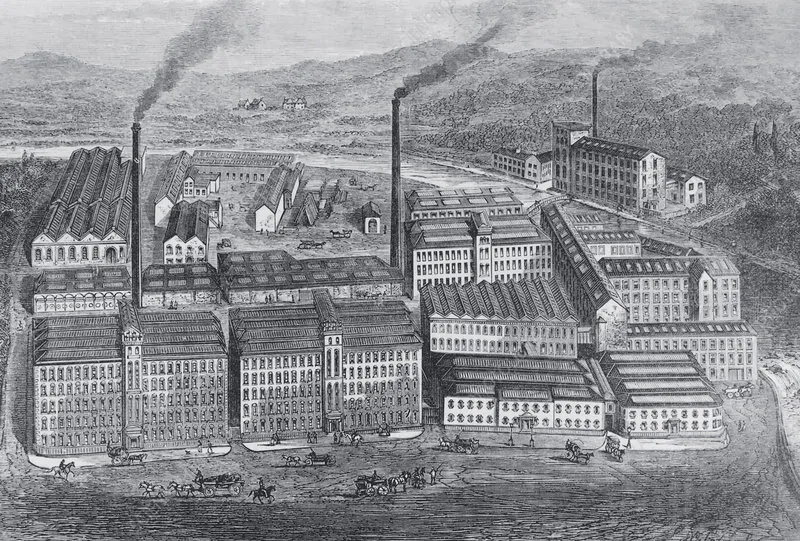
It's political failure that finally brings Marx to shed his youthful utopianism and start analyzing the reality of the coming industrial-capitalist world realistically, without Hegelian (that is: religious, magical-realist, fetishistic) mystification. He does this by taking a very close look at what from his perspective is the central praxis of this new world: the moment of collective production in the new capitalist factory.
_____________________________________________________
I finance most of my political work by way of this blog, and would be grateful for your support
_____________________________________________________
Producing the Future in the Factory
From this moment—which even in the 1850s never made up the larger part of an industrial worker's day (let alone his family's and the rest of society's)—Marx began, on the one hand, to understand the laws of this new world (among others the general formula of capital: Money – Commodity – more Money, or M – C – M'), and on the other hand to think through the strategic possibilities of solidaristic, revolutionary practice. Now the possibility of communism, of solidaristic, radical organizing among workers, is no longer derived from rather abstractly conceived "disenfranchisement" and "poverty," but from the specific form of cooperation in manufactories and factories that capital imposes on workers. And this despite the fact that at the time of Marx' writing, factories made up only a tiny share of global labour organization, despite the fact that for the vast majority of working people in the world, "the factory" still lay far in the future.
So in articulating his analysis and the strategies he derived from it, Marx is essentially placing a bet on the future, instead of engaging in too much detail with a largely still non-capitalist global present, because he supposes that in strategic terms, it's basically already obsolete (overtaken by capitalism). We could now argue at length about how strongly "capitalism" depends on "the factory" (because there's of course also other, non-factory-based forms of capitalist production and accumulation), but starting from the 1850s we definitely have to note that the factory began a long victory march from there: life in capitalism became so strongly shaped by the factory that it is impossible, for example, to think of political forms like the mass trade union or social democratic mass parties without their foundation in the moment of collective production in the factory. And a step even further yet: when French theorists like Foucault or Deleuze and Guattari write in the 1960s and 70s that the school looks like the prison, which looks like the hospital, which looks like the barracks, which looks like a factory, then in the end it always comes down to this: that life in industrial-capitalist societies is powerfully shaped by the fact that at their core lies the factory. That is, over a hundred years after Marx's strategic wager on the centrality of the factory in intra-capitalist social struggles, this assumption still held, and yielded strategic dividends.
Catastrophe as the Factory of the Future
My inner left nerd wants to spin this tale further now, wants to write about the failure of the biennio rosso in Italy (1919–20), which led Gramsci to his theory of hegemony, and how this most practical and therefore to me most useful of all Marxist theoreticians in the last years of his work didn't analyze the Italian present to develop forward-looking strategies, but rather the American future of "Fordism," which no one in Italy could yet experience at that time; about Mario Tronti, one of the leading theorists of Italian operaismo, who after the failure of the 1968 revolts started reading "Marx in Detroit" (then the center of the global auto industry)—so here again: understanding and critiquing capitalism, the present, from its most advanced point, in order to develop forward-looking strategies.
But I think we can agree that would go too far here, so back to the substantive core. Marxian theory always dealt with the future, that's where its strength lay: discussing the strategic possibilities implied, or opening up in the structures of the new world, possibilities that would need to be organised in the now. I propose that we dare to do the same for a world in collapse. Without utopian voluntarism, but with what Gramsci really meant when he spoke of "pessimism of the intellect and optimism of the will": not silly, religious hopium, but courageous strategic perspectives that create empowerment precisely because they're not based on bullshit but on a ruthlessly honest analysis of the future.
Which brings me back to the strategic line that I've been trying to develop on this blog since my own journey of discovery into our Swedish future (cf. the "Notes from the Future" texts from Sweden, autumn '23 (Öffnet in neuem Fenster)): that “catastrophe” is a strategic space we urgently need to occupy. Now I want to go a step further: starting from Marx's insight into the future strategic centrality of the factory in emerging industrial capitalism, I propose that we view "catastrophe" as the central location of the future in collapse. That we look at catastrophe as closely and in as much detail as Marx looked at the factory and Gramsci at Fordism: because that's where neww social relations can emerge, where the future will be produced. In collapse there will be more and more catastrophe, and these catastrophes will increasingly structure our societies—that is, influence them over the long-term.
No Strategy Without Simplification
To be sure, this proposal is grounded in the assumption, nowadays rejected by many of my Marxist comrades, that there is a place, a site in society that has a more strongly structuring effect (influence) on the rest of the system than other sites—that there is in a certain sense a "center," a "base," more precisely: a place where it makes strategic sense to intervene, because from there leverage can be exerted on other places/nodes/units in the system. A place from which the world could be lifted off its hinges, to stay in the image.
To be sure, collapse has just as little institutional center as capitalism does, this one place doesn't exist, it itself is a myth, a bit of magical thinking. But: whoever wants to formulate and implement strategies cannot afford to get stuck with the enumeration-Marxism of today's left, which strings together more and more places where it would be worthwhile to intervene strategically, where it's worthwhile to invest limited resources to generate social leverage (which is really all I ever talk about). Whoever wants to formulate strategies must sharpen their focus and concentrate, even when that means not reflecting every detail of an ultra complex reality: no strategy without simplification.
And given what we know on the one hand about a future in collapse (More and more Catastrophes, until catastrophe becomes a permanent state), and on the other hand about how strongly catastrophes influence people and societies, I think it makes sense to concentrate intellectually and strategically on the moment of catastrophe. In this blog, in my political work, and also in the second book that I'll publish next year again with Mandelbaum Verlag. Working title: Solidaristic Collapse-Politics: United Against Fear.
With Marxist regards,
Tadzio
Datum
27.11.2025
Kategorie
English
0 Kommentare
Möchtest du den ersten Kommentar schreiben?
Werde Mitglied von Friedliche Sabotage und starte die Unterhaltung.