March 2023
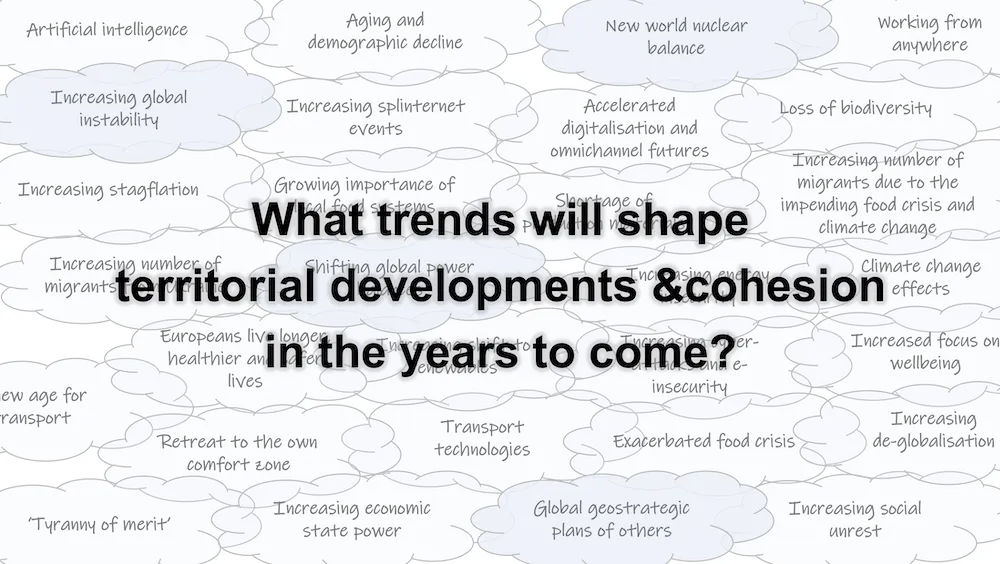
This is the last in a series of blog posts addressing trends shaping territorial cohesion. This blog post addresses a collection of more political trends. The collection is based on various studies addressing mega-trends which we have conducted during 2022, e.g. for the European Parliament (Si apre in una nuova finestra), the European Committee of the Regions (Si apre in una nuova finestra) or ESPON (Si apre in una nuova finestra). Bringing together the various pieces of trend analysis provides a rich picture about possible developments which may shape territorial development and cohesion in Europe.
Trends considered to have the strongest impacts on territorial development and cohesion include exogenous technological (Si apre in una nuova finestra) (e.g. digital society, post-carbon and circular economy), societal (Si apre in una nuova finestra) (e.g. migration, aging, fluid social institutions and shifts in values), environment (Si apre in una nuova finestra)trends (e.g. adapting/mitigating climate change and managing scarce resources), and economic (Si apre in una nuova finestra) (e.g. slowbalisation, peak of everything, working from anywhere). Also political trends play an important role, both political developments in Europe, as well as those in other parts of the world which affect development prospects in Europe.
The combined picture which emerges from this suggests that future trends are likely to exacerbate spatial and societal fragmentation, interdependencies and policy mismatches. In many regards the trends point to a risk of increasing concentration on urban areas with growing territorial imbalances and inequalities, which may translate into social fragmentation and increasing discontent. This also risks to increase perceptions of uncertainty and vulnerability in a world of disruptive changes leading to ‘pervasive uncertainties’.
Political trends
At geopolitical level, there are several antipodal developments. On the one hand, global tensions increase with a tendency towards block building and protectionism. On the other hand, multilateral agreements are negotiated in fields from climate change to free trade, although there are difficulties to keep all governments committed to their implementation (e.g. Paris Climate Agreement). At European level, there are developments focusing on Europe’s position in the world such as external security threats and energy security. There are also internal developments such as efforts to preserve the European economic and social model in times of crises or increasing divergence of government standards and qualities, as well as the rise of populism and nationalism.
Some of the trends which may indirectly affect territorial development and cohesion in the medium to long term include:
Shifting global power balances. With China becoming a global economic player, the global world order has been shifting towards the east over the past decades. This has changed the status quo of a predominant western power, with the US considering China as one of the biggest threats. Russia´s war on Ukraine adds to the shifting global power imbalances, creating precedents for countries to claim different territories, but also initiating new nuclear balances.
Increasing global instability. The Russian invasion may trigger further global instability and increased global tensions. Discussions have increased about a potential invasion of Taiwan by China, or Turkey attacking Syria to push back Kurdish fighters.
New world nuclear balance. Russia´s war on Ukraine puts a new element to the global nuclear order. The threat of nuclear attack was growing already prior to the Russian invasion, with North Korea, Iran, Pakistan and China expanding their arsenal. The war adds to this, as it puts no-nuclear countries more at risk and adds incentives to ‘go nuclear’ or create additional precedents for countries with nuclear weapons to attack others.
Global geostrategic plans of others. Geopolitical developments may impact economic and territorial development in Europe. Various strategies and plans made by non-European governments or multinational corporations include – implicitly or explicitly – ideas for the future of Europe. Among these are e.g. the Chinese Belt & Road Initiative, Chinese Cooperation Framework with Central and Eastern European Countries, US trade policies, Google server locations and research. The future of Europe will also be affected by demographic growth in Africa, global migration waves (including climate refugees), global environmental regulations, trade liberalisation and protectionism of global economic powers and technological breakthroughs (e.g. in the fields of computing, communication, transport, energy and biotechnologies).
Most of these risks are the key ‘known unknowns’ and their impacts will be extremely different across Europe. As afore mentioned, the territorial patterns of Europe already show the dominance of urban areas and concentration tendencies. Global trends are expected to accelerate this. Further concentration is expected due to ‘the winner takes it all’ philosophy underpinning many global trends. This prospect poses considerable challenges to cohesion. How will this affect our understanding of cohesion and the possibility for policies to cushion non-cohesion effects of mega-trends and related policies?
by Kai Böhme
https://steadyhq.com/en/spatialforesight/posts/f75c6801-ded7-401e-a0a9-31d0f23c02b9 (Si apre in una nuova finestra)https://steadyhq.com/en/spatialforesight/posts/81662208-b7b9-4956-b88d-9fe96b13042d (Si apre in una nuova finestra)
Data
06/03/2023
Argomento
Trends
0 commenti
Vuoi essere la prima persona a commentare?
Abbonati a spatialforesight e avvia una conversazione.