Something happened last week that I want to share before I get into the main topic. I wrote a post on LinkedIn (Öffnet in neuem Fenster) about EU-INC, and it… went kind of viral? 73K impressions, 595 reactions, 100+ comments. Maybe not "influencer numbers", but for me, that was unseen. And what struck me most wasn't the numbers — it was who commented. Founders, VCs, policy people. People genuinely frustrated and genuinely hopeful at the same time.
That told me something. People care about this. A lot. So let's talk about it.
The EU-INC proposal landed. Sort of.
The European Commission officially published its EU Inc. proposal last week. And on paper, the headline sounds great: register a company anywhere in Europe in 48 hours, for under €100, fully digital. No minimum share capital. A unified framework across the EU. Sounds like exactly what founders have been asking for.
So why does the startup community feel let down?
The core issue is this: the proposal chose to be a directive rather than a regulation. A regulation means one law, applied uniformly everywhere. A directive is a framework each country implements in its own way.
Which means potentially 27 slightly different versions 🤬.
And suddenly the "one European company" doesn't quite feel like one. The EU-INC campaign called it out directly: relying on national courts and registries "undermines the very standardization the proposal sets out to achieve."
I shared my frustration about this on LinkedIn. And then something happened that made me rethink.
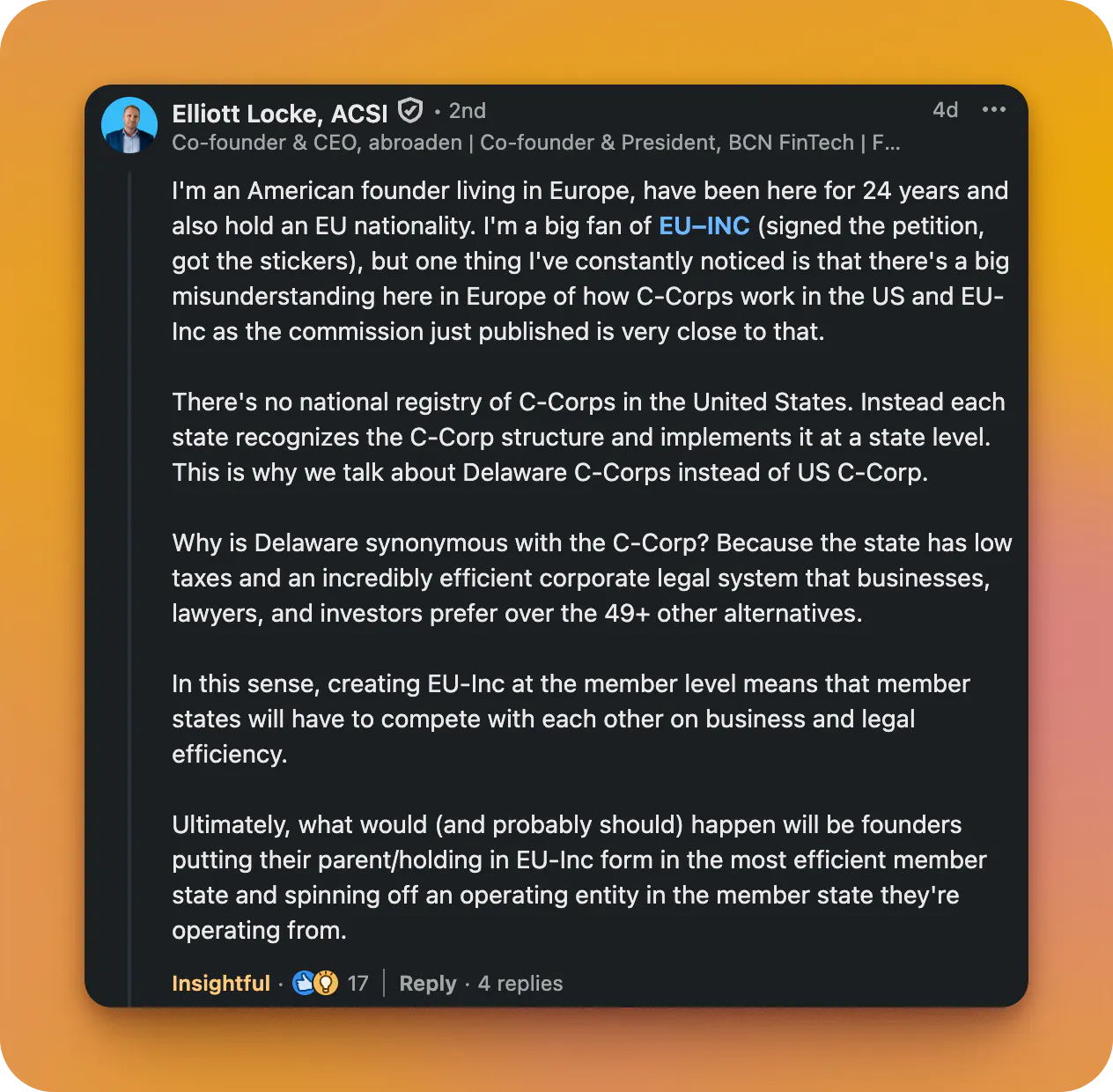
Elliott Locke (Öffnet in neuem Fenster) (American founder who's lived in Europe for 24 years) dropped a comment that genuinely reframed things for me. He pointed out, there's actually no national C-Corp registry in the US either. Delaware didn't win because of a federal mandate. It won because it built the most efficient corporate legal system, and founders, lawyers, and investors all gravitated there naturally. State-level competition did the work.
His take: EU-INC at the member state level could trigger the same dynamic. One country builds a genuinely efficient, low-friction implementation, and becomes Europe's Delaware.
I'll be honest, that shifted something for me. Not from disappointed to fully convinced, there's still the question of legal uncertainty outside corporate law, labor disputes, cross-border employment, all the stuff that doesn't have a Delaware equivalent in Europe. That uncertainty is real, and the proposal doesn't resolve it.
But maybe the directive approach isn't the death sentence I initially thought. Might be it's the starting gun for a different kind of race.
Laws are not laws of nature
Here's the ONE thing that frustrates me most when I read the debates around this. So many people argue about current legal frameworks—labor laws, national registries, corporate structures—as if these were immovable facts. As if we just have to work around them.
But these are things we made. All of them.
At one point, the EU did not exist. Now it does. At one point, there was no Delaware. Now American founders have a shortcut that Europeans can only dream of. These structures were built by people who decided things should work differently, and then fought for it.
The counterargument I keep hearing is "You can't just override 27 national labor laws and court systems." And yes, that's hard. But "hard" is not the same as "impossible", and treating it like it is helps no one. Especially not European founders who are making the rational choice to incorporate in the US because the path there is just clearer.
The EU-INC campaign knows this. That's why they asked for a regulation, not a directive. Because they understand what actually needs to happen to fix the fragmentation. And the proposal, cautiously, stopped short of that.
Cautiously hopeful. Emphasis on cautiously.
I want to be clear: this is still meaningful. The momentum behind EU-INC, the fact that the Commission launched something, the 22,000+ signatories who pushed for this. That matters.
A few years ago this conversation wasn't even happening at this level. And the proposal still needs to pass through Parliament and the Council by end of 2026. There's still room to push for a stronger implementation.
But if this takes 10 years to land and then nobody uses it … that would be a real miss.
Europe can do better. And judging by all those comment threads I read last week… a lot of people want it to.
That’s it. A longer political post this week, but hope still interesting. Have a smashing week & stay nerdy!
Best, Roman
Datum
22.03.2026


