October 2023
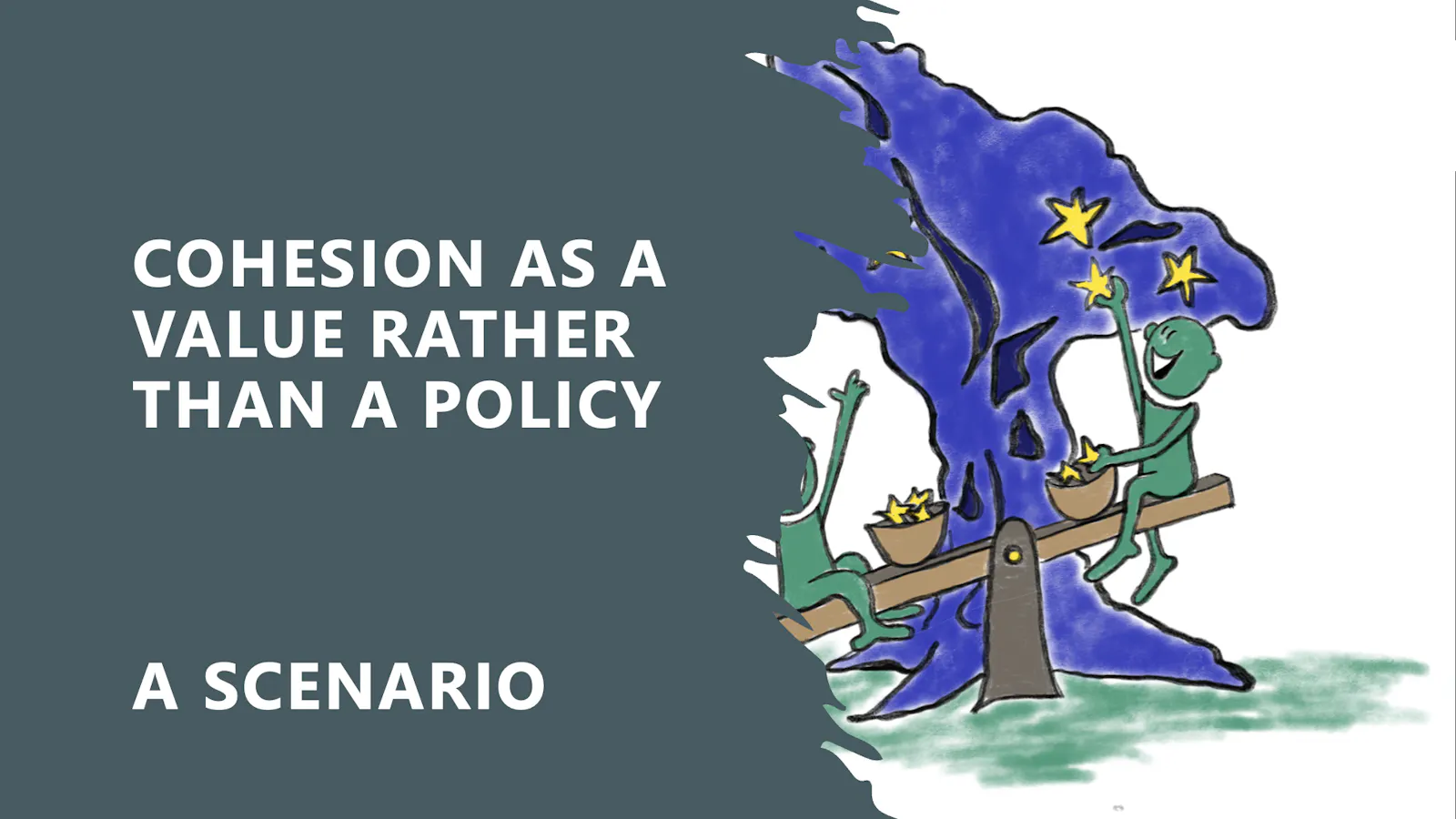
In September we published a first scenario on an EU without cohesion policy, following up on Commission President von der Leyen’s State of the Union speech. As she did not mention cohesion policy or even EAFRD, the two single largest budget lines in the multiannual budget of the EU, at all in her speech, we started thinking about what an EU without these policies might look like – merely as some sort of thought experiment.
The first scenario (Öffnet in neuem Fenster), dwells on the possibility of an EU with a focus on boosting the green and digital transitions and economic growth through sector policies focusing on productivity gains. Cohesion policy is phased out and also the cohesion objective in the EU Treaty does not really play a role in this scenario.
On October 6th, the EU meeting in Granada, Spain, touched upon possible paths to enlargement of nine new countries. These are Albania, Bosnia and Herzegovina, Kosovo, Montenegro, North Macedonia, and Serbia on the Western Balkans, as well as Ukraine, Moldova and possibly Georgia. Certainly, a new round of enlargements will affect the state of social, economic and territorial disparities and cohesion in the EU. It will also further strain the capacity of cohesion policy to deliver cohesion.
New thinking will be needed to achieve the cohesion objective laid down in the Treaty. Therefore, our second scenario focuses on solving the current complexity trap with a new and possibly simpler approach. Also in this scenario, cohesion policy is considered obsolete and phased out. However, the EU objective on economic, social and territorial cohesion is strengthened. Moving on from the ‘do no harm to cohesion’ plea, the EU moves to requiring all its policy to actively contribute to cohesion. It makes cohesion an underlying value of its policy making.
The scenarios are merely the results of intensive brainstorming and revisiting of earlier policy papers which challenged the idea of cohesion policy. We hope that they can stimulate some thinking, both about the alternatives of cohesion policy but also about what we are going to gain and miss with such alternatives.
Scenario 2 – Cohesion as a value rather than a policy
This scenario explores an EU driven by the idea of streamlining the EU cohesion objective across all policies, rather making it a task of a single policy. This results in the decision to reduce and eventually eliminate funds for cohesion policy.
Drawing on earlier think pieces, such as Committee of the Regions report on cohesion as value (Öffnet in neuem Fenster) and the Cohesion Spirit Compass (Öffnet in neuem Fenster), in this scenario all policies are tuned into strengthening economic, social and territorial cohesion.
Cohesion policy has been a long-lasting EU policy. Since its official creation in 1993, it has been counterbalancing and absorbing the effects of the single market. It supports developing and lagging EU regions to maintain economic development. Nevertheless, current debates highlight that cohesion policy, however big, will be insufficient to achieve cohesion for all EU regions, and cohesion objectives need to be pursued by all EU policies. This means cohesion must be embedded as a value in all EU policies.
This scenario is based on the hypothesis that amid all narratives for global growth, open strategic autonomy and competition, the EU chooses stronger cohesion by making it a cornerstone of all policies. It imagines the EU cohesion objective being mainstreamed across all policies and becomes integral to the single market, putting a stronger emphasis on more balanced economic development and a more holistic approach towards wellbeing and growth, shifting gradually away from the purely economic GDP lens.
This shift goes hand in hand with more state intervention in economic and industrial policies to ensure cohesion is embedded. Weak signals pointing in this direction started emerging shortly after Brexit when the fight for liberal market economies gradually weakened, while fights for interventionist approaches got stronger.
Phasing out cohesion policy, member states will contribute less to the EU budget. This may silence critical voices of net payers to the EU budget, as less contribution would be necessary, while at the same time it gives member states the freedom and opportunity to invest in other national priorities such as industrial, migration and defence policies, or cohesion.
Re-focus on state interventions. With cohesion embedded in the single market, the latter would need restructuring, making individual member states key players in this functioning. Strong state interventions might ensure that all regions are taken into account, potentially hampering the freedoms of the single market. This may result in long periods to adapt to the new situation. With cohesion embedded in the single market, member states may plan to achieve cohesion in different ways within their countries. Particular emphasis needs to be given to the lagging behind regions, as these may have faced more challenges from the single market and competition.
State aid for lagging places. One way to support the most lagging regions is through more favourable state aid regulations. State aid plays an important role in making sure that competition and fairness are balanced. In a more cohesive and inclusive EU, state aid rules may be applied with more territorially differentiated criteria to boost economic development in lagging regions. In addition, state aid might become more conditional, directly supporting projects that contribute to cohesion and bridge developmental gaps. At first, this would directly support lagging regions, which may witness an economic boost. However, this may be challenging for other regions within EU member states or across them, creating imbalances at EU level. More advanced regions, the gears of growth in each member state, may experience economic slowdown and a feeling of an inefficient allocation of resources. Without financial support, these regions may start falling behind, at the cost of growth and economic development, while the feeling of disadvantage may result in tensions within the single market. Over time, unfavourable state aid rules for all regions may challenge the very idea of cohesion and become a notion only for the disadvantaged ones.
Territorial differentiated taxation. In addition to state aid, territorially differentiated tax systems may support specific territories. Redistributive fiscal policies could help support less developed areas with tax benefits. Lower business taxes in lagging territories may incentivise businesses to invest in these areas. In addition, taxing advanced regions more might redistribute wealth to less advanced ones. However, this could cause dissatisfaction in the advanced regions, resulting in fragmentation and social unrest, especially within and then across member states.
Spatial targeting of industrial policies. To address territorial inequalities, industrial policies boosting investments in critical industries and the green and digital twin transition may give priority to lagging regions, offering additional incentives for investors. However, this again will be at the cost of more advanced regions, as support will not be channelled to boost these economies, creating kinks in the economic system. To keep a balance, the national level would need to invest in advocating the benefits of this new approach to minimise social unrest in regions that feel neglected.
All the above indicate increasing state intervention. Direct state economic interventions may also shape the economic and political profile of the EU. Investment, infrastructure development, new tax regulations, trade and infrastructure to support these interventions and strong centralised decision-making may become problematic. Protectionist measures increase to safeguard regions from global competition, which may increase state power so much it becomes risky. With democratic values being challenged due to increasing inequalities, a challenging political landscape and new forms of participation. Challenging governance may endanger economic development, as administrative instability deters investors from investing in these countries.
Cohesion changes. Following the possible new policy approaches, economic development might take a new approach, with diversified local and regional economic growth and the pursuit of green and digital transitions. The transitions have a short-term and substantial effect on territorial development in the EU, as formerly lagging regions now largely benefit from this transition. An important benefit would be more balance across territories, as economic disparities reduce, with advanced regions sacrificing growth and lagging regions catch up.
Cohesion challenges. At the same time, however, the level of cohesion will also become dependent on the individual member states, its priorities and capabilities. It may risk eventually increasing disparities between member states, as thriving ones will be able to afford targeted investments and policies, while lagging behind member states will not have the possibilities to do so.
Growth challenges. This effort on internal cohesion, however, comes at the cost of the overall growth and the global autonomy of the EU. The global role reduces over time, bringing a major impact to economic and trade relations, and slower economic development in the short term. In a changing and competitive global environment, such an approach would challenge the capacity of the EU to compete, bringing long-term resistance from more developed member states which were part of the global supply chains. Furthermore, the focus on state intervention may bring additional challenges with high social impact, as it may result in corruption or protectionism.
Although cohesion may increase solidarity and community feelings in the short term, it becomes challenging to operate in a global competitive environment. This would make it difficult in the long run for the EU to adapt to external trends and changes, leaving it more as a regional player.
Resume
The first scenario (Öffnet in neuem Fenster) looking on the possibility of an EU with a focus on boosting the green and growth at the cost of no-cohesion illustrated the risks of phasing out cohesion policy. This second scenario explored what might happen if instead the cohesion objective is mainstreamed across all policies to keep growing inequalities and political risks in check.
Well, at least following our first thought experiment on this topic, also this will not do the trick. It may be better suited to address disparities between regions in countries, however, at the cost of increasing disparities between countries.
So far it seems, there is no simple alternative to cohesion policy. Nevertheless, there is an apparent necessity to rethink cohesion policy in light of the increasing complexity of funding mechanisms and cohesion policy itself, the competition between EU budget lines, and the insight that cohesion policy is too small a policy to delivery cohesion, which will become even more true with possible new rounds of enlargement.
Could you imagine an EU without cohesion policy or with a radically different cohesion policy? How would such an EU look? We would love to read your views. Please, feel free to share your thoughts in the comment section.
By Maria Toptsidou and Kai Böhme
Datum
09.10.2023
Kategorie
Cohesion (policy)
0 Kommentare
Möchtest du den ersten Kommentar schreiben?
Werde Mitglied von spatialforesight und starte die Unterhaltung.