15/01/2026
Dear friends,
It's week 1 after a multi-day sabotage-induced blackout in parts of the German capital, and suddenly it feels as though everyone is talking about prepping. The Guardian quotes a retired nurse in an article about Berlin's reactions to the blackout (Si apre in una nuova finestra)with these words: "'It turns out (my husband) has been doing his own prepping. Everyone in Germany is doing it these days. And why wouldn't you? The difference to just a short while ago is that most readily admit it now without fear of ridicule."
Everyone's talking about prepping
Everyone is doing it, and most … admit it not without fear of ridicule. I wrote in June (Si apre in una nuova finestra)that "we've ... managed in recent months to finally wrench the concept of 'prepping' from the stranglehold of that incredibly unproductive framing whereby you must be a right-wing crazy person if you're thinking about practically preparing yourself for catastrophes and system collapses." But since the blackout, the debate about catastrophe preparation has really arrived in the mainstream, and it was probably to be expected that the trigger would be a severe catastrophe that deeply encroached upon the everyday normality of people who are, on a global scale, rather spoilt for stability, one that for several days demonstrated this simple truth: regardless of which major catastrophe hits us, we're probably not adequately prepared for it, and a lack of preparation for catastrophes means concrete suffering. (This statement holds true on average at every level, from the state level right down to the individual one.)
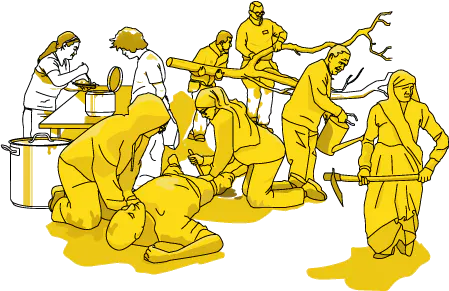
Although this week is really quite busy because we've now properly started work on our "collapse training camp/LARP/scenario game" (sorry for the unclear nomenclature, we're still searching for the perfect name ;)), I thought to myself: if everyone is already talking about prepping, including those who otherwise wouldn't engage with this somehow still rather uncomfortable topic at all, then it makes sense to go a bit deeper right here and now, and examine more closely what kinds of prepping exist, and above all, what different varieties of "Solidarity Prepping" exist or at least could exist.
"Is this Solidarity Prepping yet?"
This line of enquiry was inspired by a very productive discussion with Ulrich Brand in Jena last year, where Brand, following my criticism of the excessively hesitant and far too optimistic political approaches of many left-wing comrades, described through various aspects of his academic work at the University of Vienna as anti-fascist prepping, in the sense of: "My colleagues and I are trying, together with students, to ensure that the university can't immediately be taken over by the fascists in the event an FPÖ 'People's Chancellor' Kickl comes to power." His entirely understandable question "isn't that also Solidarity Prepping?" I honestly answered (in fact: stumbled through) with "erm, I think... well, yes, that's left-wing prepping, but perhaps it's something different from 'Solidarity Prepping?'". I had a similar experience with two other questions, firstly: "What does 'anti-fascist prepping' actually look like if I'm, for example, an NGO?", and secondly "How can I talk to my colleagues at work about 'prepping'?"
All this relative cluelessness on my part showed me that we've now reached a point in the debate and the development of a “just collapse movement" where it's necessary to look into the category "Solidarity Prepping” in somewhat more depth. Because originally the idea of solidarity prepping first served as a discursive tool, it was meant to create space for a left-wing discussion about catastrophe preparation, rather than always dismissing it as "right-wing devil's work". This space is now open, and in more and more left-wing and climate debates people are discussing what concretely needs to be done, what the idea of Solidarity Prepping could look like in reality.
Solidarity Prepping beyond the grassroots
I took the first step in this increasingly necessary process of distinction in Jena too, when someone from the audience suggested describing the kind of prepping I mainly talk about as "grassroots prepping", as a kind of prepping that closely corresponds to the modes of practice of left-wing and radical-left subcultures: organising in "activist" groups, usually on the basis of shared convictions or friendships. That is, admittedly, quite a good description of most kinds of "Solidarity Prepping" I've talked about so far, perhaps with the exception of solidaristic organising amongst HIV-positive people, which is one of my oft-recurring themes.
And if we understand "grassroots prepping" as a subcategory of Solidarity Prepping, what other categories, that is to say, solidaristic possibilities for action in catastrophe can we still imagine?
Connecting to Ulli Brand's narrative, I'd start with institutional prepping (in his case: academic prepping): "prepping" basically just means "preparing", so "institutional prepping" must = preparation of institutions for catastrophe situations. And for which catastrophe situations? Before the blackout I mainly distinguished between fascism- and climate-collapse-induced catastrophes (fascism is its own form of catastrophe), but would now add "system failures of all kinds and provenance".
How could people in an institution, for example, prepare themselves in solidarity for a fascist seizure of power? Without claiming completeness or sensible arrangement ("arranged by relevance and urgency"), here are a few thoughts on this.
E.g.: institutional/anti-fascist prepping
Question: what goal should institutional prepping pursue? Two answers seem obvious to me here. Firstly, any form of Solidarity Prepping should always have the safety of marginalised and therefore particularly endangered (migrantised, ethnicised, queer, read-as-female, etc.) persons and groups in view, which in the case of an institution means that it must ask itself how it particularly protects people active within it who are particularly at risk. Who that is, and whether/to what extent they need "protection" or support, will always depend on the individual case, but every institution should ask itself the question. Secondly, every institution must try to protect itself from a fascist takeover, so as to guarantee its ability to function: in other words, institutional self-protection and priority protection of endangered persons.
Allow me here to simply brainstorm a bit further, thinking always works best whilst writing: I recently spoke with someone from Deutsche AIDS Hilfe, which is 80-90% financed from federal funds, and asked whether there were preparations there for the scenario "100% loss of all state funding", a scenario that wouldn't be particularly unlikely in the event of an AfD seizure of power. One form of "institutional self-protection" would therefore be to think about finances and work out emergency plans, a kind of institutional triage: which elements of our work do we consider central in the sense of a democratic-anti-fascist society, how can we maintain these when the fascist catastrophe is here?
Important in prepping is thinking in scenarios: if catastrophe A, which concrete threat B arises for actor/person C? If, for example, a heatwave strikes Berlin... could universities, for instance, with their huge lecture halls and catacombs be equipped and offered as cooling spaces? In the event of a cold snap, transport companies could offer their rolling stock as warming buses and trains.
So: put the safety of particularly threatened people and groups in focus; engage in scenario planning; tap into and stabilise non-state financing sources; "institutional triage": which part of institutional work must continue, which can drop away first?; protect the institution from takeover by the fascists. Those would be a few elements of "institutional/anti-fascist prepping" that occur to me off the top of my head.
_____________________________________________________
I finance most of my political work by way of this blog, and would be grateful for your support
_____________________________________________________
Other kinds of prepping
If you'll forgive the somewhat disorganised stringing together of my thoughts in this text, I'd carry on in exactly this style and finish the article with a few brief notes on non-fascist but also not "solidaristic" modes of prepping.
Firstly, apropos "individual prepping": even though we SoliPreppers keep emphasising that it's about relationships, not supplies, it's a really good idea to build up supplies, also because that means one can share these in an emergency. Wolf and I have spent a bit of money and bought ourselves a power bank the size of a car battery, in order to be able to supply not only ourselves but also our neighbours with electricity in an emergency. Those who can help themselves can also help others, and one's own preparation can be good preparation for collective preparation. Just don't start hoarding.
Secondly, state prepping: I've largely ignored this so far, and dismissed it with the "argument" "there'll be less money for it in future anyway", even though quite a lot is happening there, e.g.: "Governments are hoarding rice and grain as insurance against a world they increasingly view as unstable (Si apre in una nuova finestra)." How and where the state invests in desaster relief is of central importance: if people don't watch and control and push and pull, state desaster relief institutions will be gutted like in the USA, their help will only go to the good dogs of the Führer, whilst the bad, bad dogs e.g. in left-wing cities or states (ok, looking too much at the USA maybe – then again, it IS our future) get nothing. That is: developing political strategies to influence public desaster relief institutions and processes would be, where possible, an important part of the political work of a solidaristic collapse movement. Here I'm not entirely sure how this connects with my thesis about politics becoming increasingly uninfluenceable from the left, and will get back to you on that.
Thirdly, workplace prepping: this thought too, the last substantive one in this text, arose from the very productive discussion in Jena, when a trade union activist with whom I've had solidaristic arguments about the climate justice question on and off over the past 1.5 decades challenged me to come into a few IG Metall workplaces and talk about precisely these questions – preparation for climate- or fascism-induced catastrophes – because he believed the colleagues could well be open to it. Here I don't want to speculate for now, I'm simply looking forward to conversations with workplace activists about possible kinds of "workplace/trade union prepping".
Closing remark
You see, the whole text isn't really thought through yet – it's rather part of what my therapist currently likes to call "search movement", my attempt to map the new terrain in which we find ourselves, to explore its possibilities, pitfalls and shallows. He means by this, btw, that I should have fewer conflicts in my life and my work, and I promise, I'm working on it. In this case, though, I meant the search movement in the new "collapse space", in which we're only just beginning to understand what's actually possible.
With ever-prepared greetings,
Your Tadzio
Data
15/01/2026
Argomento
English
0 commenti
Vuoi essere la prima persona a commentare?
Abbonati a Friedliche Sabotage e avvia una conversazione.