LA NEWSLETTER SETTIMANALE DI ANDREA BATILLA
WITH ENGLISH VERSION
Come si fa ad uscire dalla crisi
Dopo la notizia della direzione creativa di Fendi andata, prevedibilmente, a Maria Grazia Chiuri, si è conclusa questa stagione di cambiamenti che avrebbe dovuto rivoluzionare la moda ma che invece non ha rivoluzionato niente.
I grandi gruppi e i loro mega marchi hanno mantenuto posizioni conservative dimostrando di aver poco coraggio e ancor meno fantasia, tranne in un paio di casi che come ormai tutti sanno sono da ascrivere a Dario Vitale da Versace e Jonathan Anderson da Dior. Ne ho scritto ampiamente nelle scorse newsletter.
Tutta questa prudenza che si è manifestata in una mancanza di rinnovamento è dovuta alla persistenza di risultati economici negativi ma è anche vero che i risultati economici negativi sono dovuti alla mancanza di rinnovamento.
Quindi mentre è probabile che i dati del terzo quarter saranno per tutti di lieve rallentamento della decrescita, non è per niente sicuro che tra tre mesi raggiungeranno il traguardo di una nuova crescita. Siamo in una situazione che non si vedeva dal 2008 e di fatto la risposta alla crisi è stata un giro di valzer di poltrone, con le stesse facce in posti diversi.
La notizia più rilevante infatti è il bassissimo numero di nomi nuovi saliti a cariche creative importanti: il solito Dario Vitale da Versace, Duran Lantink da Jean Paul Gaultier, Miguel Castro Freitas da Mugler, Rachel Scott da Proenza Schouler. Con il problema che Vitale è l’unico che ha detto qualcosa di nuovo mentre gli altri hanno combinato disastri.
Ma cosa ha detto esattamente di nuovo e perché è importante decodificare in maniera profonda il suo lavoro?
Vitale viene da un posto che si chiama Prada che ha un metodo di lavoro la cui diversità dal resto del mondo della moda in pochi hanno ancora registrato.
Da quelle parti il designer non è qualcuno che semplicemente crea, cioè costruisce ma è, prima di tutto, una figura che deve essere capace di disassemblare, fare a pezzi, preferibilmente molto piccoli per poi rimetterli insieme in un ordine diverso.
Immaginate un bambino che smonta una macchinina ma che, invece di lasciarla a pezzi sul pavimento della cameretta, la rimonta secondo una sua stravagante idea, senza un apparente ordine logico. Le ruote tornano al loro posto e continuano a girare ma il cofano diventa una vela, le portiere ali e i meccanismi interni meravigliose decorazioni senza nessun senso apparente, però bellissime.
È sempre una macchinina ma è anche diventata un’altra cosa. È un oggetto che è uscito dalla banalità della sua esistenza e si è trasformato in qualcosa di diverso, grazie solo alle proprie risorse, ai pezzi di cui era composto.
Questo meccanismo creativo così apparentemente semplice è in realtà frutto di un approccio intellettuale che arriva dai giapponesi ma viene completamente piegato dalla mente della signora Prada e dei suoi collaboratori. A lei non interessa, come a Rei Kawakubo, fare sparire l’oggetto originale rendendolo irriconoscibile. Miuccia vuole che riconosciamo l’origine dei suoi giochi ma vuole anche che ammettiamo che il senso originario è stato spezzato, è andato perso nel rimescolamento di quella fantastica centrifuga che è la sua mente.
Per fare questa operazione il confine tra design e styling viene per sempre spazzato via, anzi il preciso stile borghese è uno degli obiettivi primari di quest’opera di devastante rigenerazione. Se spostate una poltrona che è stata nello stesso posto per vent’anni, ricominciate a vedere lo spazio che occupava in maniera creativa e tornate a riconoscere anche la poltrona stessa, di cui vi eravate dimenticati l’esistenza.
Tutto questo comincia durante i magici anni ’90, in cui la necessità di superare le gabbie borghesi anche da un punto di vista di metodo produce alcuni dei progetti più incredibili della storia della moda: Martin Margiela, Vivienne Westwood, Helmut Lang e, ovviamente, Prada. È il mal di vivere che si incarna in quella che verrà chiamata, in maniera semplicistica, estetica del brutto ma che in realtà è esattamente l’opposto, un tentativo di riscoprire il bello tra le macerie sociopolitiche del tempo.
La collezione di Mugler, di Miguel Castro Freitas, è l’apogeo del design tradizionale, perfettamente disegnata, ossessivamente perfetta, estremamente distante dalla realtà ma per molti rassicurante e consolatoria.
Tutti gli elementi della sfilata di Versace sono invece ben poco consolatori.
Il set è la Pinacoteca Ambrosiana, uno di quei posti che sanno di polvere e che nascondono tesori come il Codice Atlantico di Leonardo da Vinci ma che rappresentano anche un’idea stantia di museo, poco fruibile, poco sexy, frutto di un collezionismo non ispirato né profondo.
Un posto ideale per fare avvenire l’incontro con il passato, con Gianni Versace e il suo pesantissimo e meraviglioso heritage, fino ad oggi mai riletto, mai interpretato.
Uno dei problemi del Made in Italy è proprio che quasi nessuno dei marchi storici è stato sottoposto a una seria operazione di analisi e rilettura e Versace nel tempo è diventato uno dei più ostinatamente uguali a sé stessi, al fondatore, alla sua memoria. Una specie di santuario sterile. Un pò come la Pinacoteca Ambrosiana.
Per questo Vitale ha posto molta più attenzione al metodo che al prodotto per costruire il suo punto di vista in maniera così dirompente.
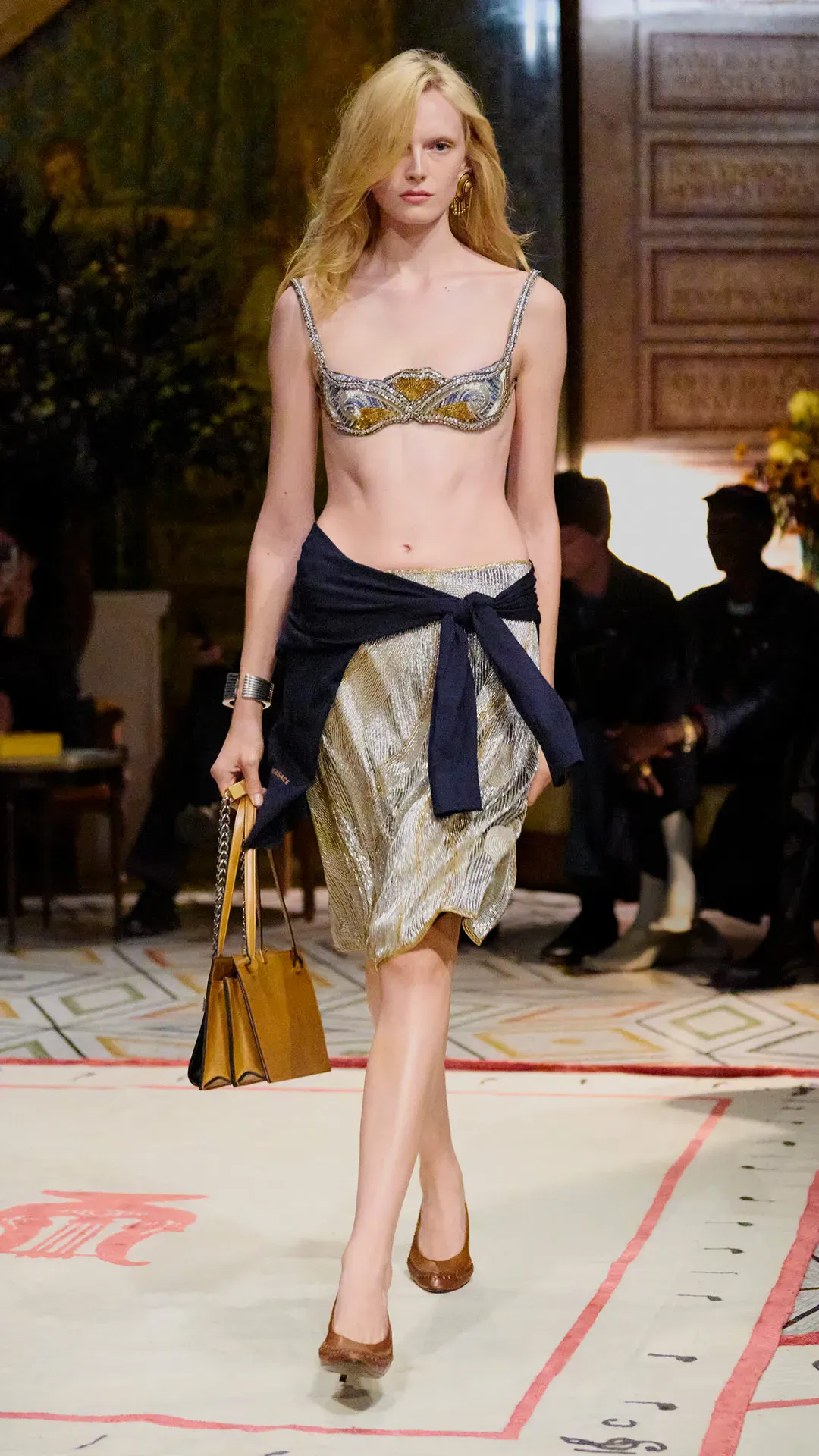
Ha deciso di esplorare molto, ma non tutto, il patrimonio simbolico di Gianni, strappandolo innanzitutto dal glamour dei red carpet, da uno stile di vita veramente molto distante dalla realtà e mettendolo addosso a facce quasi comuni, senza trucco, senza abbellimenti eccessivi. La portiera che diventa ala.
È rimasto invece il richiamo alle strade di Miami degli anni ’80, alla cultura queer underground, all’erotismo gay esplicito fatto di pacchi in evidenza e di pettorali scolpiti. Una condizione di libertà pericolosa che attraverserà gli anni dell’AIDS e incomberà sull’assassinio di Versace.
La medusa è diventata invisibile. Ha placato il suo sguardo feroce ed è diventata più mansueta, non rappresentando più l’unico segno di riconoscimento del marchio e lasciando spazio, come le vecchie poltrone, a molto altro.
Con lei ha cambiato forma l’espressione dell’erotismo femminile che, si sa, chez Prada rimane un argomento abbastanza angusto. Vitale in realtà lo ha affrontato con totale spensieratezza perché i suoi spacchi sembrano dimenticati lì per sbadataggine, non per volontà seduttiva.
Anche i jeans stampati, reference alle mitologiche collezioni Versace Jeans Couture e ai jeans ricamati con le facce di Liz Taylor, non sono più armi di seduzione di massa ma hanno volti usciti da un settimanale di cronaca degli anni ’60 di qualche sobborgo di Chicago.
Tutto è impastato in un’atmosfera alla Taxi Driver o alla Cruising, in cui gli outsider sono i protagonisti, i reietti sono al centro della scena.
Tutto questo e molto altro racconta quanto Dario Vitale sia un vero autore, con una visione del mondo personale e articolata che è esattamente quello di cui la moda ha bisogno in questo momento in cui le persone, stanche delle solite storie, hanno smesso di comprare.
Ma tutto questo racconta anche come tutte le altre ricette siano scelte di retroguardia, affannosamente incollate a un passato che non esiste più e di cui vorremmo continuare a respirare i vapori venefici della su autodisintegrazione.
La paura si combatte con il coraggio del rinnovamento che questa stagione non è arrivato ma che preme alle porte di un mondo che non ha più sufficienti lucchetti per tenerle chiuse.
The way out of the crisis
After the news that Fendi’s creative direction has, predictably, gone to Maria Grazia Chiuri, this season of supposed revolutions has come to an end—a season that was meant to shake fashion to its core but ended up changing nothing.
The big groups and their mega brands held conservative positions, showing little courage and even less imagination, except in a couple of cases that, as everyone now knows, belong to Dario Vitale at Versace and Jonathan Anderson at Dior. I’ve written extensively about both in previous newsletters.
All this caution, which resulted in a lack of renewal, stems from the persistence of negative economic results, but it’s also true that those negative results are caused by that very lack of renewal.
So while it’s likely that third-quarter data will show a slight slowdown in the downturn for everyone, it’s far from certain that in three months we’ll see the beginning of real growth. We’re facing a situation we haven’t seen since 2008, and the industry’s response to the crisis has been nothing but a game of musical chairs, the same faces sitting in different seats.
The most significant news is the extremely small number of new names who’ve risen to important creative positions: the usual Dario Vitale at Versace, Duran Lantink at Jean Paul Gaultier, Miguel Castro Freitas at Mugler, and Rachel Scott at Proenza Schouler.
The problem is that Vitale is the only one who’s actually said something new, while the others have made a mess of things.
But what exactly did he say that’s new, and why is it so important to deeply decode his work?
Vitale comes from a place called Prada, where the method of working differs from the rest of the fashion world in a way that very few have fully grasped.
There, the designer isn’t someone who simply creates—that is, who builds—but rather someone who must first be capable of disassembling, breaking things apart, preferably into very small pieces, and then putting them back together in a different order.
Imagine a child taking apart a toy car but, instead of leaving the pieces scattered across the floor, reassembling them according to his own strange idea, with no apparent logic. The wheels go back in place and still turn, but the hood becomes a sail, the doors turn into wings, and the inner mechanisms become wonderful decorations with no apparent purpose, yet beautiful all the same.
It’s still a toy car, but it’s also become something else—an object that’s escaped the banality of its existence and transformed into something different, using nothing but its own resources, the pieces it was made of.
This seemingly simple creative mechanism actually comes from an intellectual approach rooted in Japanese design, yet it’s been completely bent and reinterpreted by Mrs. Prada and her collaborators. Unlike Rei Kawakubo, Miuccia isn’t interested in making the original object disappear or rendering it unrecognizable. She wants us to recognize where her experiments come from, but she also wants us to acknowledge that their original meaning has been broken and lost in the reshuffling of that fantastic centrifuge that is her mind.
To make this operation possible, the line between design and styling is permanently erased—in fact, the precise bourgeois style becomes one of the primary targets of this devastating regeneration. If you move a chair that’s been in the same place for twenty years, you begin to see the space it occupied creatively again, and you even start to recognize the chair itself, which you had forgotten existed.
All this began in the magical 1990s, when the need to break free from bourgeois cages—methodologically as well—produced some of the most incredible projects in fashion history: Martin Margiela, Vivienne Westwood, Helmut Lang, and of course, Prada. It’s the mal de vivre embodied in what would later be simplistically called the “aesthetic of the ugly,” but which in reality is exactly the opposite: an attempt to rediscover beauty amid the sociopolitical ruins of the time.
Miguel Castro Freitas’s collection for Mugler is the apex of traditional design—perfectly drafted, obsessively flawless, extremely distant from reality yet reassuring and comforting for many.
The Versace show, on the other hand, is anything but comforting.
The set is the Pinacoteca Ambrosiana, one of those dusty places that hide treasures like Leonardo da Vinci’s Codex Atlanticus, but that also represent a stale idea of the museum: inaccessible, unsexy, the product of uninspired and superficial collecting.
An ideal setting for an encounter with the past—with Gianni Versace and his heavy yet magnificent heritage, which until now had never been reread or reinterpreted.
One of the problems with Made in Italy is that almost none of the historic brands have undergone serious analysis or reinterpretation, and over time Versace has become one of the most stubbornly identical to itself, to its founder, to his memory—a kind of sterile sanctuary. A bit like the Pinacoteca Ambrosiana itself.
This is why Vitale focused much more on method than on product, building his vision in such a disruptive way.
He decided to explore much—but not all—of Gianni’s symbolic heritage, tearing it away first of all from the glamour of red carpets and a lifestyle far removed from reality, and instead putting it on almost ordinary faces, without makeup, without excessive embellishment. The door that becomes a wing.
What remains, however, is the reference to the streets of 1980s Miami, to underground queer culture, to the explicit gay eroticism of bulging crotches and sculpted chests—a dangerous kind of freedom that would pass through the years of AIDS and culminate in Versace’s murder.
The Medusa has become invisible. Her fierce gaze has softened; she’s become gentler, no longer the brand’s sole identifying mark, leaving space, like those old chairs, for so much more.
Along with her, the expression of female eroticism has changed—a theme that, as we know, remains rather limited at Prada. Yet Vitale approached it with total lightness, because his slits seem to be there by accident, not by seductive intent.
Even the printed jeans, references to the legendary Versace Jeans Couture collections and those embroidered with Liz Taylor’s face, are no longer weapons of mass seduction but feature faces that look like they’ve come straight out of a 1960s tabloid from some Chicago suburb.
Everything is steeped in an atmosphere reminiscent of Taxi Driver or Cruising, where outsiders take center stage, and the outcasts are the protagonists.
All this and more shows how Dario Vitale is a true auteur, with a personal, complex worldview—which is exactly what fashion needs right now, at a time when people, tired of the same old stories, have stopped buying.
But it also shows how all the other approaches are backward-looking, desperately clinging to a past that no longer exists, still trying to breathe in the toxic fumes of its self-disintegration.
Fear can only be fought with the courage of renewal—a renewal that hasn’t arrived this season but is pressing at the doors of a world that no longer has enough locks to keep them shut.
Date
October 21, 2025
Topic
POST SETTIMANALI
0 comments
Would you like to be the first to write a comment?
Become a member of LA MODA È UNA COSA SERIA and start the conversation.