February 2026
Urban transformation requires more than just plans, concepts and technical expertise. It requires imagination, as well as the ability to set aside today's constraints long enough to consider how things could be different tomorrow. This can be particularly challenging for professional planners and public officials, whose daily work is shaped by regulations, budgets, political compromises and institutional routines. Asking them to 'think outside the box' is often ineffective precisely because the box defines their professional responsibilities.
One way to open up new perspectives is to change not only the topic of discussion, but also the role from which people speak. What happens when planners argue as teenagers, restaurant owners or primary school teachers? When decision-makers are asked to negotiate urban futures not from their institutional position, but from the standpoint of everyday life?
Over the years, Spatial Foresight has experimented with designing formats to overcome these mental barriers. A recurring insight is that people are more open when they are allowed to explore the future playfully, without immediate political risk. Structured role plays have proven particularly effective in this regard. By deliberately stepping into different roles, perspectives and value systems, participants are required to act differently and to engage seriously with viewpoints they might otherwise dismiss or overlook. See also our earlier blog post on territorial foresight (Opens in a new window).
Placed in imagined situations and forced to negotiate uncertainty or make decisions from unfamiliar positions, participants begin to grasp how individual choices reverberate through wider systems. An intervention in one part of the system rarely remains isolated; it triggers adaptations elsewhere as the system seeks a new balance. This combination of perspective-shifting and systemic awareness often creates a level of openness that is difficult to achieve in conventional workshops. Some of the most productive moments in territorial foresight emerge precisely in these playful settings, where the future is no longer perceived as a threat to existing plans, but as a space of possibilities requiring curiosity and creativity.
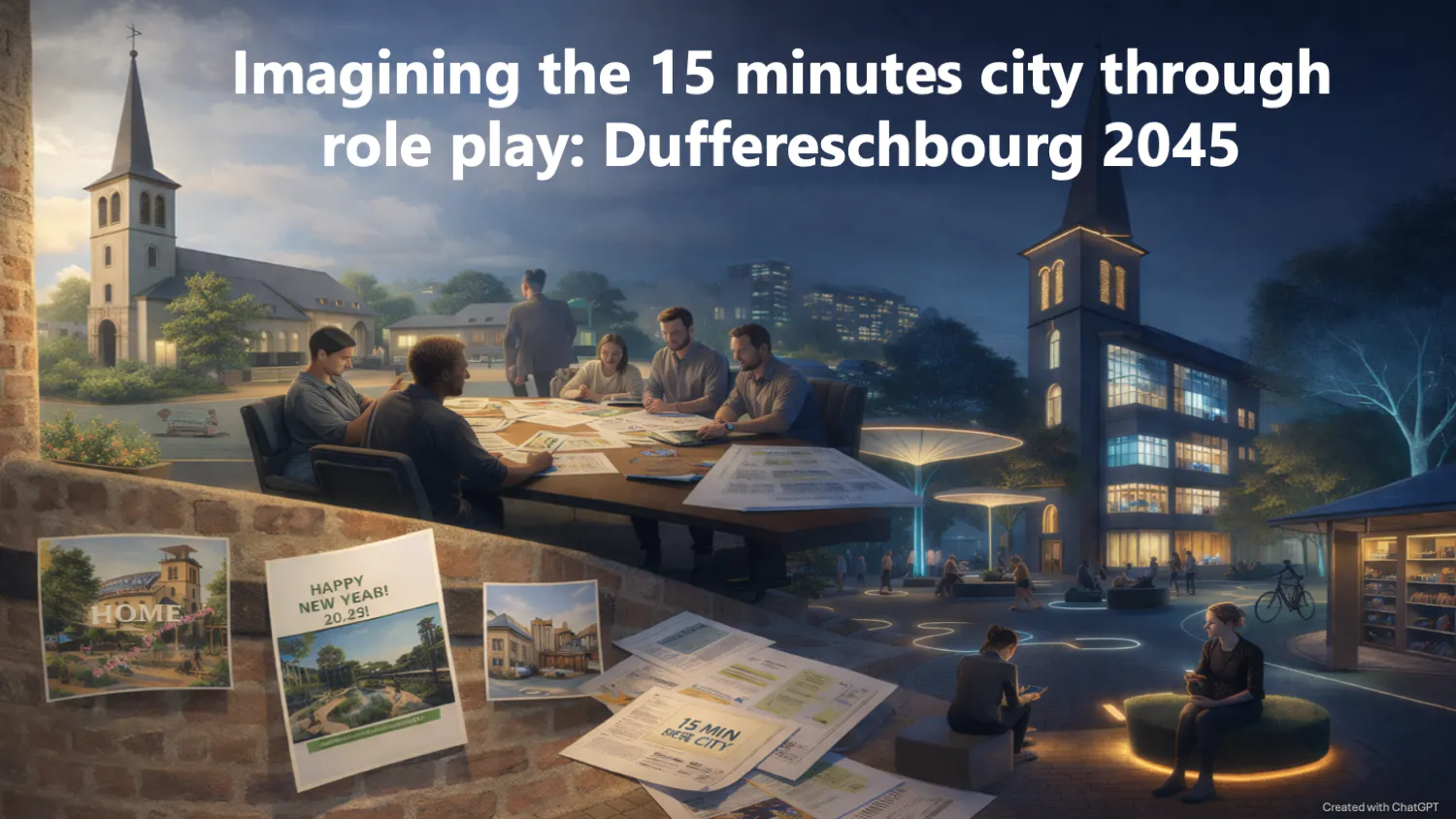
Building on previous experience of using role play in participatory foresight processes, CIPU (Luxembourg’s urban policy platform) (Opens in a new window) applied our approach in 2025 to explore what a 15-minute city could look like in a medium-sized Luxembourgish city by 2045.
Duffereschbourg as imaginary shared playground
To explore this question, the Spatial Foresight team invented the fictional city Duffereschbourg located along the Alzette river between Differdange, Dudelange, Esch-sur-Alzette and Luxembourg City. Once a steel city, Duffereschbourg has evolved into a diverse, green, tech-driven urban hub.
The choice of an imaginary city was a methodological decision. By removing the exercise from real-world political sensitivities, institutional histories, and personal considerations, participants were able to consider options that would be challenging to articulate in a specific local context. At the same time, Duffereschbourg was designed to be both plausible and recognisable. Its geography, economic trajectory and social structure echo familiar patterns in southern Luxembourg, enabling participants to easily project their professional knowledge and lived experience onto the fictional setting.
Duffereschbourg thus became a shared playground – a safe space in which to test ideas, articulate values and confront trade-offs. Rather than providing a blueprint, it served as a compass, allowing participants to explore the urban qualities, experiences and forms of proximity that might matter in twenty years' time. What does 'urban proximity' actually feel like in everyday life? How do mobility, public space, the local economy and social participation interact on a neighbourhood scale? And how might these interactions change as demographic structures, lifestyles and expectations evolve?
Preparing the ground: understanding the 15-minute city
The role play workshop did not emerge in isolation. It was the culmination of a broader sequence of participatory activities organised in 2025 with planners and interested stakeholders in Luxembourg, focusing on the concept of the 15-minute city. A series of online colloquia helped to establish a shared understanding of the concept of the 15-minute city. Building on this, two workshops explored what this concept means in a Luxembourgish context.
The first workshop addressed the question, what the idea of a 15-minute city means in the Luxembourgish context. Participants worked in creative groups to develop a shared vision for Duffereschbourg 2045. Using maps and visual tools, they explored how short distances, mixed uses and diverse functions could be combined to support everyday life without or extremely reduced car dependency.
Several guiding principles emerged. Daily needs, such as schools, shops, healthcare, leisure, should be accessible on foot, by bicycle or by public transport. Public spaces should be multifunctional and flexible, accommodating social encounters, mobility and ecological functions at the same time. Strong local identities and social cohesion were seen as essential, supported by both physical meeting places and digital connectivity. Participants emphasised the importance of developing existing neighbourhoods, e.g. by reusing industrial sites and underused spaces, rather than relying on new construction. Green and open spaces were conceived as a connected network, linking quarters and strengthening ecological resilience. Finally, a decentralised urban structure with thematic city districts was favoured, avoiding monofunctional zoning while ensuring good connectivity to higher-order facilities.
These ambitions also revealed tensions. Compactness competes with green space. Innovation must be balanced with heritage and social acceptance. Costs and political feasibility remain persistent constraints. The relationship between centrality and decentralisation requires careful calibration. A key takeaway was the need for early and meaningful citizen participation as an integral part of shaping urban proximity.
The second workshop shifted focus from vision to implementation. Participants explored how the principles developed earlier could be translated into concrete neighbourhood-level strategies in different thematic city districts. Discussions centred on mixed-use development, shared spaces, adaptive reuse and flexible infrastructure. Questions of governance, actors, costs and acceptance were brought explicitly into the debate. Temporary and pilot projects emerged as a promising way to test ideas, build trust among inhabitants and political stakeholders as well as to generate learning. Across discussions, adaptive planning, use of existing resources and new forms of cooperation between public authorities, civil society and private actors were identified as critical success factors.
Together, these preparatory workshops laid the conceptual and cognitive groundwork for the role play. They ensured a shared language and understanding of the 15-minute city, while deliberately leaving open how these ideas might play out in practice.
The role play: experiencing urban proximity in Duffereschbourg 2045
In October 2025, the real-life district Dommeldange in Luxembourg City became Duffereschbourg, the setting for an all-day role-playing planning simulation. The role play was designed as a fictional public participation process and invited participants to step into the year 2045 and actively shape the culture and leisure district.
Those involved in planning, politics and civil society were given detailed role profiles, including information on their professions, socio-economic backgrounds and value orientations. Crucially, these roles were not aligned with their real-life positions. For example, planners might have found themselves playing the roles of local business owners, teachers or teenagers, while decision-makers might have played the roles of residents or street workers. This deliberate mismatch forced a conscious shift in perspective.
The process unfolded in two phases. In the morning, participants worked in task-based groups on four concrete assignments: redesigning a building complex, transforming a public square, developing a neighbourhood hub and designing a tiers-lieu – an open, non-commercial space for everyday life. Groups physically walked through five locations in the district, observing, debating and questioning. Is a place too loud? Too hidden? Is it vibrant at noon but empty at night? How do people access it? What might residents need here in twenty years' time?
At one point, the future quite literally interrupted the present. Fictional time travellers from Duffereschbourg beyond 2045 challenged participants to think of public spaces as 'resonance rooms', shaped by behaviour, rhythm and proximity rather than control and centres as social engines fuelled by energy, exchange and time. This provocation challenged some preconceptions and prompted groups to reconsider their ideas.
In the afternoon, the groups were reshuffled into sector-based constellations. Ideas that had previously been developed in isolation now had to be compared, negotiated and synthesised for a common plan of the neighbourhood. Conflicts surfaced, such as competing claims for the same space, tensions between noise and tranquillity, and questions of access, care and control. Gradually, four distinct yet plausible maps emerged, each reflecting a different interpretation of urban proximity – ranging from a reimagined central hub around the station to a largely car-free, decentralised neighbourhood structure.
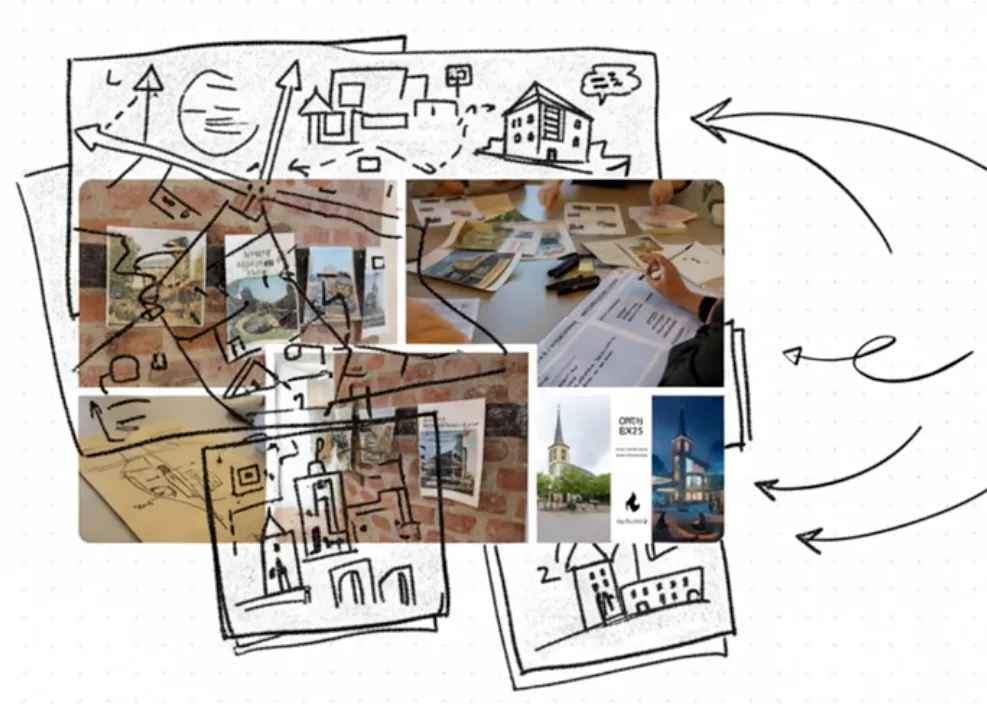
Throughout the day, vivid exchanges illustrated the format's effectiveness. A restaurant owner argued for lively streets and visible terraces, a primary school teacher prioritised routines and protected spaces for families, and a teenager simply wanted a place to hang out without getting in the way. These fictional voices brought abstract principles to life and anchored debates in everyday experience.
Outcomes beyond a single map
The immediate outcome of the role play was not a single 'best' solution, but rather a shared understanding of what is important and what remains contested when implementing the 15-minute city at neighbourhood level. Participants experienced first-hand how urban proximity is continuously negotiated and shaped by competing needs and evolving practices, rather than fixed models.
Several cross-cutting insights emerged. Mobility was identified as both an enabler and a constraint, and temporary and pop-up solutions were considered realistic starting points. Multifunctional spaces were recognised as essential for accommodating a variety of uses over time. Social infrastructure and non-commercial spaces were recognised as being critical to inclusion and to everyday urban life. The change in perspective allowed participants to re-evaluate familiar citizens’ viewpoints, concerns and arguments. At the same time, they acknowledged the difficulty of thinking radically about future needs while remaining anchored in present-day realities.
Based on the role play and broader activities conducted by CIPU in 2025, a practical toolbox on the 15-minute city was developed. For more information see also the CIPU blog posts ‘Envisioning the 15-Minute-City: Co-Creating Urban Futures in Luxembourg (Opens in a new window)’ and ‘Duffereschbourg 2045: A role play planning simulation (Opens in a new window)’.
Role play as a window into possible futures
The Duffereschbourg 2045 experience demonstrates the effectiveness of role play in exploring potential urban futures. By temporarily suspending roles, rules and expectations, it creates a space in which participants can engage with complexity without immediately retreating to institutional positions.
From a territorial perspective, this is particularly important. Although concepts such as the 15-minute city are often discussed as universal models, their implications are deeply context-specific. Role play reveals these territorial dimensions by embedding abstract ideas in specific locations, individuals and conflicts. It reveals not only what could work, but also where tensions are likely to arise and which values are at stake.
However, role play is not a substitute for decision-making or implementation. Its strength lies in exploration, learning, opening minds, and making sense of things. When used thoughtfully, it can complement more formal planning instruments by broadening the scope of what is considered possible and legitimate.
Ultimately, the Duffereschbourg exercise suggests that engaging with the future is fun but also requires more than just forecasting and strategy. It requires spaces where professionals and citizens alike can experiment, disagree and imagine together. In an era of accelerating urban change, such spaces may be among the most valuable planning resources available to us.
by Kai Böhme, Jean Claude Zeimet & Kirsti Hagemann
Watch an experimental video summarising this blog post ▶️ (Opens in a new window)
 (Opens in a new window)
Date
February 4, 2026
Topic
Scenarios & visions
0 comments
Would you like to be the first to write a comment?
Become a member of spatialforesight and start the conversation.