November 2025
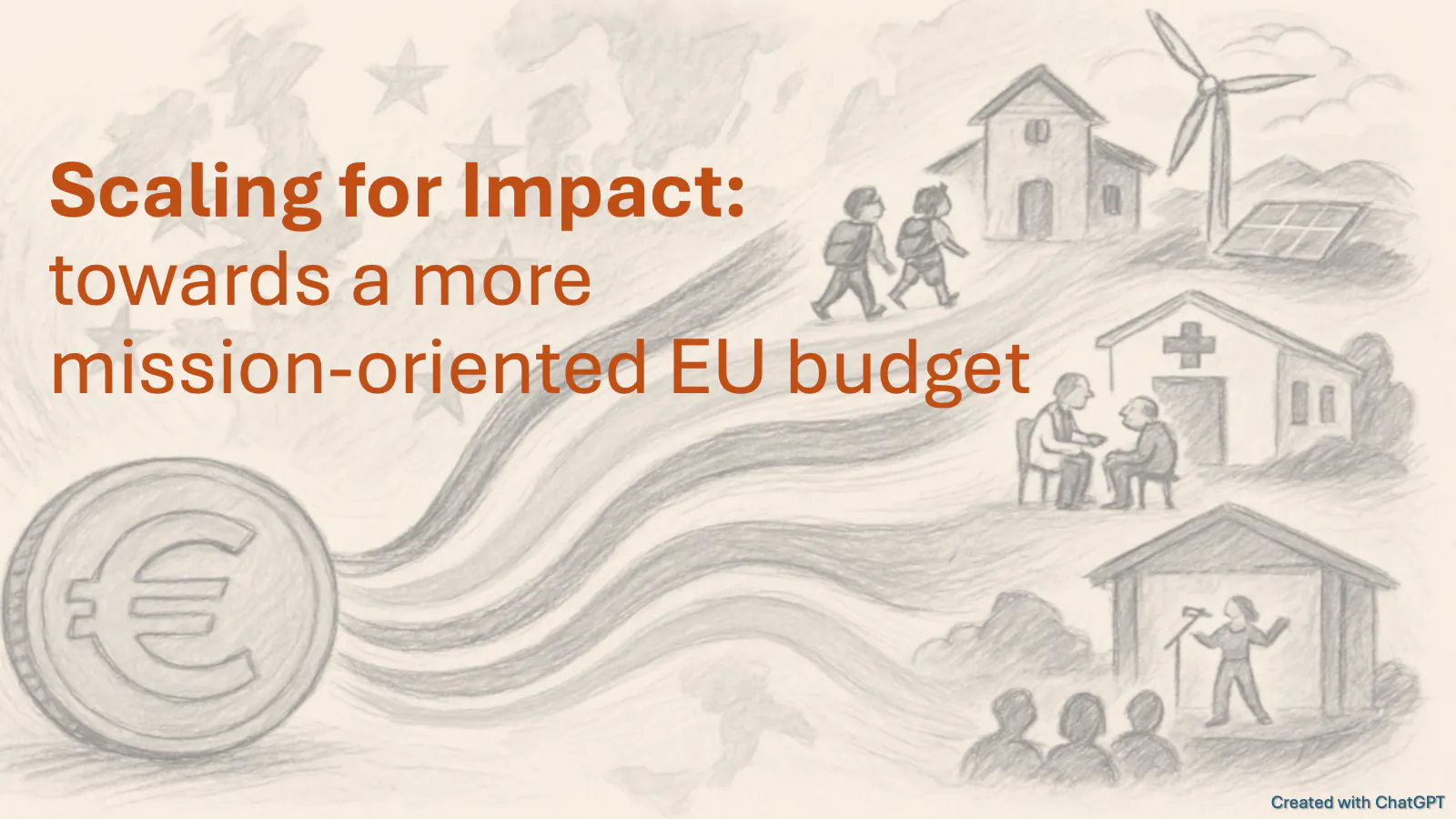
As Europe looks toward the next programming period, the real question isn’t whether cohesion policy still matters – it’s how it can evolve to deliver more strategic impact in a world that feels increasingly unstable. With geopolitical tensions rising, resources stretched, and trust in public institutions under pressure, the EU cannot afford to rely on old ways of working and tried and tested, even if not the most effective and impactful policy styles. We argue that what is needed now is a shift toward a more agile, experimental, and mission-driven approach to territorial policy – one that learns by doing, connects the dots across sectors, and translates investments into real outcomes for people and places.
At present, the EU’s policy machinery remains fragmented – structured around hundreds of funds, programmes, and calls, each with its own rules, cycles, and reporting frameworks.
This fragmentation often results in inefficiency and incoherence. Similar or overlapping objectives are pursued through parallel instruments, while synergies across domains – such as between research, regional development, social innovation, and infrastructure – remain underexploited. The result is a patchwork of well-intentioned but disconnected initiatives.
The next Multiannual Financial Framework (MFF) could be an opportunity to change this logic. Instead of spreading limited resources thinly across numerous silos, Europe could concentrate effort around societal missions – broad, cross-sectoral objectives that mobilise multiple actors and instruments towards a shared goal.
As Europe prepares for the next Multiannual Financial Framework (MFF), the key question is not whether cohesion policy still matters, but how it can evolve to deliver greater strategic impact in an increasingly uncertain world. With geopolitical pressures, fiscal constraints, and declining public trust, the EU can no longer rely on fragmented, siloed, and incremental approaches. It needs a bolder, mission-oriented model – one that aligns diverse instruments, actors, and funding streams around shared societal goals.
From fragmentation to focus
Europe’s policy ecosystem remains highly compartmentalised, divided across hundreds of programmes and funds with separate cycles and rules. This fragmentation dilutes impact and prevents coherent action across domains such as innovation, regional development, and social inclusion. The next MFF could change this logic by consolidating resources around a limited set of cross-sectoral missions – such as climate resilience, digital transformation, or wellbeing – each mobilising multiple policies and partnerships toward common outcomes.
Each mission would function as a policy ecosystem rather than a financial silo. It would integrate funding from research, cohesion, agriculture, and social programmes; involve national, regional, and local authorities; and engage private and civic partners in co-designing solutions.
For example, a Mission for Climate-Neutral Living might align Horizon Europe research funding, ERDF infrastructure investment, ESF+ social transition support, and CAP rural development funds to accelerate climate adaptation at local level. Similarly, a Mission for Just Digitalisation could blend technological innovation, skills training, and social inclusion measures under a single strategic umbrella.
A mission-oriented MFF would not simply mean fewer programmes, but a more strategic way of working: integrating funding, aligning objectives, and focusing on measurable results that improve people’s lives. It would move beyond coordination “after the fact” to integration “by design”.
Why scale matters
Scale is critical – not only for efficiency but for credibility. The EU’s sizeable R&I and cohesion budgets have generated countless innovations, yet too few have achieved systemic reach. Larger, mission-based funds could bridge this gap, allowing successful initiatives to grow from local successes into Europe-wide transformations. By concentrating effort and investment, the EU can turn ambition into tangible results that reinforce citizens’ confidence in European action.
Designing a mission-oriented framework
A restructured MFF centred on missions could deliver multiple benefits:
Strategic Coherence and Focus. Bundling resources around common outcomes would align policies and reduce duplication, ensuring that infrastructure, innovation, and social measures reinforce each other.
Simplified Governance. Fewer, larger programmes would clarify accountability, freeing managing authorities to focus on outcomes rather than compliance.
Ambitious experimentation. Larger programmes with cross-sectoral reach could support bold experimentation—testing innovative solutions that require combined funding for research, infrastructure, and social dimensions.
Cross-Sector Mobilisation. Missions would foster collaboration among ministries, regions, and private partners, encouraging shared responsibility for results.
Stronger European Narrative. Visible, mission-led investments in climate action, wellbeing, or digital inclusion could demonstrate how EU spending improves daily life and advances shared values.
Balancing ambition and diversity
However, mission orientation is not without risks. Simplification can drift into centralisation, and consolidation can unintentionally weaken local ownership or stifle innovation at the margins. To prevent this, missions must embed territorial differentiation as a core principle, recognising Europe’s regional diversity as an asset. Regional and local authorities should help shape mission pathways suited to their unique contexts, ensuring that impact grows from the ground up rather than being imposed from above.
Making missions work
For mission orientation to succeed, Europe will need to rethink how it designs and governs its funding architecture:
Define missions around clear, outcome-based goals that resonate with citizens and link directly to long-term societal needs.
Integrate instruments across policy domains—research, regional development, social inclusion, and infrastructure—within coherent portfolios.
Simplify financial and administrative frameworks to enable blending of funds and joint implementation.
Strengthen partnership and co-design with regions, cities, and communities to ensure that missions remain inclusive and place-sensitive.
The bottom line
A more concentrated, mission-oriented MFF could mark a genuine shift from fragmented spending to purposeful investment. It would align Europe’s resources with its biggest challenges, providing a common framework for action and accountability.
If missions are treated not as branding exercises but as genuine vehicles for impact, Europe could harness its diversity to achieve shared progress—turning cohesion policy from a mechanism of redistribution into a driver of transformation.
The challenge now is one of political courage: to simplify not just the structure of EU funding, but its mindset—towards a truly mission-oriented Union capable of delivering visible, lasting results for its citizens.
by Kaisa Lähteenmäki-Smith & Kai Böhme
 (Abre numa nova janela)
Data
05/11/2025
Tópico
Cohesion (policy)
0 comentários
Gostaria de ser o primeiro a escrever um comentário?
Torne-se membro de spatialforesight e comece a conversa.