November 2025
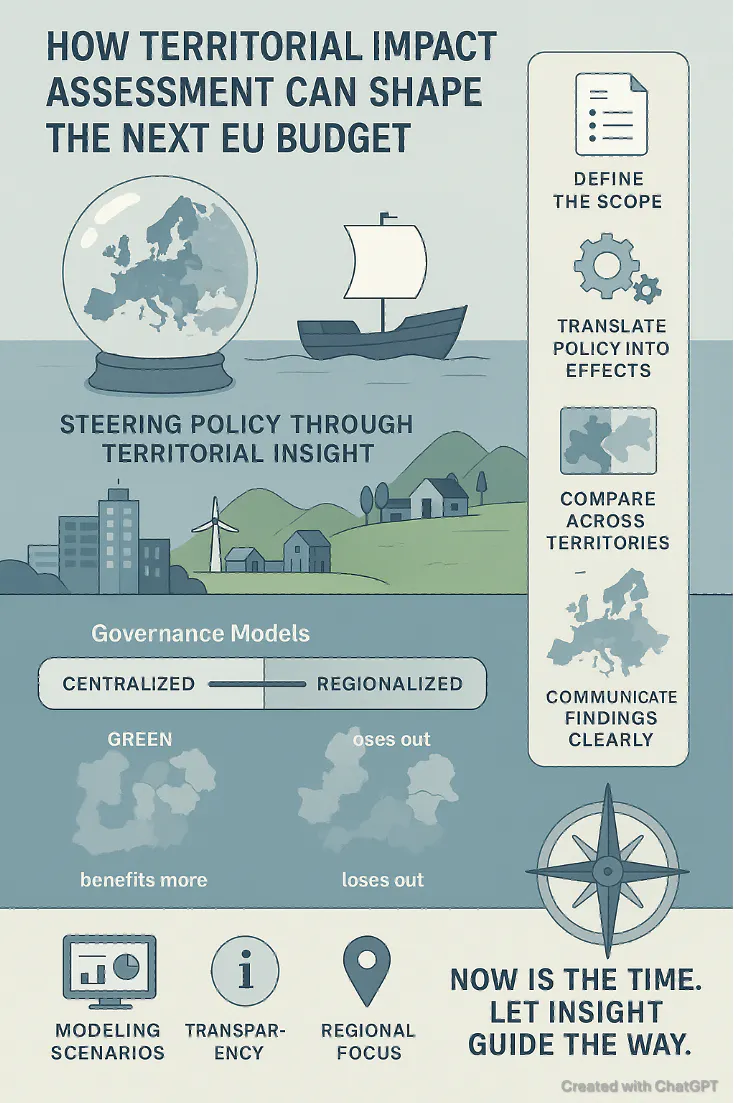
In July 2025, the European Commission unveiled its proposal for the next Multiannual Financial Framework (MFF 2028-2034). This proposal is not just a routine update to the EU’s seven-year budget – it’s a fundamental shift in how funding is structured, governed, and targeted. With fewer programmes, broader goals, and more centralized national control, the new MFF promises efficiency – but raises critical concerns about cohesion, fairness, and territorial balance. (see also our earlier blog posts on the MFF proposal (Abre numa nova janela).)
This is where Territorial Impact Assessment (TIA) comes in. As political negotiations unfold and stakeholders vie for influence, the need to anticipate territorial consequences of the MFF becomes urgent. We need to know now – not years from now – how different regions will be affected. That is what TIA offers: a structured way to look into the crystal ball of policymaking.
What is changing in the MFF?
The proposed MFF consolidates funding sources and programmes. These funds will be to 44% distributed through National and Regional Partnership (NRP) Plans. The rest of the MFF funds will be the European Competitveness Fund (under direct management of the Commission) with 21%, Global Europe (under direct management of the Commission) with 10%, Next Generation EU repayments 8% and a bundle of programmes/ policy funding such as Erasmus+/ AgoraEU, CEF, Civil protection and health, Single Market and Customs Programme, Euratom Research and Training, CFSP, Justice, Nuclear Savety Cooperation and Decommissioning, Association of Overeas Countries and Territories and Pricles accounting for the rest of 17% of the MFF. On the surface, this sounds efficient and focussed on fewer activities and goals. In practice, it signals a nationalisation of decision-making power – moving it from th European Commission and regional authorities into the hands of national governments.
This structural shift also comes with the fear of too much subsidiarity on the national levels: an example may be the controversial plan to merge agricultural subsidies and cohesion funds into unified funding pots on the national levels. Critics warn this could allow national governments to repurpose funds meant for struggling rural regions, channelling them instead toward politically strategic or urban areas.
In response to concerns, the Commission has earmarked EUR 218 billion over seven years for Europe’s less developed regions. Yet there is a conspicuous silence when it comes to support for transition and more developed regions, many of which face their own unique challenges like aging populations, deindustrialization, and geographic isolation.
Why this matters for territorial cohesion
This debate is not just about budgets – it is about Europe’s territorial integrity and the risks of increasing fragmentation and growing number of places of discontent. The fear is that funds will gravitate toward ‘growth poles’ – mainly major urban centres – leaving behind smaller urban areas, inner peripheries, rural areas, remote and sparsely populated areas and border regions. Many of these areas hold important potential not at least related to the necessary green transition and increasing focus on resilience and defence. More importantly, they are critical to Europe’s social fabric and political stability.
There is also mistrust around governance. If more power shifts to national capitals, will regional voices be heard? Will national interests override place-based needs? Will cohesion policy, a cornerstone of EU integration, be sidelined?
These concerns are not just abstract – they are politically explosive. The ‘geography of discontent’ has already fuelled populist movements and eroded trust in EU institutions. The upcoming MFF risks deepening these divides – unless we get serious about understanding its territorial impacts before it is too late.
The Role of Territorial Impact Assessment
This is the moment for TIA to shine. TIA is widely recognised as a tool to evaluate how policies affect specific territories. It doesn’t just estimate whether a policy is effective – it reveals “where” that impact is expected to be felt, how intense it might be, and whether it aligns with broader cohesion goals.
Importantly, TIA is not a political wish machine. It is not designed to validate preconceived opinions or provide politically convenient results. It is a decision support tool. It helps policymakers visualise trade-offs, question assumptions, and design smarter interventions that account for territorial diversity.
As Bernard Roy – the “godfather” of multicriteria decision support put it – originally speaking about decision analysis – TIA’s purpose is not to ”decide”, but to “support” decision-making: to help actors clarify preferences, understand consequences, and make informed choices aligned with their goals.
This means that the tool itself is a neutral agent and thus the use shall be offering the chance to go to extremes by the decision makers (e.g. by using scenarios), so to depict any potential outcomes of decision situations like policy plans such as the MFF.
What a TIA can do for the upcoming MFF
To be useful in the MFF context, a TIA can help answering following key questions:
Will different types of regions (e.g. urban, rural, outermost, border, island) experience the MFF’s impacts differently?
Are the policy’s intended target regions (like less-developed regions) actually benefiting – or are unintended effects showing up elsewhere?
Cankey policy goals (e.g. competitiveness, social inclusion, green transition) being achieved in the “right” places?
How will the effects – economic, social, environmental – distributed across the EU territory?
Answering these requires more than a quick analysis. It demands a structured, scenario-based approach that breaks down the complexity of the MFF and rebuilds it into a usable model.
The four steps of a proper TIA

Define the scope. What part of the MFF are we assessing? Are we looking at specific funding allocations, governance models, or policy goals? Clarity here ensures the rest of the process has focus.
Translate policy effects into computable Information. This is the core technical challenge. We must identify cause-effect chains: How do different MFF investments translate into changes on the ground? What assumptions are we making about economic multipliers, regional capacities, or policy synergies?
Aggregate and compare. Once we have simulated impacts, we need to analyse how they differ across territories. Do some regions emerge as winners while others lose out? Are there trade-offs between policy goals?
Produce outputs. The results must be communicated clearly – through visuals, narratives, and decision trees – so that policymakers, stakeholders, and the public can understand what is at stake.
Two focal points for the TIA
To deliver maximum insight, the TIA for the upcoming MFF should concentrate on two core dimensions (to be understood as two layers of territorial effects triggered by the MFF):
Territorial effects of policy content. This looks at “what” the MFF is trying to achieve: competitiveness, green transition, defence readiness, affordable housing, water resilience. How do different combinations of spending (e.g. heavy investment in energy vs. social cohesion) affect different territories? The analysis should be done through ”extreme scenarios” – e.g. what happens if all funds go to green goals vs. competitiveness, or a balanced approach? These simulations help expose territorial winners and losers.
Territorial effects of governance models. This looks at “how” the MFF will be implemented. Who controls the funds – European Commission, national governments, or regional authorities? How do different governance structures shape the territorial distribution of effects? Again, this is best assessed through contrasting scenarios: centralised vs. decentralised models, strong vs. weak regional involvement, direct management vs. shared management. Each model has its own territorial footprint.
Data, methods, and outputs
A robust TIA must combine quantitative and qualitative information. It should rely on systemic cause-effect models that capture the interaction of funding, governance, and territorial characteristics.
Rather than produce classic EU maps with statistical granularity, the TIA should offer “schematic maps” by type of region and governance scenario. These can then be aggregated by region type (e.g. less-developed, rural, outermost) or compared across policy goals using multi-criteria analysis.
The goal is not pixel-perfect precision, it is actionable insight.
What can we learn?
Two big takeaways emerge from this approach:
TIA is only as good as its application. While TIA is often hailed as a silver bullet, it is not magic. To generate meaningful results, it must be applied rigorously – with clear scoping, grounded data, and transparent assumptions.
Complex frameworks need scenario-based decomposition. The MFF is not a single policy – it is a multi-dimensional framework with overlapping goals and governance layers. Breaking it down into scenarios, then reassembling the results, is the only way to provide reliable ex-ante evidence for policymakers.
Final thought: now is the time
We are at a critical moment. The MFF proposal is on the table, but nothing is set in stone. Political negotiations are ongoing. Stakeholder positions are fluid. The Commission has made bold proposals, but member states, regions, and citizens have yet to fully weigh in.
That makes this the ideal time for a TIA. Not as an afterthought or box-checking exercise – but as a serious input into policy design. By mapping out the potential territorial impacts of both policy content and governance models, TIA can illuminate blind spots, avoid policy failures, and strengthen the legitimacy of the MFF.
In short, it can turn a gamble into a guided decision.
by Bernd Schuh
 (Abre numa nova janela)
Data
12/11/2025
Tópico
Cohesion (policy)
0 comentários
Gostaria de ser o primeiro a escrever um comentário?
Torne-se membro de spatialforesight e comece a conversa.